Far-Right German Party Ahead of Rivals in State Election, But Misses Majority

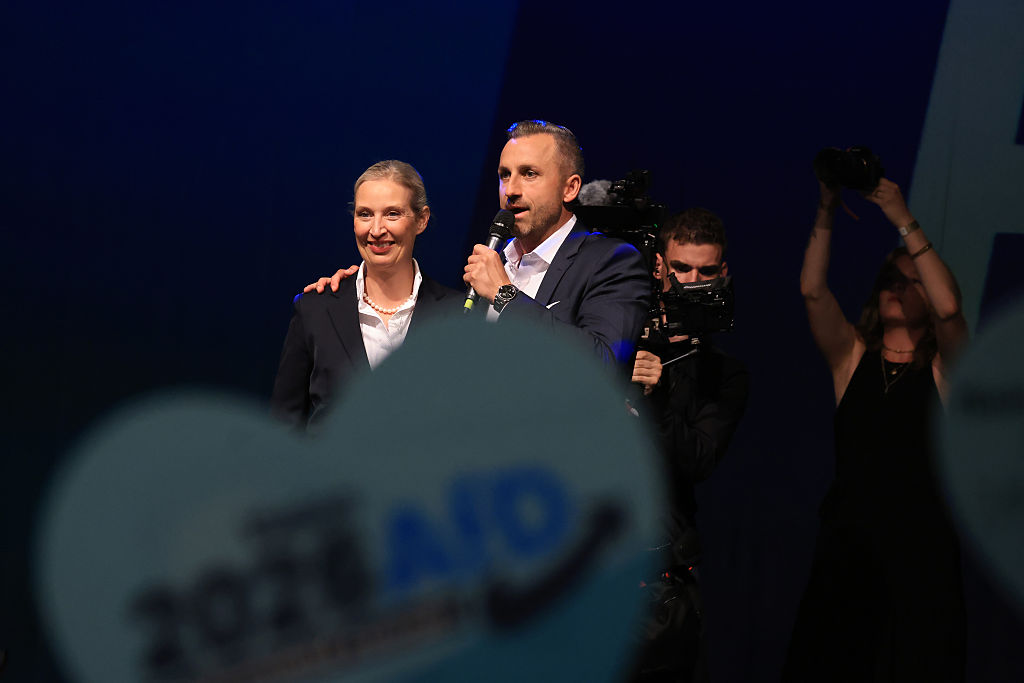
Germany’s Alternative for Germany (AfD) is poised to finish ahead of rivals in a state election, coming closer than any other far-right party in the country to governing at a regional level since World War II.
The party won 44% of the vote in Saxony-Anhalt’s state election on Sunday, according to provisional results. By comparison, center-right CDU, the party of Chancellor Friedrich Merz, won less than 20%. The state of 2.1 million people saw a record voter turnout of 77%.
But the party faces an uncertain path towards power. Without an absolute majority, it would need a coalition partner or support from lawmakers outside the party to form a government—something that German mainstream parties have thus far refused to provide.
Nevertheless, the surge in support for the AfD, which ran on a platform of restricting immigration, ending aid to Ukraine, and taking Germany out of the euro, is remarkable in a country where the legacy of Nazism has long kept the far right at the political margins. The party’s Saxony-Anhalt branch is classified by the state’s domestic intelligence as “right-wing extremist,” a designation that its leaders reject.
“We have made history in this country,” Ulrich Siegmund, AfD’s lead candidate in Saxony-Anhalt, said after polls closed.
“We’re taking our country back, it starts in Saxony-Anhalt,” he added. “A jolt is going through all of Germany.”
The result has already drawn global reactions.
U.S. President Donald Trump posted a screenshot of the projected results without comment on Truth Social. Members of Trump’s Administration, including Vice President J.D. Vance, previously expressed public support for the party.
Tech billionaire Elon Musk, who spoke at AfD’s campaign launch last year, congratulated AfD co-leader Alice Weidel on the projected win. In response, Siegmund thanked him “for your support” and said he would “welcome the opportunity for strong and constructive cooperation.”
Russian presidential envoy Kirill Dmitriev posted a screenshot of Trump’s post. He said in the caption,“Historic win for the pragmatic AfD that will put migration under control. The ruling Bidenthink coalition eviscerated,” referring to former U.S. President Joe Biden, a Democrat. The AfD is friendly to the Kremlin and has advocated for Germany to end support for Ukraine.
Invoking the collapse of the communist regime in East Germany and the fall of the Berlin Wall, Herbert Kickl, leader of the right-wing Freedom Party of Austria (FPO) said, “As of today, the strong wind of freedom from 1989 is blowing through Germany once again.”
Other European leaders expressed alarm over the result.
France’s Europe minister, Benjamin Haddad, said the win was a “grave moment in Europe.”
Polish Prime Minister Donald Tusk said more bluntly, “In Poland, only idiots or traitors can rejoice at the triumph of the AfD in Germany.”
What to know about Siegmund and the AfD
The AfD’s platform in Saxony-Anhalt ranges from tighter immigration controls to a sweeping overhaul of the state’s education system. Among its more controversial proposals is a policy of “remigration,” which is widely interpreted as mass deportation, although the party says it will prioritize deporting people with a criminal record. It has also called for segregating children of refugees and asylum-seekers in schools, and ending war refugee status for Ukrainians fleeing the war with Russia.
The party would largely be unable to enact many of its immigration policies in any individual state even if it can form a government, since many of its proposals would require federal action. But it could tighten policing and pursue changes to schools and cultural policy at the state level.
The party wants to steer schools and cultural institutions towards more traditional and nationalist values. It has also advocated revising history curricula to shift emphasis away from the Third Reich and for schools to ban rainbow flags. Instead, it wants schools to fly the German national flag daily, sing the national anthem at school celebrations, and teach more Russian language.
The AfD has also attacked Bauhaus, calling the influential school and design movement an “aberration of modernism.” Critics, including Germany’s culture minister, have said the AfD’s rhetoric echoes that of the Nazis, who forced the Bauhaus school to close in 1933.
Other proposals include establishing citizen patrols and imposing a moratorium on new wind farms.
The AfD capitalized on disillusionment with the political establishment and drew on regional and national pride, including “Ostalgie” or nostalgia for aspects of life in the former communist East Germany. That message found fertile ground in eastern strongholds, like Saxony-Anhalt, where economic disparities with western Germany persist decades after reunification. During the campaign, Siegmund frequently rode a blue Simson, a moped manufactured in the former East Germany, a move that drew criticism from the descendants of the Jewish family that founded Simson.
The Halle Institute for Economic Research in Germany has warned that the AfD’s anti-immigration policies could deepen Saxony-Anhalt’s labor shortage and cost the state billions in economic output. Merz has also argued that an AfD victory could turn away foreign investment from the state.
Founded in 2013, support for the AfD has grown significantly in recent years.
The AfD doubled its national vote share in 2025, and is the country’s most popular party nationally, polling at 28%, according to a recent INSA poll. At the same time, support for the federal government led by Merz, which is struggling to revive a sluggish economy, has fallen to historic lows. In the same INSA poll, Merz’s conservative party had 20% support. In Saxony-Anhalt, 87% of voters were dissatisfied with the federal government, according to an ARD poll.
Siegmund has said he wants to become state premier and eventually bring the AfD to victory in the 2029 national elections.
What the results mean for the AfD
While the election delivered the AfD a commanding victory, the party still lacks enough votes to govern alone. With 39 seats in the 83-member legislature, the party remains three short of an outright majority, and faces no obvious path to obtaining it.
Germany’s established parties have refused to work with the AfD, continuing their “firewall” against cooperating with the far-right. State premier Sven Schulze acknowledged defeat but his party, the CDU, said it would explore talks with other parties about forming a multiparty coalition.
The AfD could find unlikely support in the populist Sahra Wagenknecht Alliance, or BSW, which scraped into parliament with 5.3% of the vote. BSW has rejected the firewall and expressed a willingness to speak with the AfD, although it said it would not elect either Siegmund or Schulze as premier.
Siegmund has thus far ruled out leading a minority government or adopting an informal arrangement that would leave his government depending on unsteady support. “If necessary there’ll just be new elections, then we’d just get 50 or 55%,” he told ZDF on election night. He said, however, that he would be willing to work with individual lawmakers or parliamentary groups.
Thousands joined an anti-AfD demonstration on Saturday in the regional capital of Magdeburg. Some carried banners that read, “life is better without Nazis.” One protester, Laura Saalfeld, told AFP, “Whatever the results, the atmosphere will change. Far-right sympathisers will show themselves more openly on the streets.”

 点赞
点赞 收藏
收藏 点踩
点踩 分享
分享