You&Me Star: Designing Connection Before Sleep

Bedtime routines for parents and toddlers take many forms, typically focused on creating soothing and familiar sounds and experiences. This is the environment that You&Me Star helps to create through a combination of sound, light and touch.
Developed by Chicco, Artsana Group, in collaboration with students from La Sapienza University of Rome, You&Me Star is a night light built to do something more than simply light a room. It turns bedtime into a ritual of relaxation, play, and emotional connection.
The idea started during the Final Synthesis Course in Product Design at La Sapienza, taught by Professor Sabrina Lucibello and myself, a course built specifically to push academic thinking into manufacturing reality. The project represents a synergy between the academic and manufacturing worlds, an experience I am particularly proud of because it ultimately led to a tangible, finished product.
Students Luca Montanaro, Fabio Mattei, Leonardo Marongiu, and Paolo Maurizi took the question and split it in two: what sounds does a baby remember from before birth, and what does a baby need to feel safe enough to stop fighting sleep? Their research followed auditory memory down one path and light down the other.
The first question was fascinating; could sounds experienced before birth become part of a baby's auditory memory? Research into prenatal auditory perception suggests that fetuses can respond to sounds and melodies during pregnancy, and that familiar sounds may elicit recognizable responses after birth. The students saw an opening- sound as a bridge between the world before birth and the one after it.
The second thread concerned the role of light in the transition to sleep. Studies of circadian rhythms have shown that light wavelengths matter enormously to melatonin production, the hormone that governs when we sleep and when we wake. The longer wavelength of red light has drawn attention as a gentler alternative to the blue-heavy glow of most evening lighting, one less likely to jolt a drowsy brain back awake.
Sound and light, memory and biology. Together they became the blueprint for a night-time play lamp built to meet a child on both fronts at once, engaging them just enough to settle them, and building something reassuring and familiar out of the process.
Concept development sketches
From auditory memory to play
Given how many sounds a baby absorbs in the womb, the students narrowed their focus to relaxing melodies, ones calm and consistent enough to travel with a child from pregnancy into their first months outside it. The intention was to create a familiar auditory experience that could accompany the child from pregnancy into the first months of life, associating the melody with a feeling of safety and comfort.
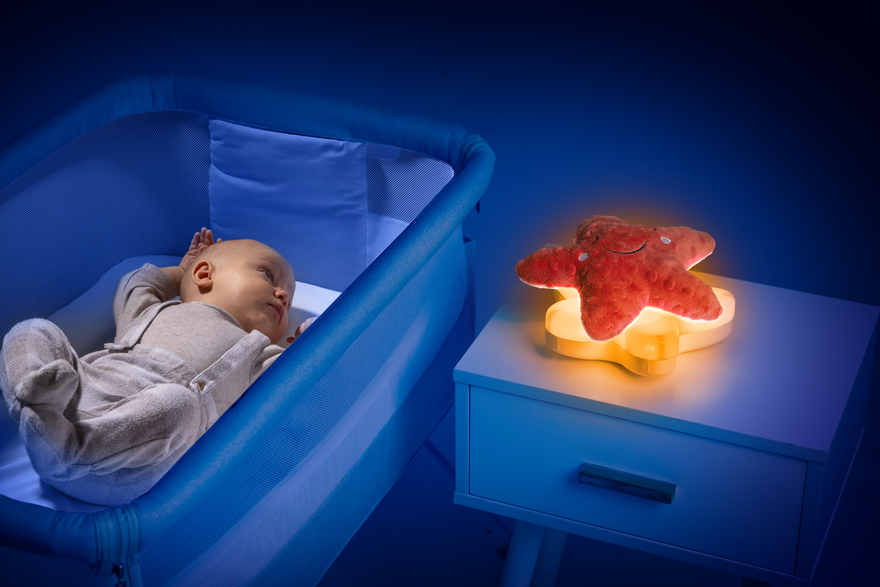
The result fuses three elements, sound, light, and shape, into a single object that functions both as a night light and toy.
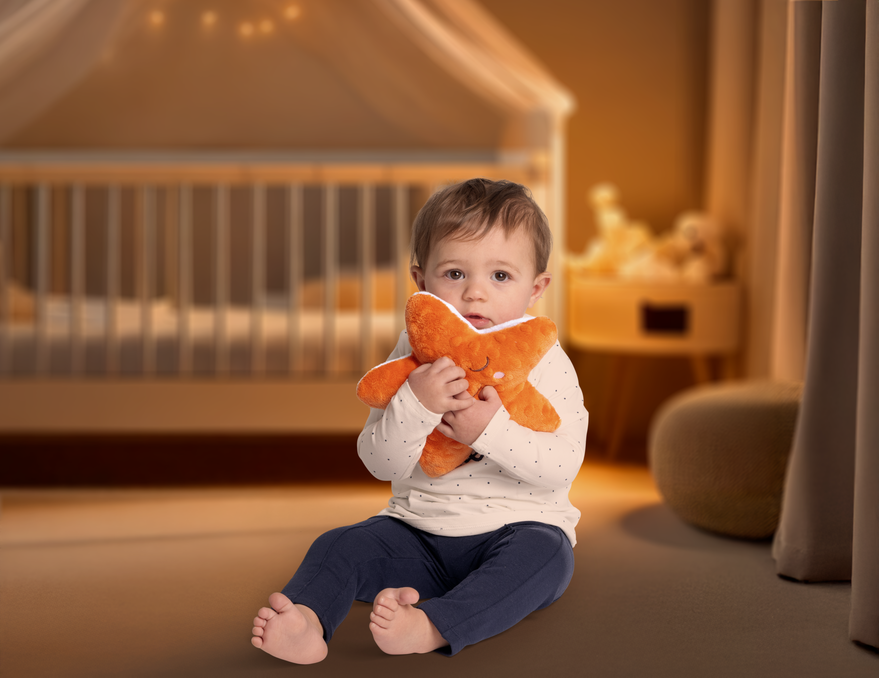
It comes in two pieces. A portable element carrying the sound unit becomes the part a child plays with, while a fixed base holds the light source steady on a shelf or nightstand.Once those functional pieces were locked in, the real design work began: a search for a form that felt natural rather than manufactured, two parts that could hold their own individual character while still belonging together. In the initial idea the answer came from the sea, in the pairing of a starfish and a piece of coral. Subsequently, in product development, the coral also became a starfish. So two stars meet in an embrace, one soft and one hard.
The soft starfish is the toy, and it lives a double life. Its two faces carry different colors and textures. The material itself, soft and forgiving, was chosen with small hands in mind, the same texture families already reach for in comfort objects and baby gear.
The hard starfish, meanwhile, becomes the base, its five arms reaching upward to cradle the soft starfish so it can rest securely on top. Look closer and that arrangement reads as something else too: a handshake, a small architectural nod to connection, love, union, protection.
Switch it on and the plastic starfish glows a soft, warm red, and just like that, the daytime toy quietly becomes the anchor of the bedtime ritual.
From university project to real product
What I keep coming back to with You&Me Star isn't just the finished object. It's everything that had to happen for it to exist at all. This is what it looks like when design education and industry meet in the middle; students get the rare chance to carry research and raw creative thinking all the way through to something that ends up in a child's hands.
The students started with abstract questions about memory, sound, light, the emotional weight of bedtime, and had to land somewhere concrete: an object a child can hold, listen to, watch glow, and fold into a nightly routine.
That's what pushes You&Me Star past the ordinary night light. It functions as an emotional mediator, quietly wiring together sound, memory, light, play, and the bond between parent and child.
It's a small object built around a large idea: that design can take one of the most ordinary moments of the day, going to sleep, and turn it into a moment of real connection.

 点赞
点赞 收藏
收藏 点踩
点踩 分享
分享