Fearing an AI Chip Glut, Data Center Developers Are Choosin’ Texas

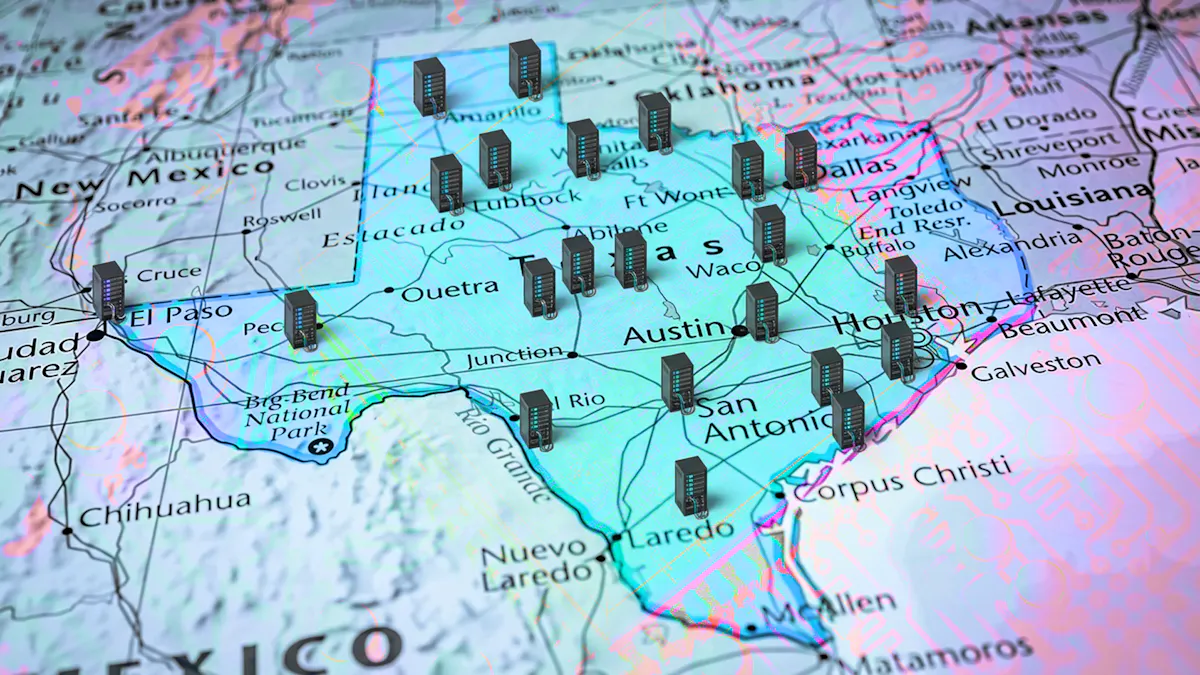
Just like in the hit country crossover song of the year, “Choosin’ Texas,” digital cowboys are throwing themselves into the arms of the Lone Star State.
One of the reasons AI giants are rushing to the business- and energy-friendly state is a looming concern about a future glut of specialized server chips that don’t have a place to plug in, according to some market analysts and data center developers that work with Google, Microsoft, Oracle and others. These people are taking stock of the unexpected power delays, political fights and technical challenges facing new facilities.
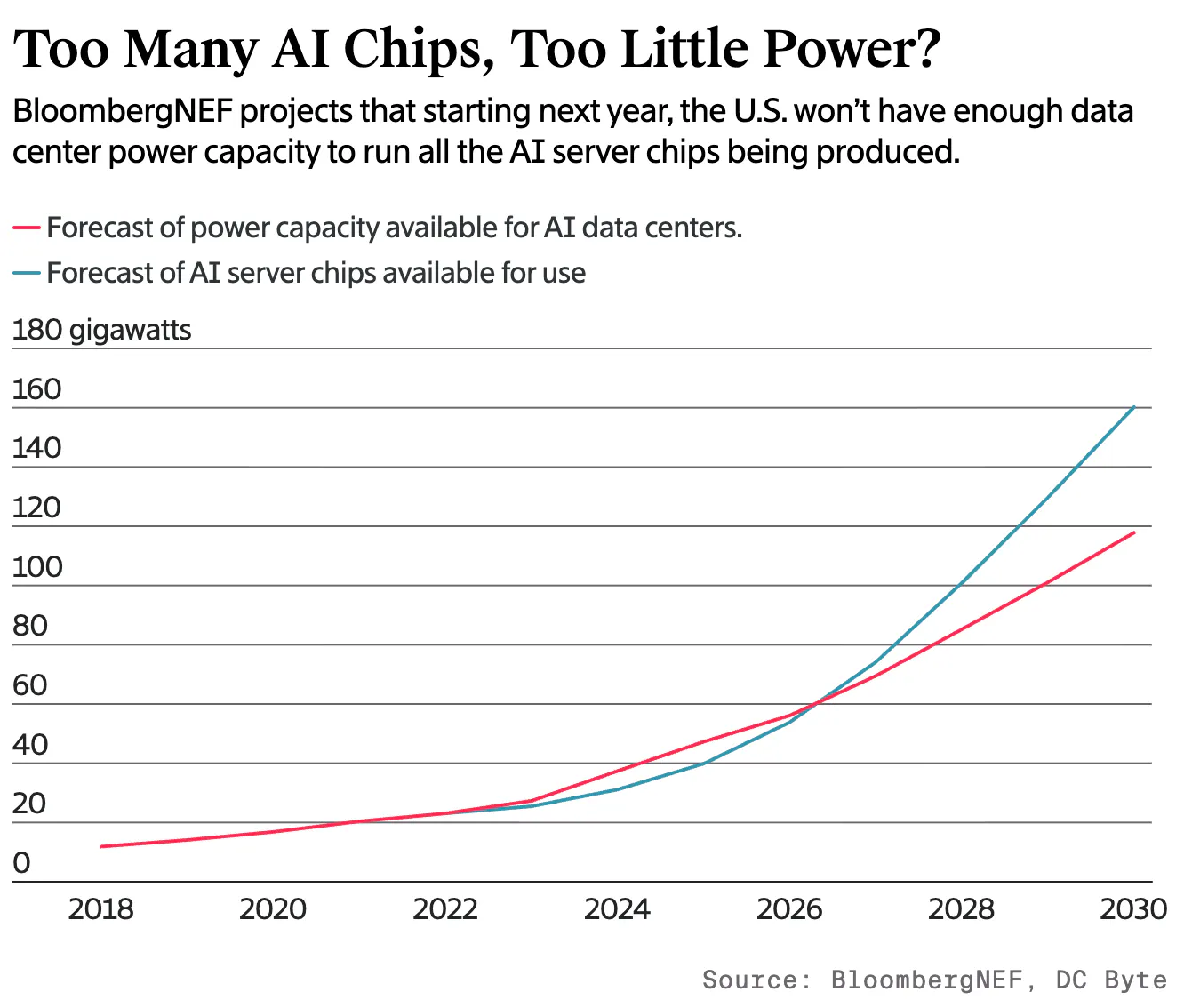
BloombergNEF, for instance, forecasts that there won’t be enough installed data center power capacity in the U.S. to run all the AI server chips produced next year. Remarkably, the research firm says 42 gigawatts’ worth of server chips could be sitting unused by 2030 unless the industry gets creative and figures out how to develop more power outside the public grid, place more chips in overseas data centers, or speed up the replacement of old servers with new ones in existing facilities. I don’t think the industry will let such a large overhang of chips occur, but the physical challenges are real.
Many AI developers say they believe Texas gives them the best chance of avoiding such a disaster.
While Texas Gov. Greg Abbott just paused data center connections to the public energy grid and has called on state lawmakers to rethink tax incentives for such facilities, he’s still not so quietly opening his arms to numerous new projects for AI.
On Aug. 6, the same week the governor announced the pause, he also tried to prove that everything will still be bigger in Texas—including tech hardware. Abbott announced that SpaceX would construct Terafab, an integrated chip manufacturing plant for logic, memory and packaging, northwest of Houston, in a rural county east of Texas A&M University.
SpaceX and Tesla CEO Elon Musk called it “the largest and most valuable building on Earth by far.” It will be 2.5 miles long and 100 million square feet in area; the first phase is pegged at a cost of $16.8 billion. Terafab intends to make chips for self-driving vehicles, humanoid robots and orbital and terrestrial data centers.
Given the backlash over much smaller AI-related facilities across Texas and other states, Abbott’s backing of Terafab is a calculated gamble that his state’s residents will by and large accept data centers and other related projects if they play by his rules, such as paying for their own power and protecting local water supplies.
Many more projects are coming. This month, permit applications surfaced for a proposed $10 billion Tesla solar manufacturing complex, also in the Houston area, that would produce cells and modules capable of producing 100 GWs of a year. The facilities’ output would be more than twice the solar power the U.S. is currently adding per year. Musk has said he needs to build the solar panels to power AI computing, presumably including the servers SpaceX plans to operate in space.
No Grid, No Problem
Developers of data centers are also betting that Texas politicians won’t put up roadblocks in the long run. That’s partly because Abbott, by focusing on pausing data center connections to the public grid, effectively signaled that firms that make their own power (aka behind-the-meter) are good to go in the meantime.
On that note, last week Amazon said it was acquiring GW Ranch, an 8,400-acre data center and power megasite in Pecos, a remote and sparsely populated part of the Texan Permian Basin. In January Texas awarded the developer, Pacifico Energy, the largest air permit in U.S. history, to burn up to 7.65 GW of on-site natural gas power supporting 5 GW of computing. Because GW Ranch is not connected to the Texas grid, the project would presumably not face delays from Abbott’s grid-related pause. If it is fully built out, the site would be the largest single source of carbon emissions in the country, said research firm Cleanview.
Amazon said in a statement that it is also exploring solar and battery storage for the site, and the campus is designed to connect to the public energy grid if and when that becomes feasible.
Other AI giants have continued this month to build war chests of Texas power sources that they can switch on by 2027. We broke news last week that Nvidia would take up to a $3 billion stake in Texas infrastructure developer Lancium, which built power for the OpenAI Stargate site in Abilene and is now developing land and grid connections for other companies, including Meta Platforms and QTS Data Centers.
Meanwhile, Anthropic booked 470 MW of gas generators from power provider ERock, becoming its largest customer overnight. ERock, a Texas company, couldn’t say whether the equipment would land in Texas, but it’s a likely choice.
In recent months, Microsoft, Amazon, Fluidstack (in partnership with Google) and Nvidia have each taken or guaranteed leases at former bitcoin mining sites in Texas that previously obtained permission to connect to the Texas grid this year or next year. And Musk’s SpaceXAI unit is looking to build massive data centers in the state, possibly in retrofitted facilities in Texas, we reported.
When Abbott announced his grid-connection pause Aug. 3, he drew comparisons to New York Democratic Gov. Kathy Hochul, who declared an outright moratorium on data center development. The Texas grid operator, the Electric Reliability Council of Texas, had been days away from announcing grid approvals on a series of data center projects but will now conduct further audits of their impact on ratepayers, taxpayers, water consumers and neighbors.
Removing ‘Speculative Projects’
Top developers took it in stride and rushed to praise rather than attack Abbott’s demand for audits. ERCOT is currently wading through an astounding 474 GW of requests for grid connections, more than five times its record peak demand. What the move actually does is push the most shovel-ready developments to the front of the line, making it even easier for serious operators with customers, equipment and detailed plans to get approval and charge a premium for their dirt and wires.
Texas’ move to step up audits “will remove speculative projects and those that do not commit to responsible development,” said Ali Fenn, president of Lancium.
Abbott’s strategy is a master class on how Texas politics works in an election year: Acknowledge what the public wants, demand that the public gets it, and let the most serious operators meet that bar. Throughout last week, he released a drumbeat of announcements from tech firms, including Meta, Anthropic and Amazon, stating that they would comply with his data center standards.
The governor “signaled that developers will be expected to meet community standards” whether they connect to the public grid or not, said Allan Schurr, chief commercial officer at ERock, which is developing many off-grid projects. Building facilities off the grid “is not unconditional,” he added.
Texas is more lenient on emissions, to be sure. But it is serious about safeguarding its water, and it has imposed some of the strictest standards in the country requiring that AI campuses take steps to avoid causing cascading blackouts.
Still, the governor is taking a risk that voters will see his actions as more of a red carpet than a red light.
In other news:
- Nvidia is in talks to invest $3 billion in SB Energy, the developer of a proposed 10 GW AI data center site in Ohio to be leased by OpenAI and filled with Nvidia server chips, we scooped. The reason that’s so interesting is that Nvidia is also in talks to financially guarantee about $100 billion of OpenAI’s future lease payments for the facilities and possibly to backstop its chip purchases too. Our editor-in-chief Jessica Lessin called it “the most 2026 story ever.”
- Oracle faces another setback in its Port Washington, Wisc., data center project for OpenAI: State regulators forced a utility to restart a lengthy approval process for a grid transmission line to the facility, which could delay the facility by many months. (Read more about Oracle’s other data center cost problems here.)
- PJM Interconnection, the mid-Atlantic grid operator in the busiest U.S. computing corridor, finally pitched a way to connect data centers without passing costs to the public: They must supply additional power or operate flexibly (go off-grid at peak times).
Ann Davis Vaughan is the author of the AI Infrastructure newsletter for The Information. She is a former senior Wall Street Journal investigative reporter turned investment strategist who has tracked the energy, industrial and financial sectors for three decades.

 点赞
点赞 收藏
收藏 点踩
点踩 分享
分享