Connect to your future selves

While your connection to your past self is mostly about your sense of identity, your connection to your future self is more practical. Broadly, it’s about building a better life.
You do this through a timeless policy of charity and trust. Act charitably toward your future self, and in turn you inherit a better life. Be accountable to your past, and in turn you have a trustworthy future self whom you can hand work off to.
Disconnection
Many people are woefully disconnected from their future selves, living in a kind of eternal present where “the future” is an imaginary place, and their “future self” is a stranger whose problems don’t matter. Some examples that come to mind:
- The internet is a graveyard of barely-started projects. I was looking for Substack names for a new writing project, and for every name I tried, I found a person who claimed it years ago, wrote 1-2 posts (or just “coming soon”), and then never posted again. If you’ve ever shopped for domain names or landed on a random person’s website by some other means, you’re familiar with this pattern. Their latest post gushes about, “Whoops I haven’t posted in so long, sorry, but I’m going to be posting more consistently from now on!” and it’s from 2013. And it’s tempting to judge them, but I know the exact experience that causes people do this, because every time I publish a post, I distinctly feel like “that was easy, I could do this more often, like once a week for a while.” But I know better: that feeling is miscalibrated, it’s present-bias, and it can disconnect me from the reality of my future self. We get an emotional high from finishing work, and in that highly motivated state we commit to more work that our future selves just can’t deliver.
- At my job I often see this pattern where someone gets excited about a new project or initiative, yet somehow I know the momentum isn’t going to last. Maybe it’s that I know their other responsibilities will pull them away; maybe I think they’re underestimating the work it’ll take; but it’s just a sense I get, and it’s always right. I know if I just wait a week or two, the project will stall out and be completely forgotten.
- Closely related to the above is the planning fallacy. People are consistently bad at guessing how long a project will take. They underestimate it every time, and even when they know they underestimate it every time, they still underestimate it every time. I see this firsthand, a lot.
- Being bad at planning is both a cause and symptom of a low-control lifestyle, which I’ve written about before. If you’re not connected to your future self, you can’t plan. Then what you call “planning” is really just wishing. And when your plans fail, you’ll be surprised, but no one else will be.
- When you ignore your future self, you demonstrate high time preference: you systematically prefer rewards and pleasures that come right now, even if it means depriving your future self of better things. High-time-preference people are easy to predict, and that’s how they get taken advantage of. You can convince them to buy junk food on their way out of the pharmacy, just by putting the junk food in front of their face. You can get them into credit card debt and gouge them with interest payments, just by letting them spend money they don’t have.
- Closely related: people can’t do things at the proper time, even if they once intended to. “Sign up now, cancel anytime!” says the checkout page on a service they don’t need. The important subtext, never spelled out, is “But you won’t, lol.” If the time of action and the time of benefit don’t line up perfectly, the thing never gets done.
The timeless justification
So, there are warnings listed above and lifestyle benefits listed below, but I feel like the tallying of benefits doesn’t quite work here; there’s a mental shift that’s needed.
It was easy to see the benefit of Connecting to our past selves: I can recall things from my past that make me smarter or wiser right now. But, how could it benefit me to connect to my future self? Causation only goes one way; my future self hasn’t happened yet!
The decision to care about your future self is not a causal transaction, it’s a policy. Policies are timeless decisions. The result, of course, is that the future self you arrive at will have already been cared for by a past self. You didn’t cause it in a single moment, but you installed it as a stable pattern in your life. This is roughly the intuition behind timeless decision theory: a decision is not just a causal event, it’s also an expression of the kind of person you are. It addresses the question, “What kind of person does this make me, and what kind of future do people like me tend to find themselves in?”
If you’re thinking in this frame, treating your future self well is justified entirely by you appreciating or wishing for good care from your past self.
In this frame, you solve problems timelessly. After they crop up, you respond by making sure they won’t happen again. For example, if I learn that I’ve missed a promising recruiter’s message on LinkedIn, before I even start thinking about “What should I message this person now that I’m a month late,” I first ask, “How do I make sure this doesn’t happen again? Have I set up LinkedIn forwarding to my email? Do I check my email often enough? Do I filter out the annoying emails so I can check emails in earnest?” Or, if I’ve misplaced something in my apartment—once I finally find it, the most important thing is that I put it back in the first place I originally looked for it, so it’s there next time. This is what it looks like to solve problems timelessly. It’s a lifestyle of compounding benefits.
In another frame, this is the classic virtue of charity: it’s non-transactional love. You don’t know for sure that you’ll get a payoff—you probably will, eventually / on average / in the long run, but the future is uncertain. It’s not cash in your hand; the benefit is indirect and hard to predict. That’s why it’s a virtue and not a transaction.
If your past self let you down
A lot of people have been neglected by their past selves. If that’s you, then you have to be the hero, like that trope of the person who had a bad upbringing and then says, “I won’t make the mistakes my parents did,” and doesn’t. You do a mini version of that when you break the bad habits and patterns your past self left you with and put in the work to make life better for your future self.
If your past self lifted you up
It’s a pay-it-forward kind of thing. It gains a momentum of its own. I receive care and support from my past self → I feel gratitude → I express that feeling by paying it forward to my future self.
It is so easy to be me. My body is strong; I have good relationships; I have a good job; I have a good apartment; I have savings. This is due in part to the fact that my past self loves me. What kind of person would it make me, if today I just sat and absorbed all those gifts and put nothing more into the world?
The benefits of connection
And here are the practical benefits you receive, once you’ve established that timeless connection in your life.
Inherit habits
Building a good habit is one of the best gifts you can give your future self. They get not only the direct benefits of the habitual practice, but also the habit-ness of it—the ease of fitting it into regular life; the way it has no psychological cost, because it’s already the norm!
Make planning easier: one less unknown
When you make a plan, you’re trying to solve an equation with multiple unknowns: What will the whole situation look like in six months? What resources will be available to me? What obstacles will appear along the way? There’s a lot that’s out of your control when you try to plan. But there’s one unknown in every plan that often gets a free pass: Who will I be when the time comes?
If you don’t know your future self, you’re writing plans for a stranger. You’ve declared that you’ll finish the project by September, but you have no real sense of what September-you is going to care about, how they’ll be feeling, or whether they’ll even remember why this project mattered. The plan is nothing more than a wish.
Knowing your future self collapses this whole category of unknowns. You have an idea of what that person will be capable of, what will exhaust them, and what will actually motivate them when the time comes. It’s not perfect knowledge, but a basic calibration is possible.
Stack your brainpower
You have aspirations to do this-or-that task, but it’s unfamiliar and challenging. The act of preparation lets you stack your brainpower across time, so there’s less to figure out in the moment. The novice stage of any activity is always a messy deal where your brain is trying to learn a hundred things at once. You can reduce this stage! Some examples from my life:
- In college, when I was thinking about starting a real weightlifting program for the first time, I spent about a week just reading about programs and exercises and watching videos. So when I started the workouts I felt ready, had motivation, had good form, didn’t hurt myself, etc. Having a baseline familiarity with everything was also important for the self-consciousness of it all: I might be starting with really low weights, but at least I don’t look clueless.
- Years ago when I got an interview opportunity at Microsoft for a type of role I never really knew existed (but thought I’d be a good fit for), I spent every day for a month preparing for that interview loop—not only drilling the job-relevant technical writing skills, but grabbing tangential knowledge like learning theory; not only learning about the hiring team, but studying the whole structure and history of the company; not only communicating promptly with the recruiter, but social-media-stalking her and each of the interviewers she mentioned. During my meals I’d watch keynote speeches from the CEO. I was aggressively consuming context, so nothing would surprise future-me. 30 Patrick-days’ worth of attention, all closing in on this one interview day. You are very capable when there are 30 of you!
- When I joined my Muay Thai gym I got through the novice stage quickly, and enjoyed it. I had done some research about what Muay Thai is like, what the gyms are like, what you do in classes—all typical questions a newcomer would have, that you can in fact answer for yourself before you even start. I see newcomers at my gym all the time, and despite how good a learning environment it is, they look uncomfortable and overwhelmed. You can reduce this!
This aggressive context-gathering may be especially natural for generalists, because you get to approach the same subject through many different modes. For example, I genuinely enjoyed reading about the history and sub-schools of Muay Thai.
Greater trust → greater responsibility
The better you know your future self, the more willing you are to depend on it.
If you barely know a colleague, you won’t delegate anything too important to them. But if you’ve worked with them successfully for years, you’ll hand over critical work; they have a track record. Your future self works the same way. When you’re disconnected from it, you can’t trust it to follow through. Sensing this, you might hesitate to ever commit yourself to long-term projects.
But if you know your future self through policy—if you’ve been sending it messages, reviewing what your past self left for you, tracking how your predictions played out—then you develop a trusted relationship with it.
- Stick to long-running commitments. I do this with fitness planning, for example. I’ll sit and plan a full year, sometimes longer, of exercise programs: in the winter I want to gain weight; in the summer I want to cut; I’ll do three months of lifting and easing off kickboxing, then three months of more kickboxing but still gaining weight, etc.
The programs are tracked in my goal sheet, and then I’ll make a separate list or sheet for the actual exercises I work through. I can literally choose what body I’ll have, and when. - Return to the present. If you can reliably push tasks and thoughts into the future when they’ll be more appropriate, it frees you up to ignore them right now. If you’re unable to ignore things now, they pull you out of direct experience. Good things in your future that you can’t ignore make you impatient! Bad things in your future that you can’t ignore make you needlessly worried! Passing things to the future is a hack to get you back into the present.
- Show more ambition. You’re not alone when you take on big plans; you have a team of future selves you can trust.
An ordinary tree can tear apart concrete. It has no muscles, no nails, no teeth, but it has perfect coordination with its future selves. Every day it dutifully swells its roots a little larger, pushes a little harder against its obstacles, over years and years. You can be like this. You can decide to put out your roots and grow, even if you find yourself surrounded by “concrete,” as long as you know your future self will continue the work.
How to connect
Like I did in the past-selves post, I’ll list my favorite ways to strengthen your connection to your future self:
Make self-predictions
Try to predict what you’ll do in the future. The act of writing down your predictions makes them real and keeps you from conveniently misremembering your past beliefs.
Tools like fatebook.io make this easy for you. Write your prediction in plain text, like, “By the end of this month I’ll finish my project,” and the tool smartly interprets the date and takes your own % likelihood prediction. When the outcome is due, it emails you so you can make a ruling.
This can benefit you in both directions: it motivates you to do the thing, and it reminds your future self of what you believed and what was important to you.
Send messages to the future
In my grade school we did a time-traveling exercise that I still remember fondly. In kindergarten our teacher had us write letters to our future selves. And in eighth grade, those of us who had been there in kindergarten got to open and read those letters—we’d long forgotten them, but the school had saved them.
It’s very easy to do the same thing as an adult. Email clients like Gmail have a delay-send feature, and there’s no upper limit on how far ahead you can schedule messages to send. So, many years ago I started writing emails to my future self. I’d write a little entry on what I was thinking about lately, what I was struggling with, etc., and then schedule it to send to myself in the future. I’d copy it and send it to different dates—5 years, 10 years, 20 years ahead, etc.—so that multiple future selves could open and reflect on its message. Every two years or so I get a reminder in my todo app to write another batch of emails to my futures selves, and I do it.
At this point I’ve received emails from multiple past selves. From as far back as 2014 and as recent as 2021.
Technical note: For convenience, I send these emails from my junk email address to my main email address, because in Gmail your scheduled messages hang around in the inbox until they send, which is annoying if you’re checking that inbox regularly. The point is to write the message and then forget about it.
Send tasks to the future
Put task reminders and project notes somewhere where your future self will see them (but that you can ignore right now). This is solved by any kind of todo app or system that can schedule notifications for the future—as long as you trust your future self to check and read those notifications! I use ticktick, which is more-or-less a clone of todoist.
Stay organized
Your future self is occasionally going to need to look up your stuff. Organize your thoughts and work so your future self can easily navigate them. That’s the theme of The two rules of personal organization. Your future self is a different person, so give them context! Go watch Memento again: we are all Leonard Shelby. We have the same condition, just less severe. Losing short-term memories is the norm!
Conscientiousness is future self-interest
Conscientiousness is the psychological trait of being “responsible, careful, diligent, organized, and goal-directed,” and it predicts income, health, longevity, and similar outcomes. What is conscientiousness, other than nurturing your future self? What is low conscientiousness / impulsiveness / ADD behavior, other than neglecting your future self?
They say “Treat yourself!” I ask, which one?
“Treat yourself” is used to justify present indulgence. But it doesn’t specify the present. You should love all of your selves: the past selves, present, and all possible future selves (weighted by the probability that they’ll come to be).
What we call self-denial or even austerity at one point on the timeline may be self-love or even indulgence at a later part of the timeline. And the later period might last longer!
Bittersweet
There’s a lot of upside here, but it’s not all upside. Having a relationship with your future self is a bittersweet thing, because one day your future selves will disappear. It’s like a parent who loves their kid but knows the kid will eventually move out. Being in communion with your future self means facing the fact that you’re going to die someday.
Indeed, the whole mindset of “living in the present” has a lot of advantages (and like I said, it’s easier to get into when you can reliably punt stuff to the future), but being in that state 24/7 is a cope. You’re coping with the fact that your time (your future) is limited, by forcing yourself not to think about it. It’s the blissful ignorance of the animal kingdom:
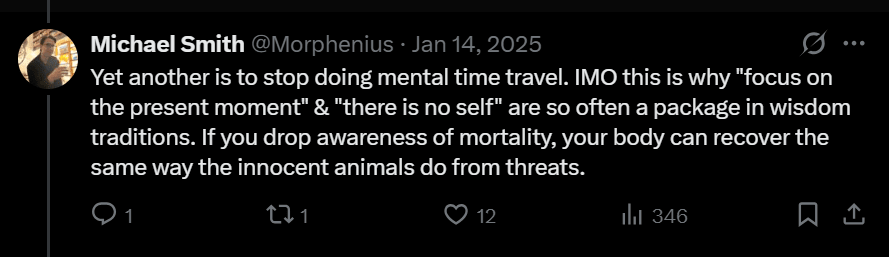
When you pick up the fantastic tool of mental time travel, you also pick up the grim knowledge of the human condition. This is your inheritance as a thinking human: both the grimness and the dignity.

 点赞
点赞 收藏
收藏 点踩
点踩 分享
分享