Can geometric compactification (e.g., $S^4 \times T^3$) serve as a valid regularization to bypass Wick rotation obstructions on $\mathbb{R}^4$?
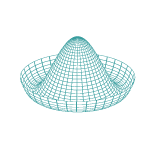
While studying spectral geometry and the foundations of non-perturbative gauge theories, I noticed an interesting geometric aspect regarding the mass gap problem, and I would love to hear the thoughts of the community on this.
It is well known that on infinite, non-compact domains like $\mathbb{R}^4$, forcing global theorems often leads to severe analytic traps in the non-perturbative regime, such as complex poles on the Wick contour and the failure of Osterwalder-Schrader reflection positivity.
Out of pure mathematical curiosity, I wonder if the most elegant bypass to this obstruction is simply geometric.
What happens if we strictly regularize the domain geometrically by transitioning to a compact manifold? For instance, consider a manifold like $M = S^4 \times T^3$, where $S^4$ is the one-point compactification of the spacetime base, and $T^3$ is a compact internal torus.

Here is the interesting geometric catch I noticed: on any compact Riemannian manifold without boundary, the spectrum of the Laplace-Beltrami (or gauge-covariant Dirac) operator is purely discrete. By Cheeger’s inequality, the first non-zero eigenvalue is strictly positive and bounded by the isoperimetric constant $h$: $\lambda_1 \ge \frac{h^2}{4} > 0$ In other words, on this compact geometry, a strict spectral gap seems to emerge automatically as a trivial consequence of the manifold's compactness. By removing the infinite volume of $\mathbb{R}^4$, the continuous spectrum vanishes, and the $S^4$ compactification inherently removes the infinite boundaries that carry the topological charge anomalies.
This leads to my questions:
To what extent can the automatic appearance of a spectral gap on a compact Riemannian manifold be considered a valid geometric regularization that sidesteps the analytic issues of Wick rotation on non-compact $\mathbb{R}^4$?
Are there fundamental physical reasons why constructing the theory on a compact space like $S^4 \times T^3$ (and relying on compactness for the gap) wouldn't conceptually resolve the analytic traps found in the standard $\mathbb{R}^4$ formulation?
I would greatly appreciate any insights from the mathematical physics and spectral geometry perspective.
(P.S. Please forgive any slight unnatural phrasing, this text was translated from Belarusian, so there might be some linguistic nuances).

 点赞
点赞 收藏
收藏 点踩
点踩 分享
分享