The Biggest AI Gap Isn’t Between Models — The Hidden Variable in Every AI Rollout


Summary: Organizations often assume that choosing a more powerful AI model will automatically improve productivity. In reality, business value depends on the relationship between model capability and the organization’s ability to use it effectively. This article explores why AI adoption is fundamentally a capability-building challenge, how uneven AI maturity creates hidden performance gaps, and what leaders can do to align technology investment with organizational readiness. If you’re leading AI transformation, product strategy, or design and innovation, understanding this gap is essential to realizing the full value of AI.
A design team I know rolled out a new AI model six weeks ago, one of the strongest on the market. Leadership expected a productivity jump across the whole org. Instead they got a familiar split: a handful of people started producing noticeably better work, and everyone else kept doing what they’d always done, just a bit faster.
Nobody’s access changed. Everyone got the same tool, the same day, the same onboarding email. What changed was invisible until you looked for it: the gap between what the model could do and what each person actually knew how to ask of it.
This is the problem hiding inside most AI rollouts. Leadership treats AI adoption as one decision: pick the best model, license it, announce it, assume the value follows. It doesn’t. Value depends on two things that move on their own. How capable the model is. How mature each person’s ability to use it actually is. When these two are out of sync, you pay for it either way.
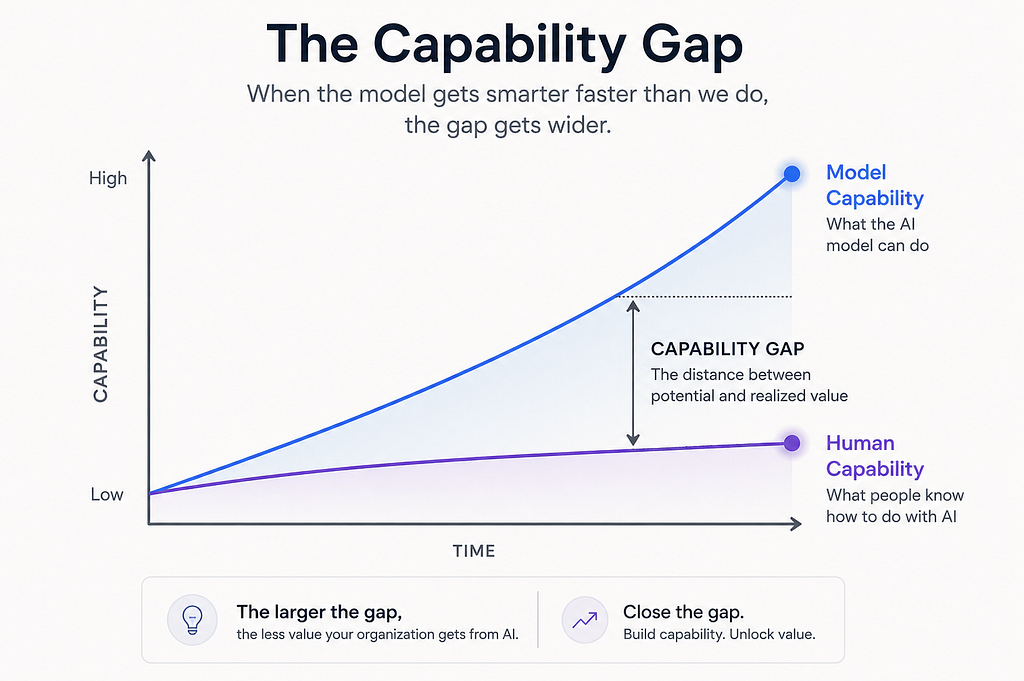
The gap between AI model capability and human capability determines how much value organizations actually create from AI.
Two ways it breaks
Weak model, strong user. The model becomes the bottleneck. Anyone who really knows how to work with AI hits a wall fast. The tool can’t keep up, so they work around it or stop trusting it.
Strong model, weak user. The ceiling disappears, but so does the floor. A great model doesn’t fix someone who doesn’t know how to prompt well, doesn’t know what a good answer looks like, or can’t spot a confident wrong answer. The model isn’t the problem here. The person using it isn’t equipped yet. And the gap between employees grows instead of shrinking, because the people who already knew how to direct AI now have a much bigger lever, while everyone else is holding the same lever with nothing behind it.
Most organizations are living in that second scenario right now, and most haven’t noticed. A rollout with uneven results still looks, from the outside, like a rollout that’s working. A few loud success stories can hide a much larger group getting little value from an expensive tool.
Find out where your value is actually coming from
Before changing anything, it’s worth checking where the value you already have is coming from. There are two very different sources, and they call for two very different fixes.
Sometimes most of the value comes from your top 20%, the people who already push a model hard. If the current model is genuinely holding them back, that’s a real ceiling, and the fix is a better model, or fewer restrictions on how they’re allowed to use it.
Sometimes most of the value comes from the other 80%, people using the model in simple, low-skill ways, but still getting real, measurable benefit from it. In that case a better model won’t move the needle much. The model isn’t the constraint, skill is, and the fix is training, not procurement.
Most companies never check which of these two is actually true. They assume it must be the model and buy an upgrade, or assume it must be the people and launch a training program, without ever looking at where the value in their own numbers is really coming from.
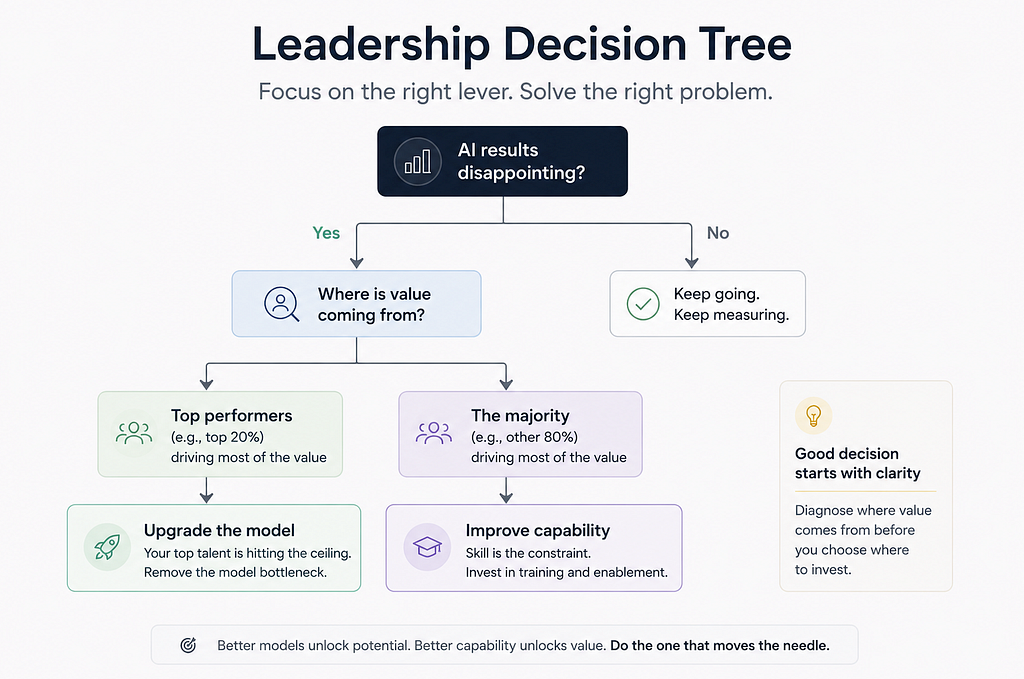
The right intervention depends on whether the constraint is the technology or the capability of the people using it.
What design already knows
This shape is familiar if you’ve spent time in experience design. Design maturity in a company was never really about the tools designers had: Figma, a component library, a research archive. It was about whether the company had built the support for people to use those tools well. Onboarding that matched someone’s actual skill level. Feedback that taught judgment, not just process. A culture where “I don’t know what good looks like yet” was okay to say out loud. The tool was never the real constraint. Readiness was.
AI adoption is the same problem in a new outfit. Buying a great model without building the conditions for people to use it well is like handing someone a professional camera and calling it a photography plan. The camera isn’t holding them back. Nobody taught them to see.
Five ways to close the gap
Start here: measure the real skill level, before changing anything else. Job title and seniority tell you almost nothing about someone’s AI maturity. A mid-level analyst who has spent months experimenting can outperform a director who hasn’t opened the tool since the announcement email. Find out how people actually prompt and whether they know how to judge an output, before deciding whether the problem is the model or the people.
Build tiers, not one flat rollout. Give your most capable users room to work near the edge of what the model can do, with light oversight, because they can catch its mistakes. Give less experienced users a guided setup first: templates, guardrails, reviewed output. Everyone reaches the same place. They just don’t start from the same point, and pretending otherwise slows everyone down.
Teach evaluation as a skill. The real bottleneck in AI use isn’t generating output, it’s judging it: knowing what good looks like, catching a confident wrong answer, knowing when to push back instead of accepting the first draft. Almost nobody arrives already good at this. Build it on purpose, with paired reviews and clear, shared examples of what “good” actually means.
Let people teach each other. The employees who already climbed the learning curve are your fastest, cheapest way to raise everyone else’s floor. Give this a real structure instead of leaving it to chance: office hours, shared examples of prompts that worked (and ones that didn’t), a channel for real attempts, not just wins.
Be honest about the change from the top. If leadership rolls out a model and says nothing about what good use looks like, people fill in the blank themselves, and everyone fills it in differently. Say plainly that this is a skill everyone is expected to build, that it takes time, and that struggling with it early is normal, not a personal failing. That alone makes it safer for people to admit they’re still learning, which is usually the first real step forward.
Model fit isn’t a one-time decision
Here’s the part that’s easy to miss: your people’s AI skill won’t stay where it is today. It will keep growing the more they use the tool. That means the model that feels like a good fit right now will slowly stop being one. Month by month, it becomes a limitation for more people, not fewer, simply because their skill is catching up to its ceiling.
Build in some buffer for that from the start. Don’t pick a model that only just meets today’s needs; leave headroom for where your people will be in six or twelve months.
And check the fit again periodically, not just once at launch. Numbers alone won’t tell you the whole story. Usage stats and output volume are easy to track, but they miss the moment when your best people quietly start working around the model’s limits. Ask them directly where they’re hitting walls, and treat that qualitative signal as seriously as the quantitative one.
None of this makes the choice of model unimportant. But it changes what the real decision is. Picking a model is a purchasing decision, made once. Building the maturity to use it well, and rechecking that fit as people grow, is the actual leadership work, and it’s the part almost nobody puts on the roadmap.
Most organizations that see uneven AI results will conclude they picked the wrong tool. They’ll switch vendors, run another pilot, buy another license. The gap will still be there, because it was never really about the model. It was about how ready the people in front of it were, and how ready they were becoming. That isn’t something you can buy once. You have to design for it, and keep checking.
The Biggest AI Gap Isn’t Between Models — The Hidden Variable in Every AI Rollout was originally published in Bootcamp on Medium, where people are continuing the conversation by highlighting and responding to this story.

 点赞
点赞 收藏
收藏 点踩
点踩 分享
分享