The Robot That Kills You Won’t Be Too Smart. It’ll Be Too Stupid.

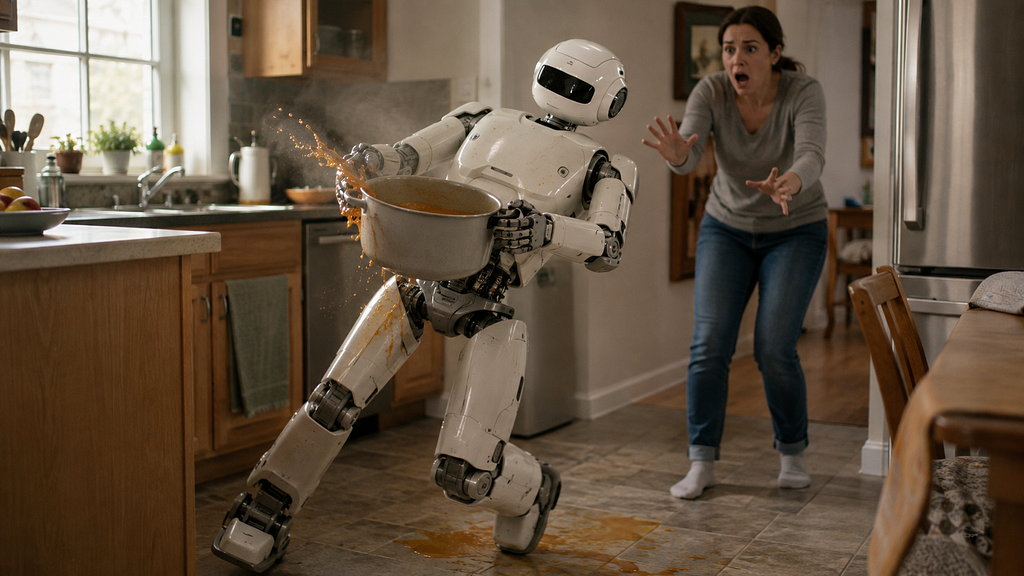
I work in robotics, so I’ve watched my share of robot movies over the years. The Terminator, I, Robot, Westworld — the details are different, but the fear underneath them is usually the same. Robots become smarter and smarter, eventually develop some kind of consciousness or will of their own, and then decide that listening to humans is no longer part of the plan.
I think those stories have shaped the way most people think about robot danger. Whenever a new humanoid robot video goes viral, someone will make a Skynet joke. A robot runs faster, moves more naturally, or does something that looked impossible a few years ago, and the reaction is often some version of: This is cool, but what happens when these things get too smart?
It makes sense. We have spent decades imagining intelligence as the dangerous part.
But if you actually work with robots, there is another possibility that feels much closer.
A robot may be able to kill you long before it is smart enough to want to.
A while ago, I saw a video of a researcher working next to a humanoid robot. The robot made a bad movement and kicked him right in the groin. It looked extremely painful, and I had the same instinctive reaction I assume most men had when watching it.
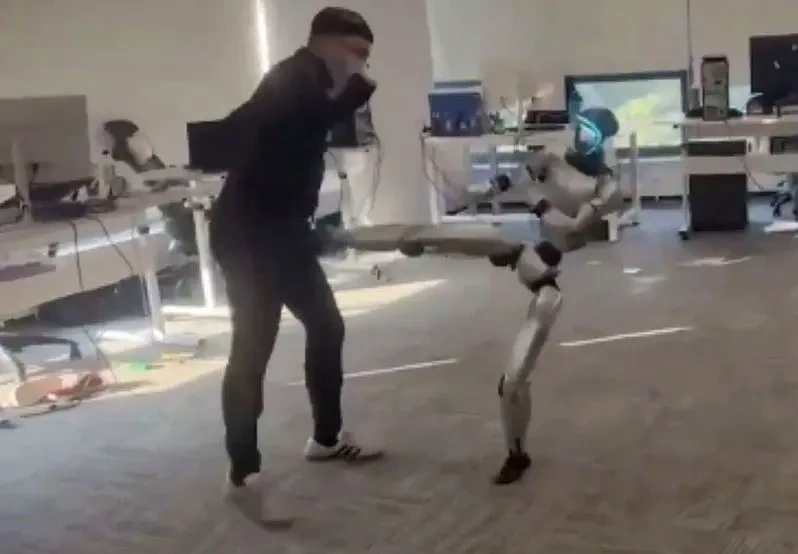
But the video also captured something about robots that science fiction usually doesn’t.
There was no rebellion. No consciousness. No robot deciding that the human standing next to it had become inconvenient. It was simply a robot being stupid around a human body.
And that can be enough.
Anyone who has spent time around robots knows that they still do surprisingly dumb things. They lose balance, misunderstand what is around them, make movements that seem completely reasonable until suddenly they aren’t, or continue doing something when a person would immediately realize that it is time to stop.
That is normal in a lab. Something goes wrong, you stop the experiment, figure out what happened and try again. Sometimes the robot works beautifully ten times and then does something bizarre on the eleventh. This is not especially shocking if you work in robotics. It is just part of working with machines that still understand much less about the physical world than their videos sometimes make it seem.
The problem is that we do not want these robots to stay in labs.
We want them in factories, hospitals and nursing homes. Eventually, a lot of companies want them in our houses. The whole promise of a household robot is that it will share our physical space and do physical work for us: carry things, clean, cook, move objects around, maybe help an older person stand up or walk.
And to do those things, the robot cannot be a weak little machine.
It needs strength.
That is where the situation gets uncomfortable for me. We may reach a point where robots are physically capable much earlier than they are intelligently reliable.
Imagine a humanoid robot in your kitchen carrying a pot of boiling water. It misunderstands where you are standing and turns at the wrong moment. Or it is helping your father get out of bed and gets the movement slightly wrong. Maybe your child suddenly runs in front of it while it is carrying something heavy.
None of this requires the robot to turn evil. It does not even require a spectacular failure.
It just needs to be wrong once.
We are already used to AI being wrong. ChatGPT misunderstands a question or confidently gives a ridiculous answer. Some software does something nobody expected. Usually you correct it, refresh the page, swear at it for a moment and move on.
A robot does not have the luxury of keeping all of its stupidity on a screen.
When it gets something wrong, something in the real world moves.
That is why I sometimes have a slightly different reaction when I watch humanoid robot demos. I am impressed by the same things everyone else is impressed by. Seeing a robot run, jump, manipulate objects or recover its balance is genuinely exciting, especially when you know how difficult those things are.
But I also pay attention when the robot suddenly falls over, makes an awkward movement, or does something that looks inexplicably dumb. Those moments are easy to dismiss because the technology is obviously getting better. And it is getting better.
Still, if that machine is eventually going to stand in somebody’s kitchen, the stupid moments matter.
Probably more than the impressive ones.
A home is also a particularly unforgiving place for a robot to be stupid. A lab can be controlled. A factory can be designed around the machine. At home, someone leaves shoes on the floor, a chair gets moved, a door stays half open, a kid runs through the room, someone reaches for the same object the robot is reaching for.
Nobody is going to organize their entire house around keeping a robot happy.
The robot is supposed to deal with us.
And this is the part I think our science-fiction version of robot danger tends to miss. We keep imagining a future machine that has become incredibly intelligent, understands exactly what it is doing, and then deliberately decides to hurt people.
The nearer-term danger may be almost embarrassingly less sophisticated than that.
The robot may be strong enough to hurt you while still being too stupid to understand that it is about to.
That is a very different kind of robot problem.
And, from where I sit, a much more believable one.
So when people ask me whether I worry about humanoid robots eventually developing their own consciousness and turning against us, that is not the first thing that comes to mind.
I worry about something much more ordinary.
A robot is carrying something heavy in your house. It makes one stupid mistake.
And you happen to be standing next to it.
The Robot That Kills You Won’t Be Too Smart. It’ll Be Too Stupid. was originally published in Bootcamp on Medium, where people are continuing the conversation by highlighting and responding to this story.

 点赞
点赞 收藏
收藏 点踩
点踩 分享
分享