A docent-in-training’s look behind the scenes at the Computer History Museum

A docent-in-training goes behind the scenes at the Computer History Museum
Ninety minutes with the curator who built Revolution, and four years of design decisions most visitors walk right past.
I just completed day one of a six-Saturday docent training program at the Computer History Museum (CHM) in Mountain View, California.
We spent 90 minutes with Kirsten Tashev, one of the creators of Revolution: The First 2000 Years of Computing. Kirsten spent 20 years at CHM, from its “trailer days” to the design of the exhibits in its current building, which had been part of Silicon Graphics. She walked us through the gallery the way a docent would and shared stories about the exhibits, including her own iPhone, now memorialized in a case. Along the way, she pointed out a few Easter eggs in the exhibit.
The exhibit took three years of conceptualization and one year of production and installation. It finally opened to the public in 2011. Once you know that, you start seeing the decisions.
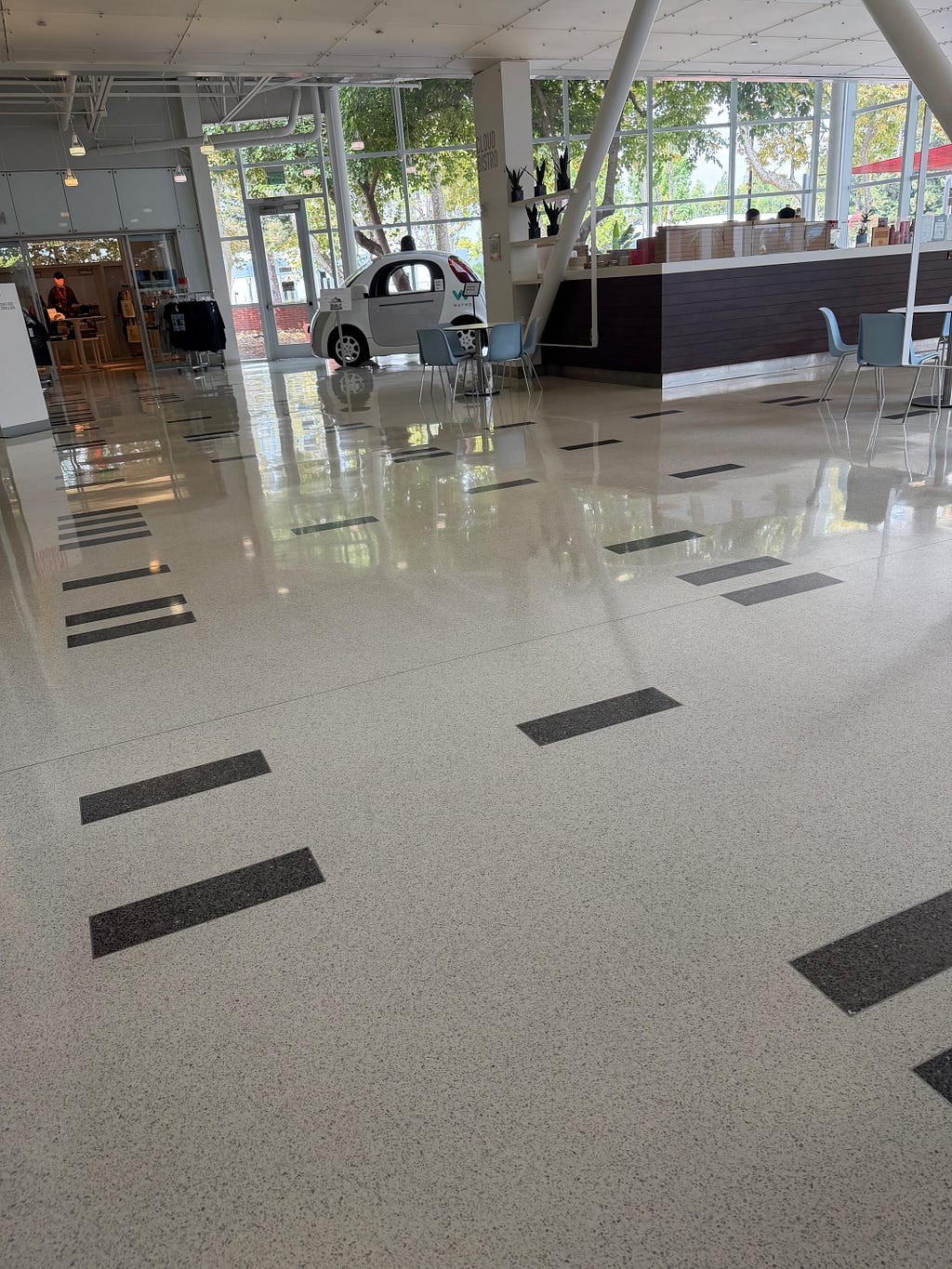
Before you reach the main gallery, the lobby floor pattern mirrors the holes of vintage punch cards. I had walked across it many times without ever looking down.
The entrance to the exhibit is a dark, narrow pathway. It exists to transition the visitor from the lobby to the start of a 2,000-year history tour. From there you move through 19 galleries and pass under three LED arches. Each one marks the shift from one computing era to the next.
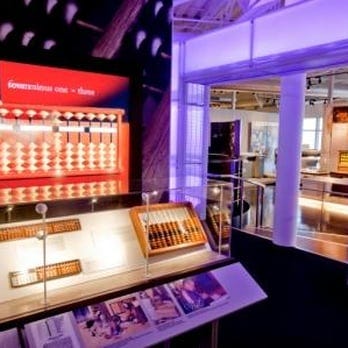
The bigger decisions aren’t physical. Museums generally pick a lane: story-first or object-first. CHM chose objects. There is no single continuous timeline. Content is grouped into themes (Analog Computers, Memory & Storage, Supercomputers, Artificial Intelligence & Robotics, etc.), with timelines running inside each one. This early decision governs everything downstream.
Roughly 40% of CHM’s visitors come from outside the US. The curators built for that, making an effort to keep the story from being US-centric. One entire section is dedicated to IBM PC clones engineered around the world. One of the docent mentors told us about a Swiss visitor who stopped cold in front of the exact machine he grew up with. Not a famous machine. His machine. Apparently this happens all the time, people finding a piece of their own past behind glass.
The docent mentors said the best moments come when someone on your tour turns out to have worked on the machine you’re presenting. Meeting the people who built this history is what makes the work meaningful.
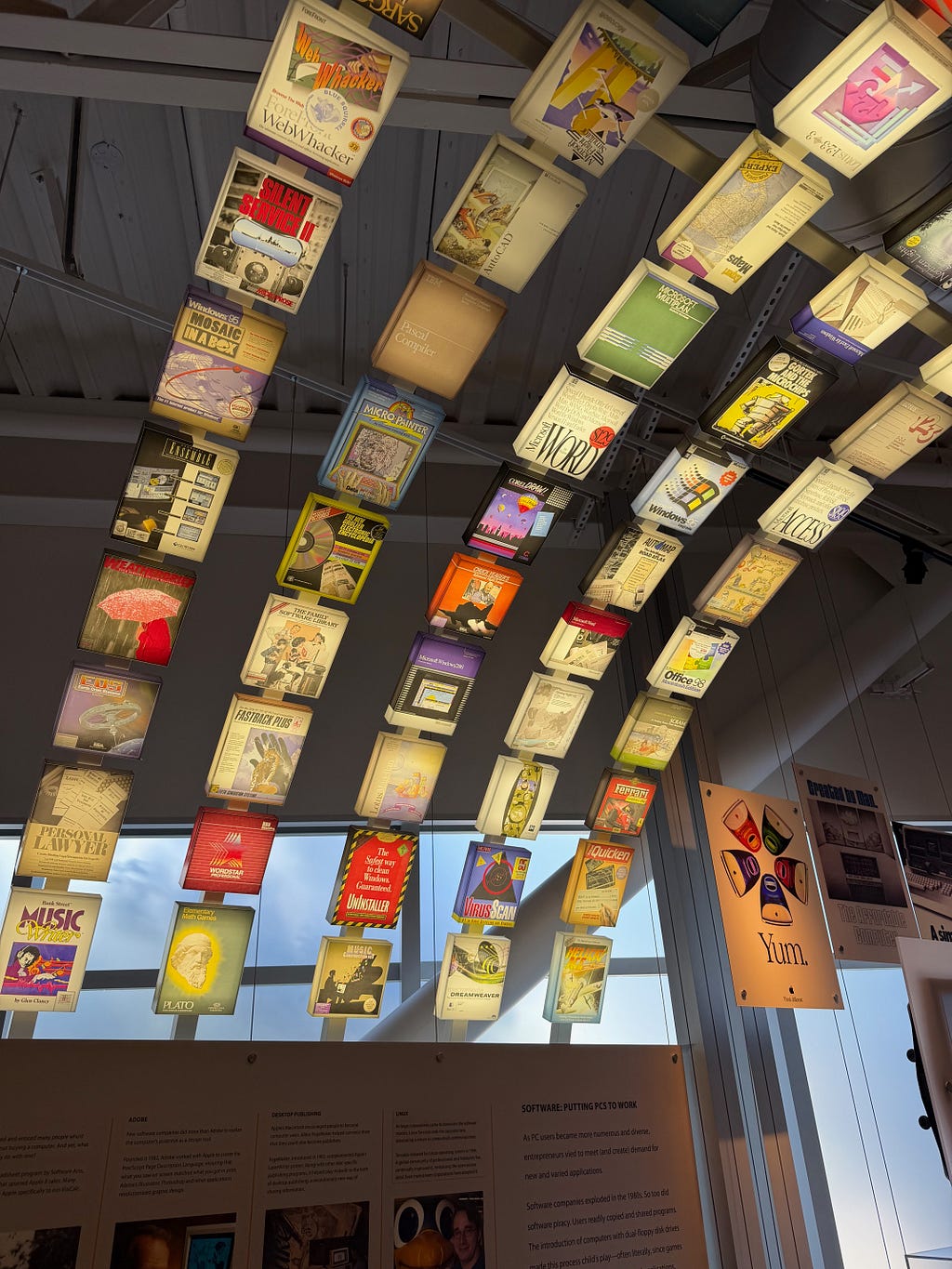
Two objects stuck with me. The Software Tsunami is an arch built from stacked retail software boxes. It’s easy to assume a computer museum is a hardware museum. Hardware survives, and it looks good in a case. Software is harder, because there’s nothing to look at. The boxes are the answer. Stacked together, they show what happened once software stopped coming bundled with the machine and started being something you bought on its own.
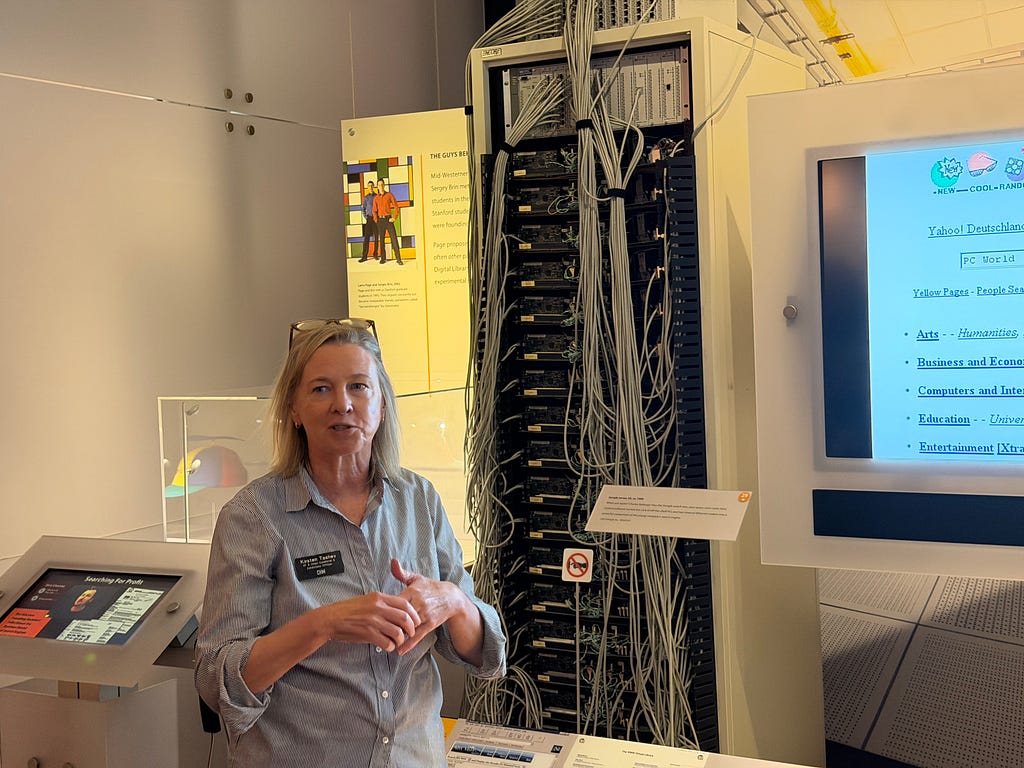
Google’s first server rack from 1999 sits in the Networking & the Web gallery. After CHM acquired it, Google sent someone over to wipe the data. The rack itself is a do-it-yourself cluster of off-the-shelf PC boards, custom trays, and hand-mounted cooling fans, holding 80 PCs plus networking equipment. It was one of many identical systems answering search requests in Google’s early days.
Kirsten shared that for curators, it’s not about what you put in, but what you take out. Revolution displays about 1,100 objects, roughly 2% of CHM’s collection. The other 98% sits in storage. Those cuts were made once, for a visitor the curators would not meet.
A docent makes the same cuts, but in the room. Which objects, which stories, which things I love that don’t make the tour, decided partly by who showed up that morning. Every so often one of them will have built the machine behind me.
Product work is mostly the first kind. You make your best guess about a person you’ll never talk to, ship it, and read the analytics later. A tour is the second kind. You watch someone’s face and change course.
I spent thirty years doing the first. I’m about to learn the second.
A docent-in-training’s look behind the scenes at the Computer History Museum was originally published in Bootcamp on Medium, where people are continuing the conversation by highlighting and responding to this story.

 点赞
点赞 收藏
收藏 点踩
点踩 分享
分享