Why the NGBs are the parameters of the vacuum manifold?
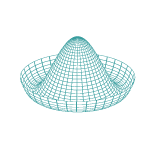
I attended an Effective Field theory class where we studied the CCWZ formalism, in order to construct effective field theories for the NGB ( Nambu Goldstone Bosons), starting from a symmetry breaking pattern of a global group G into its subgroup H.
G is assumed to be a compact internal ( no space time ) connected semi-simple group.
In class we identified two types of generator the broken generators $X^a$ and the unbroken generators $T^a$, clearly the broken generators are related to the element of the coset $ \frac{G}{H} $, meanwhile the unbroken generators are related to the elements of the subgroup $ H $.
Now my professor said that since we have SSB we have a non trivial overlap between the particle state $ |\pi^a(p)>$ and an infinitesimal transformation along the direction given by the broken generator $ X^a $ ( this is just one of the results of goldstone theorem ).
Now here is the part that I do not understand, my professor said that from the results of Goldstone theorem, the parameters that describe an element of the coset space $ \frac{G}{H} $ should be "identified" with the goldstone bosons. I do not see a formal mathematical way to prove this to me, the only intuition that I got is that usually when we do SSB we can parametrize the field as
$ \phi(x) = \frac{(\phi_{0}+\rho)}{\sqrt2}exp\left({i\frac{\pi_{a}(x) X^a}{f}}\right) $
now if I do not look at the radial mode, (which in the context of EFT typically gets integrated out), I can see that the action of the NGB on the vacua is equivalent of the action of an element of the coset space namely:
$ exp\left({i\frac{\pi_{a} X^a}{f}}\right) \phi_0 $
since in general $\phi_0$ will stay invariant for elements of $H$ and near the identity I can always decompose the group element as product of an element of $H$ and an element of $G/H$
So yeah from this equivalence I can see why I can identify the two's quantity, provided that I promote the $\pi^a