Why every food app needs a heart, not just an algorithm

Food delivery apps mastered the transaction and forgot the person ordering. I built one that tries to remember the person first

Not long ago when I came home after spending two hours of running on a football pitch, my mother used to take one look at my dust-covered shins and heavy shoulders and basis my physical exhaustion, she instinctively adjusted the menu on an immediate basis. Fast forward to adulthood: you finish a gruelling, late-night work call and open a food delivery app where you are greeted by a blank, flashing search bar that demands a keyword. In our rush to build hyper-convenient, multi-billion-dollar digital vending machines, we have perfected the transaction but entirely abandoned context.
Right now, platforms like Uber Eats or DoorDash use what engineers call behavior-based recommendation loops. They look at what you ordered last Tuesday, what time you usually open the app, and what is popular within a five-mile radius. The technical irony is staggering. We are living in an era of hyper-advanced machine learning models, yet food app is fundamentally blind to the most critical variables that dictate human appetite: your context
These apps rely heavily on collaborative filtering — a machine learning technique that groups you with users who share similar transaction histories. If thousands of people in your pin code order spicy wings on a rainy Friday, the app assumes you want it too.
To the app, you are simply a static user ID clicking a screen at 9:30 PM. Without that external context, the algorithm falls back on lazy historical averages, offering you the same generic pizza or burger you ordered when you were lazily watching television last weekend. It forces an active, exhausted human to do the cognitive heavy lifting of figuring out what they need.
We have spent the last decade building an internet that optimizes for speed, frictionless checkout, and advertising real estate. In the process, we accidentally stripped away the human elements of software design. As developers and product builders, our goal shouldn’t just be to make transactions faster but it should be how closely AI can replicate the unspoken, intuitive understanding of the people.
By simply changing the opening prompt from ”What do you want to eat?” to ”How was your day?”, we bridge the gap between cold algorithms and human emotion. We don’t need an invasive web of biometric tracking to build software that understands us. We just need to give users a space to be heard, and design engines capable of listening. So, I decided to build a prototype to test the idea — Intelligent Bistro, an AI-powered restaurant ordering app that opens with “How was your day?” instead of a search bar.
Logic
When the app opens, you can either pick a mood from the flash cards on screen or simply type how you’re feeling, the way you would describe it to a friend. This is fed to the AI layer, which interprets the mood and recommends a set of dishes that fit that feeling: comfort food for a rough day, something celebratory for good news and so on.
From here, you can go ahead with the AI’s recommendations, or type exactly what you want, for instance “add 2 burgers and 1 fries for me.” The AI interprets this and returns a response that updates your cart with the right items and quantities.
It also looks for opportunities to complete the order. Order a burger, and it might suggest adding a lemonade to make it a combo. Because the chat remembers what was just said, replying with a simple “sure” or “yes” is enough for it to know exactly what you meant. The same logic extends to managing your order: type “clear my cart,” and it does.
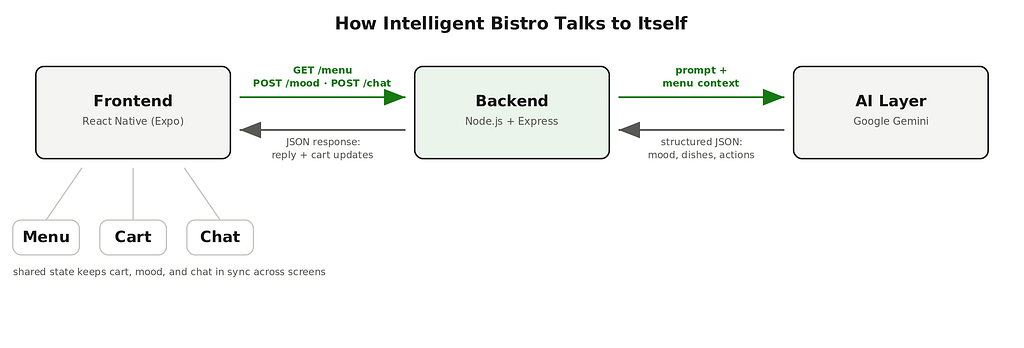
Under the hood, the frontend is built with React, the backend runs on Node, and Gemini powers the AI layer that understands and responds to what you type. The frontend fetches things like the menu using GET requests, while your messages and cart actions go through POST requests to the backend, which talks to Gemini and sends a structured response back. A shared state layer keeps the cart, mood, and conversation in sync across the Menu, Cart, and Chat screens, so an action in one place shows up correctly everywhere else.
To conclude, as my mother kept adjusting dinner without being asked without any engine, Intelligent Bistro is my attempt to give software that same instinct, not to predict what you will buy next, but to notice how you are doing, and let that shape what happens next.
That is the shift I think food ordering technology, and maybe technology in general, is overdue for. Less prediction, more attention. Less inferring you from your last five orders, more just asking, the way someone who actually cared about you would.
You can view the architecture, experiment with the 7-state mood mapping framework, and contribute to the project on GitHub here:
Github: link
Food Discovery with Uber Eats: Recommending for the Marketplace
http://spin.atomicobject.com/software-architecture-llm/
Why every food app needs a heart, not just an algorithm was originally published in Bootcamp on Medium, where people are continuing the conversation by highlighting and responding to this story.

 点赞
点赞 收藏
收藏 点踩
点踩 分享
分享