How A Random Cat Led To One Of Road Safety’s Most Ingenious Inventions

Curiosity can be a dangerous thing, especially when it involves big metal objects that literally weigh tons and move at breakneck speeds. I lived in Britain for a time as a kid, and while I was keenly aware that sitting in the middle of a narrow “B” road was a bad idea, an object installed in the tarmac had piqued my curiosity so intensely that I determined the risk of examining it was acceptable.
I thought this device was a brilliant new invention, even though it was already some fifty years old at the time. Today, the concept of “cat’s eyes” road reflectors is almost a hundred years old and still saving lives on UK roads. Nonetheless, even many English people are unaware of all the tricks the original ones were ingeniously designed to perform. It’s time everyone learned about these small wonders before they disappear from roads forever.
So Where’s The Road Go?
Not all ideas resulting from alcohol are good ones; running onto a football field naked and stealing a pace car at a NASCAR event are two good examples of such bad ideas. However, one of the greatest traffic safety devices ever might very well have had an indirect connection to booze. As Halifax Today told it, in 1933, Percy Shaw was a Yorkshire road contractor and mechanical tinkerer in the years when headlights were generally crap and night travel could be quite treacherous. Percy’s stories varied over the years, but the most common one told involves a foggy evening when he was driving back from The Old Dolphin pub in Clayton Heights, which is still there and has been for 300 years.

On the way home, in areas where the trams and trolleys ran, Percy could use the shiny silver tracks as a guide. But as soon as the tracks ended, he was pretty much plunged into darkness. On one tricky stretch of the road, he was saved from driving off the pavement because his headlights reflected off the eyes of a wandering cat sitting on the side of the road. This fortuitous occurrence put the idea of road reflectors into Percy’s head, modeled after the peepers on the feline creatures. Shaw later gave different accounts of how he came up with the idea, but I’m betting that the first story was true and he was encouraged not to retell the real tale that involved possibly a pint or two. Or three.
Like all nocturnal creatures, the backs of this animal’s eyes have a reflective layer behind the retina called the tapetum lucidum, which reflects incoming light and bounces it back off to make the most use of the existing light (cats can see in about one sixth of the light that humans can). The reflected light also bounces back through the retina for that distinctive glow.

Six years earlier, in 1929, a man named Richard Hollins Murray developed what’s known as a retroreflective lens. Invented for advertising signage, it’s essentially a manufactured equivalent to a nocturnal animal’s eye with a reflective coating on the concave back of a glass cylinder, so it reflects light back in roughly the direction that it was received.
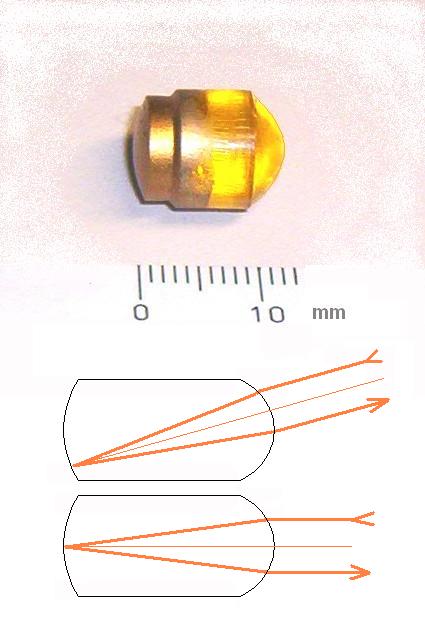
So, retroreflective lenses would be the means of achieving the cat’s-eye glow Percy was after. But how could such reflectors survive in a harsh road environment? For maximum durability, Percy began with a heavy-duty, durable cast base to be sunken into the tarmac. With a low profile and a tapering shape, the housing allowed car tires and snowplows to comfortably ride over it.

The actual glass reflectors were contained within a flexible rubber housing with two reflectors facing in each direction of traffic.

The rubber housing then sat below the level of the durable metal surroundings.

They don’t protrude much, but it’s enough to catch the headlights of cars and create a dramatic glow:

Besides the visual benefits, the tactile and audible feedback from contacting one would alert a driver to Wake The Hell Up. This is all clever enough, but there was an additional feature Percy developed to make the infrequent but inevitable times that these were trodden upon beneficial.
Signs That Blink
How do the cat’s eyes in actual cats stay as clean and clear as they do? Obviously, these finicky pets will blink with regularity to accomplish that task, but the road-mounted cannot do the same. Or can they? Percy found a way that they could. The flexible rubber housing will naturally get pressed down when driven over, and when this happens, the section containing the glass lenses drops down; the front surface of the glass pieces rubs against a stationary part of the rubber to effectively clean off the “eyes.”

It gets better. The void space in the housing under the rubber holder for the lenses would fill with water after it rained; believe me, if there’s one thing Britain has more in abundance than biting humor (sorry, humour) it’s rain. That means that when the rubber housing gets crushed down by a passing vehicle, the wiper is often working in conjunction with water to really get them eyes good and clean. Here, I’ve cued this video up to the squish-cleaning demonstration:

This is a flat-out ingenious concept; an idea that doesn’t require electricity for illumination or even maintenance from an era when the UK was known for innovation (and ultimately let down by labor relations, among other things). The concept apparently didn’t take off immediately but slowly started to spread; with the second World War and cars often having “shuttered” headlights to stay less visible to enemy bombers, these “cat’s eyes” were essential for nighttime driving when your forward lighting output was about the equivalent of a dude sitting on the hood with a candle.
Over the following decades, cat’s eyes became the rule and not the exception on all UK roads. It’s impossible to tell how many lives Percy’s invention has saved, but we do know of a few odd cases where they did the opposite.
Killer Safety Devices?
You can’t get more batsh*t crazy than the racing that took place during the infamous Mille Miglia in the fifties with cars going at triple-digit speeds through narrow roads lined with spectators instead of barriers. The last time the race was run was in 1957, and the reason for this was apparently a faulty safety device: a damaged cat’s eye. Jamming through the Italian village of Guidizzolo at around 150 miles an hour, driver Alfonso de Portago’s left front tire blew out on his gorgeous Ferrari 355 S. The car flipped violently out of control, ultimately killing de Portago, his navigator, and nine spectators, including five children.

Enzo Ferrari was charged with manslaughter, but an investigation showed that a damaged cat’s eye was the cause of the blowout. Outrage from the incident put an end to further races, a rather ironic outcome of a safety device gone wrong. Today, aging road infrastructure means that there are numerous cases of tire damage to cars from older cats’ eyes, but there’s an even bigger issue: flying cats’ eyes.
Snowplows often dislodge the devices, leaving them only loosely secured. This creates a serious problem, as vehicles can kick the cats’ eyes into the air, potentially resulting in struck windshields. Possibly the most famous case was the 1999 incident in the UK where electronic musician Kemistry was struck by a cat’s eye housing while sitting in the passenger’s seat of a car on the M3 motorway, killing her instantly.
Today, steps are being taken to solve the problems, but at the loss of some earlier innovation.
Of Course, They Got Cheapened Up
As with most manufactured things, over time cat’s eyes became more “cost effectively” made. Cat’s eyes with the original self-cleaning design and vault-like housings are disappearing. You can still see versions here in the US, like the one below on my way to work, but I don’t recall ever seeing the self-cleaning ones here in America.

Many are replaced with much simpler reflectors merely stuck to the road surface, at least in places where snowplows never run. Made from lighter and cheaper plastic, they’re far less durable but justified in some ways by being less dangerous projectiles when they finally lose their grip on the road.
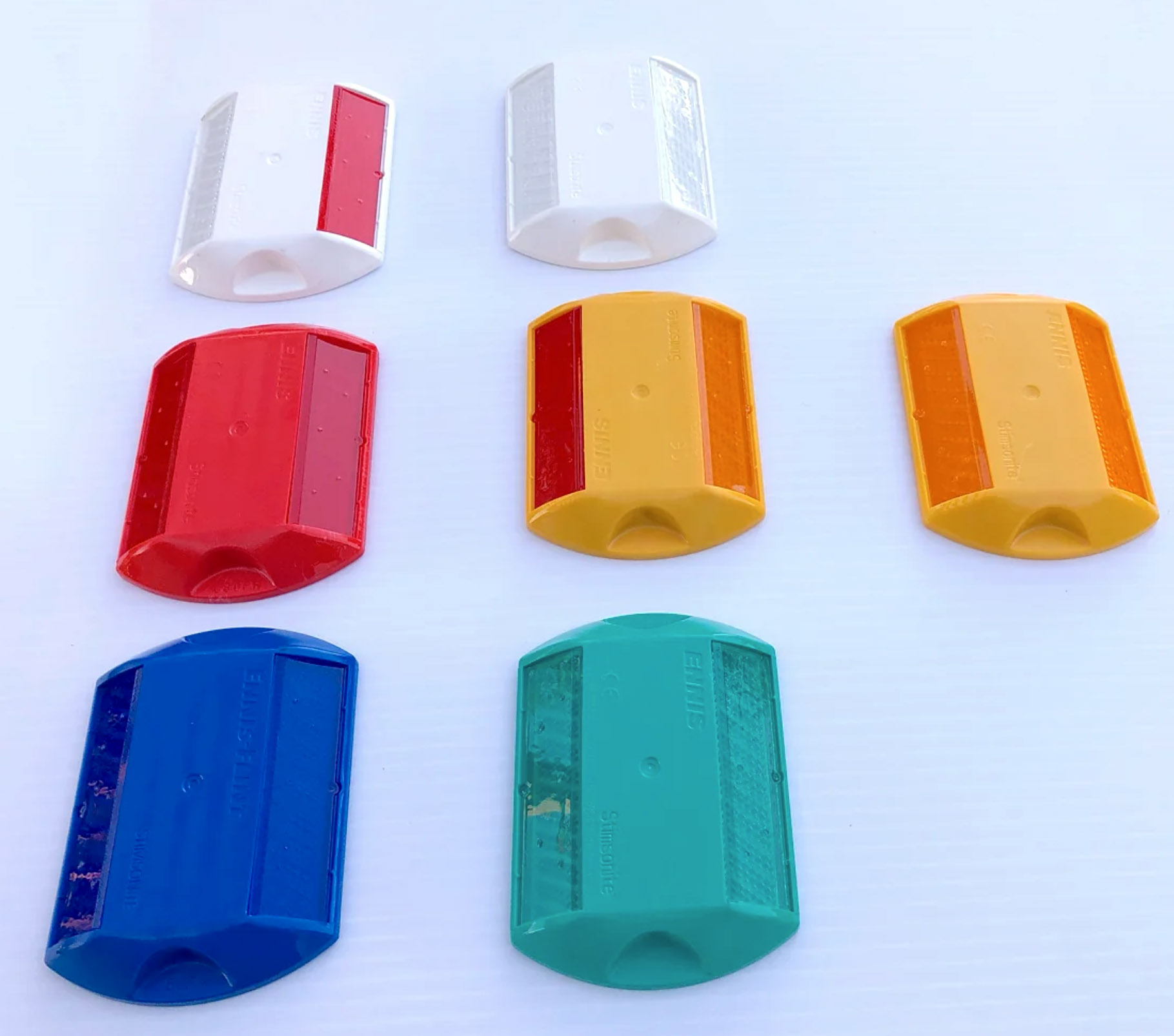
Even more municipalities are looking at LED cats’ eyes with solar cells mounted on top, though they got off to a rocky start when some of them exhibited flickering that could trigger seizures in some drivers. Also, these lights give the impression of driving on an airport runway at night and almost encourage you to cut your headlights and just cruise like you’re playing Night Driver on your Apple IIE back in 1985. Don’t do that.

Honestly, with the output of modern headlights, it seems like a bit of a waste not to just use reflectors. The simplicity and effectiveness of Percy’s product has yet to be topped.
Soon Gone, But Not Forgotten
Twenty years ago, the BBC organized a vote for the top ten British design icons. The list included such famous items as the Concorde, Morris Mini, Supermarine Spitfire, K2 telephone box, World Wide Web (I thought Al Gore invented that?) and the AEC Routemaster bus. You know what else was on the list? Percy’s cat’s eye. I was unable to find out how many of the original-style units still abound on UK roads, but I am sure it’s a dwindling figure.
Ironically, we were all under the impression that by now cars would drive themselves from satellite directions, meaning that such visual devices would be as obsolete as typewriters. That day will come, but it’s still a way off. For now, such reflective devices are still quite valuable. Any of us who drive after sunset can thank a Yorkshireman heading back from a local watering hole nearly a century ago for making our paths that much clearer.
Top graphic images: Eliot2000 via Wikimedia Commons; Amazon.com
The post How A Random Cat Led To One Of Road Safety’s Most Ingenious Inventions appeared first on The Autopian.

 点赞
点赞 收藏
收藏 点踩
点踩 分享
分享