How to put 170 atoms in an atom



You might already know that atoms are mostly empty space. Physical size behaves a bit weirdly at the atomic scale, but essentially the radius of an atom’s nucleus is tens of thousands of times smaller than the radius of an electron’s orbital. That’s the same ratio as a single grain of sand1 to a football field.2
So what can we fit in all that space? Well, if you build it just right, you can fit a bunch more atoms of the same element – theoretically over a hundred. Yes, scientists actually did this, and no, it doesn’t violate the laws of physics. You just need one really big atom, and a bunch of really cold normal ones.3
Let’s start with the big atom. An atom consists of a nucleus and the electrons that surround it. So if you want to make an atom bigger, you can move the outermost electron farther out from the nucleus. This is called “electron excitation”, and it happens when an electron absorbs extra energy and temporarily jumps to a farther out, more loosely bound orbital. This happens all the time: atoms in nature are constantly absorbing and releasing the energy around them.
As an electron gets bumped to higher and higher energy levels, the radius of its orbital gets bigger very quickly. But if we add too much energy, the electron flies away from the nucleus completely, and we’re left with an ion – not a complete atom. So we need to tune the energy we add very carefully. The biggest atoms we can create like this are called “Rydberg atoms” after Swedish physicist Johannes Rydberg. In 1888, Rydberg discovered a pattern in atomic spectra which would later lead to the theory of electron energy levels. In laboratories, Rydberg atoms can be over 1000 times wider than a normal atom – plenty of space to stuff some more atoms inside.
Johannes Rydberg: Not an atom, but made of atoms
But if the stuffed-in atoms have too much energy of their own, they’ll knock that carefully placed electron away. So we need to get rid of nearly all of their energy. For that, we can turn to an exotic state of matter called a “Bose-Einstein Condensate”, or BEC for short.
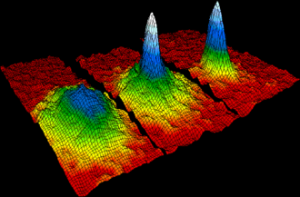
Remember that temperature is a measure of particles are bouncing around, so if you cool particles down you can get them to move slower and pack closer together. For certain atoms, at well under a millionth of a degree above absolute zero, a cluster of atoms will start to all share the same quantum state. This has all sorts of cool scientific implications, since it lets quantum physics researchers see quantum effects on a much larger scale, but for our purposes all we need to know is that the atoms in a BEC get really, really cold.
Density map of a BEC forming over time (left to right)
So in 2018, an international team of scientists created a BEC out of strontium atoms, and hit one of those atoms with a carefully tuned laser, exciting its outermost electron and turning it into a Rydberg atom. Several other atoms from the BEC were caught within between that outer electron’s inflated orbital. Those interior atoms interacted slightly with the electron, and together formed something like a very bizarre molecule, called a “Rydberg polaron”.4 And according to the scientists’ computer simulations, up to 170 more strontium atoms could pack themselves into the Rydberg polaron.
So yes, you can fit a bunch of atoms in an atom. It’s unclear right now if Rydberg polarons will ever be directly useful to ordinary people, but they certainly have a lot to teach us about quantum mechanics and the way atoms work. And sometimes, that’s all the justification you need.
—

 点赞
点赞 收藏
收藏 点踩
点踩 分享
分享