For All The Doom And Gloom, Normal-Car Buyers Have A Lot Of Power

The overwhelming narrative about the car market seems to be that no one will ever be able to afford a car again unless they’re heirs to the Hy-Vee supermarket fortune. That’s not quite true. Cars are expensive, and the cost of financing cars has gone up with interest rates, but the majority of buyers who trade in cars are sitting on a bit of a superpower.
A rising tide lifts all prices, and the value of trade-ins remains way higher than anyone would have guessed. And, unlike the rest of the market, the best-positioned individuals are normal-car people.
While The Morning Dump will be attacking one bit of conventional wisdom, I can’t help but tap the Decade of the Hybrid sign once more with the news that hybrids are outselling EVs in our most EV-happy state. It’s such a rush that even Audi, eventually, is getting in on the hybrid game.
That doesn’t mean all is doom and gloom in the EV space, either, as Rivian’s move into a lower price tier seems to be paying divid … seems to be aiding the company’s financial position.
The Average Value Of A Trade-In Is $13,330, And That’s Because Of Mainstream Cars
Yesterday, I wrote about how the wealthiest are driving the car market, and asked how people felt about the economy. The general sense seems to be that people are doing okay, but that the increase in the cost of everything hasn’t been matched for everyone in an increase in earnings or wealth. There was also a lot of discussion that reflects the K-shaped economy, where stock market highs don’t seem to benefit everyone.
It’s a common point of reference here that, during the semiconductor shortage, prices of both new and used cars shot up. What most buyers have realized is that, while those new car prices have stabilized, they haven’t exactly come down as inventory has increased. There are various reasons for this, including the introduction of tariffs and costs associated with the EV headfake, but the overall lesson is that prices that go up generally don’t come back down so easily.
While affordability is a serious issue, I do think that the popularity of higher-trim models and large three-row crossovers like the Toyota Grand Highlander has skewed the average transaction price, giving a somewhat misleading view of the market (this is why I prefer to look at The Keating Line as a price reference).
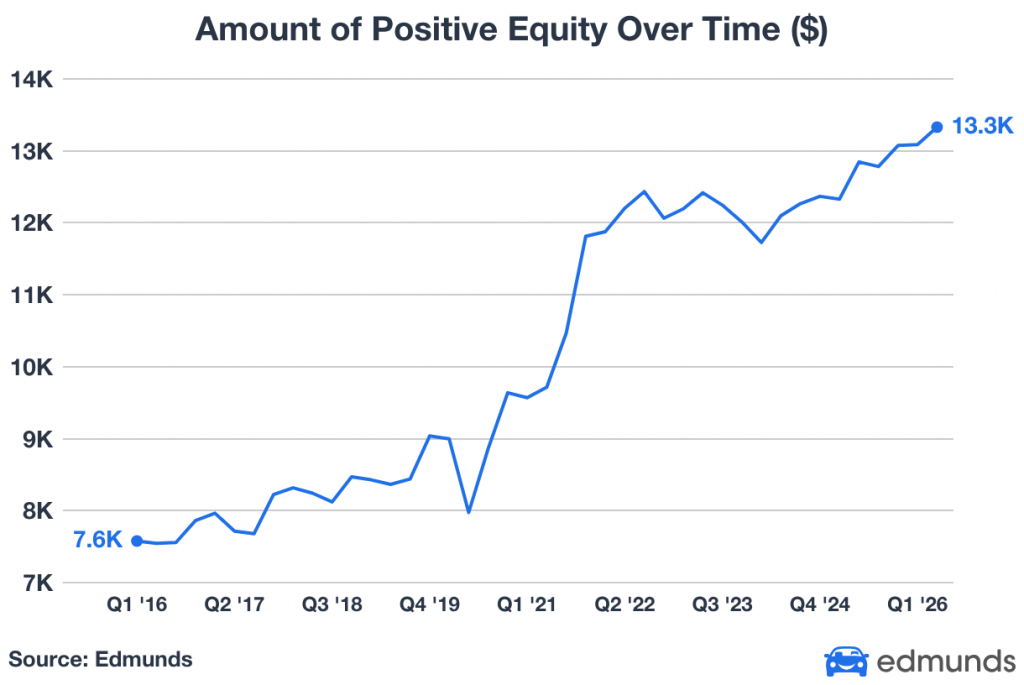
Approximately half of all new car purchases involve a trade-in, and this is where there’s some good news for car buyers. While new car prices have mostly stabilized, the value of trade-ins has continued to increase. According to this Edmunds report, buyers trading in vehicles have a record $13,300 in positive equity.
Because of the pandemic, wild values for used cars led to 83.6% of all trade-ins in Q1 2022 having positive equity. That’s no longer the case, though the market is still above historical norms with 69% of trade-ins above water. The power that buyers with trade-ins have is that the values have never retreated. Why? Edmunds explains:
A big part of the explanation is the timeframe when vehicles were bought — during the pandemic, when inventory was so tight that paying sticker price or above was a reality for many. Those cars depreciated, but used-vehicle demand stayed strong enough that values didn’t fall as far or as fast as they normally would have. Buyers who rode that out are now sitting on more equity than the math would have suggested a few years ago.
Even better, it’s not the high-end models that are driving this value. Luxury cars are still depreciating at mostly normal rates, whereas the most mainstream vehicles are the ones holding high values:
The most frequent and consistent winners in today’s market are owners trading in “normal” vehicles around 7 years old. Drivers who bought mass-market models around 2019 — and signed up for conventional 60-or-72-month financing — have largely cleared the depreciation curve. Because secondary-market values for reliable used vehicles remain historically elevated, these average owners are routinely walking onto dealer lots with about $13,000 in positive equity.
The list of the 20 most commonly traded-in vehicles with positive equity is basically a list of the most popular cars, albeit slightly shuffled (the CR-V tops the F-150 and Silverado 1500). If you’re trading in a roughly 2019 CR-V, you can expect to get $10,545.
This tracks with my experience. While I didn’t do a conventional trade-in (I bought my car from Galpin Honda in LA and shipped it across the country), I was surprised that my 2016 Forester was worth more than $10,000 when I sold it to a dealer back in 2024. Literally every time I go to get my CR-V serviced, they ask if I want to sell them back the car, and because I put the value of my Subaru towards a down payment, I already have positive equity.
Obviously, if you don’t have anything to trade-in, this doesn’t apply to you, but for a large chunk of buyers trading in normal cars and buying normal cars, there’s a real opportunity to reduce the amount that has to be financed.
More California Buyers Are Opting For Hybrids Than EVs
Photo: Griffin Riley
Guess what? People like hybrids. You’ll be shocked to discover this is happening if you’re a regular reader of TMD. Just kidding. I write about it all the time. Maybe too much!
I’m not stopping anytime soon, and a report from the California New Car Dealers Association shows that, for the first half of 2026, hybrids (excluding PHEVs) outsold EVs by a large margin. The market share YTD through June is still primarily gasoline (57.6%), with hybrids (22.1%) and BEVs (15.9%) in second and third place.
“Californians are buying the vehicles that fit their budgets and the way they drive, and right now that means a lot of hybrids,” said Jessie Dosanjh, Owner of Stevens Creek Chevrolet and CNCDA Chairman. “Every hybrid registered in this state came through a franchised dealership. When a customer needs to compare options, work out financing, and know the vehicle will be serviced for the next ten years, they come to their local dealer. We support any rebates or state incentives that help buyers and move the market forward,” said Dosanjh.
This doesn’t mean EVs are failing. Some of this is just the impact of having so many EV sales pulled forward in Q2 and Q3 by the expiration of the IRA tax credit. California also has a new program focused on first-time EV buyers, and that might help increase sales in the second half of the year. The Model Y also remains the best-selling vehicle in California, followed by the Camry and CR-V Hybrid.
Audi Will Do Hybrids Again, Sort Of, Eventually
Photo: Audi
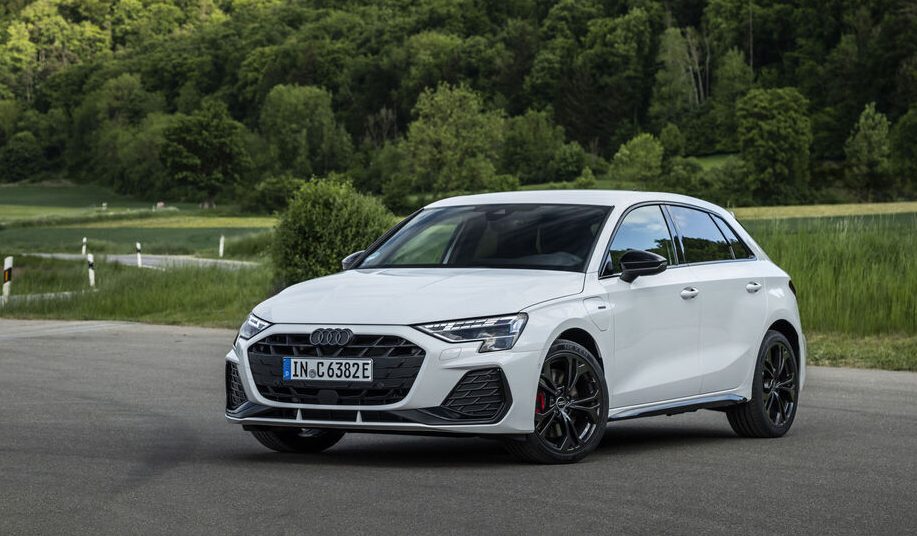
It’s hard to remember, but Audi has sold a few plug-in hybrids over the years. Then the brand went full-in on EVs. Now it’s retreating, and Audi of America President Vito Paladino told Automotive News that hybrids are going to happen again:
“We will have hybrids in our lineup,” Paladino told Automotive News at the introduction of the new Q9 crossover here. “We’re looking at which segments, which models do we need to further extend the offering.” Paladino didn’t specify which models Audi is targeting or which form of hybrid technology ― PHEVs or full hybrids ― are planned for the U.S.
That’s … something.
Rivian Earnings Were Better Than Forecast
David wrote the ultimate Rivian R2 review and came away mostly impressed. The introduction of the model appears to be paying off for Rivian, which saw better-than-expected returns in Q2.
Rivian Automotive Inc. reported better-than-expected earnings as it began deliveries of a new midsize sport-utility vehicle, a positive sign while the company contends with a weakened market for electric vehicles in the US. The adjusted loss before interest, taxes, depreciation and amortization was $379 million in the second quarter, down from a $667 million loss a year ago, Rivian said Thursday in a statement. The latest figure was smaller than the $548 million deficit anticipated on average in estimates compiled by Bloomberg. Its…

 点赞
点赞 收藏
收藏 点踩
点踩 分享
分享