Ask Ethan: What would “first life” see in their night sky?


We see our Universe as it is today: 13.8 billion years after the Big Bang. Because of how quickly and how long it’s been expanding and cooling, the Universe is now sparse, possessing less than 1 proton per cubic meter of normal matter on average. Dark matter and dark energy, not normal matter, dominate our Universe’s contents today, and the expansion rate is much lower, around 70 km/s/Mpc, than it was at earlier times. The cosmic microwave background, or the Big Bang’s leftover glow, is a mere 2.7 K, and although galaxies clump together in groups and clusters, the distance between various galactic groups and clusters is enormous: tens of millions of light-years, on average.
While most of what our naked eyes can see are stars and nebulae within our massive, heavily evolved Milky Way, with telescopes, we can see incredibly far into deep space. What would someone who came along long before humans did have seen? That’s the question of Sayan Banerjee, who wants to know what the earliest form of intelligent life to arise in the Universe would have seen, and how it would have been different from what we see today.
“In a hypothetical scenario where an intelligent being existed shortly after the Big Bang—perhaps on a planet, though I understand planets may not have formed for the first 1-2 billion years—how would their view of the night sky differ and evolve from what we see today?”
To understand that, let’s first try to understand when the Universe could have first made life, and then, if it grew to become intelligent, what it would see when it peered out at the cosmos.
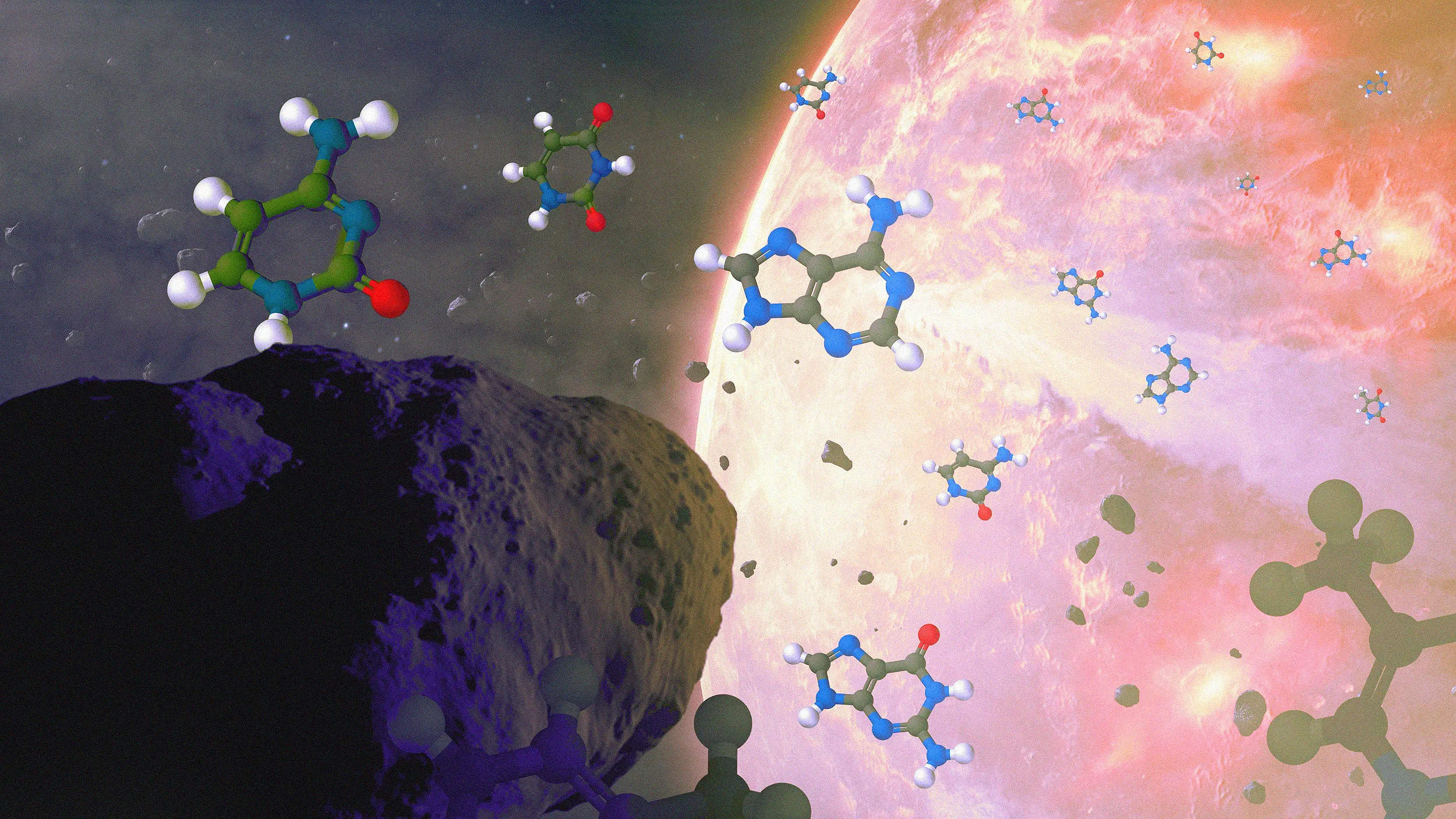
This conceptual image shows meteoroids delivering all five of the nucleobases found in life processes to ancient Earth. All the nucleobases used in life processes, A, C, G, T, and U, have now been found in meteorites, along with more than 80 species of amino acids as well: far more than the 22 that are known to be used in life processes here on Earth. Similar processes no doubt happened in stellar systems all throughout most galaxies over the course of cosmic history, bringing the raw ingredients for life to all sorts of young worlds. Credit: NASA Goddard/CI Lab/Dan Gallagher
In order to have life — or life as we know and understand it — you need a few ingredients. You need a star to provide a source of energy: one that’s stable enough over time and won’t vary in temperature too much or flare too excessively. You need a planet that has a solid, rocky surface, along with a sufficient amount of liquid water on that surface: something that requires a thin-but-substantial atmosphere. And you need a sufficient quantity of heavy elements in order to create a variety of complex molecules capable of binding together to create organic compounds that can metabolize nutrients and reproduce: generally understood as the bare minimum for life.
The Universe wasn’t born with those conditions, however. In the immediate aftermath of the hot Big Bang, there were no stars. There was also no carbon, no oxygen, no nitrogen, no phosphorus and more: none of the heavy elements needed to make rocky planets, liquid water, or complex molecules in general. In order for them to be created, we need stars to be born, live, and die in cataclysmic explosions: returning the heavy elements made inside to the greater Universe, where future generations of stars and star systems can form.
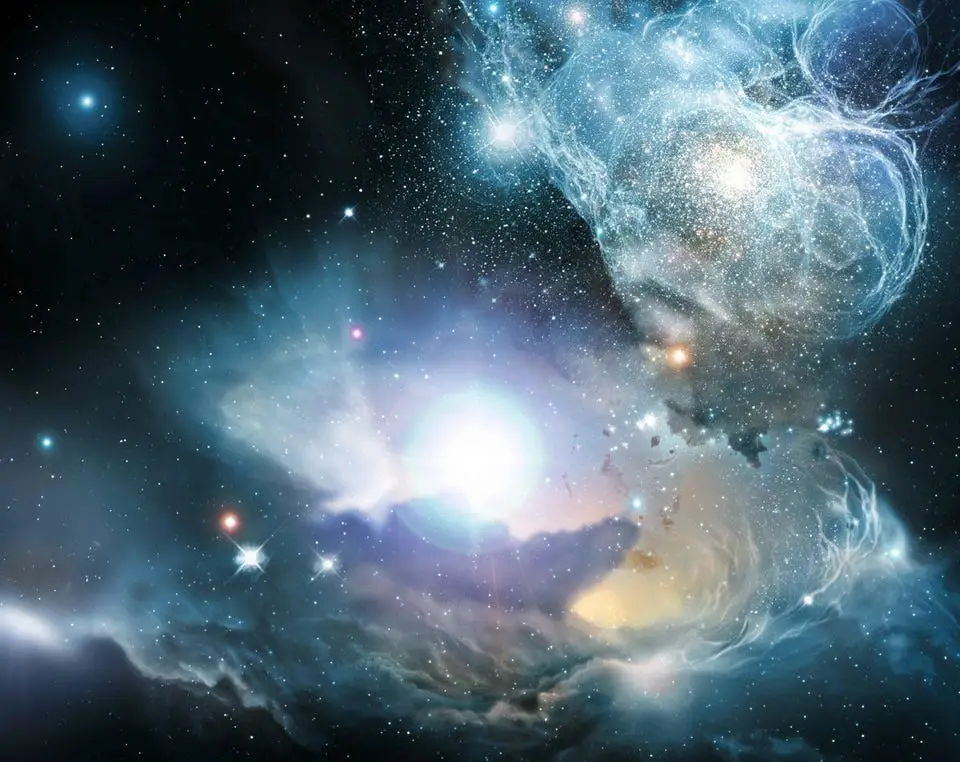
An artist’s conception of what the Universe might look like as it forms stars for the first time. As they shine and merge, radiation will be emitted, both electromagnetic and gravitational. The neutral atoms surrounding it get ionized, and get blown off, quenching (or ending) star formation and growth in that region. These stars will be short-lived, but their deaths will enrich the Universe with heavy elements, enabling the creation of more evolved, lower-mass, and eventually, planet-possessing star systems in their wake.
Credit: NASA/ESA/ESO/W. Freudling et al. (STECF)
One generation of stars that live-and-die is probably insufficient, however. In today’s exoplanet-rich Universe, we still only find rocky planets around stars with at least 1% of the heavy elements found in the Sun, and only typically find them when they have somewhere between 10%-25% of the Sun’s heavy elements. A single generation of stars that live-and-die might be sufficient to get the interstellar medium up to near 0.01% of the current value, but many generations — building up the fraction of heavy elements located in the interstellar medium — are required in order to enable the formation of rocky worlds.
In the densest environments in the young Universe, however, this process can occur very rapidly. The very first stars of all might form when the Universe is merely 30-100 million years old, and the earliest galaxies we can see, some 280 million years after the Big Bang, are already heavily evolved and enriched. By the time it’s around 800 million-1.1 billion years after the Big Bang, the interstellar medium in the most enriched galaxies has enough heavy elements that rocky planets can form around newborn stars. If conditions are right, life can arise almost immediately on those worlds.
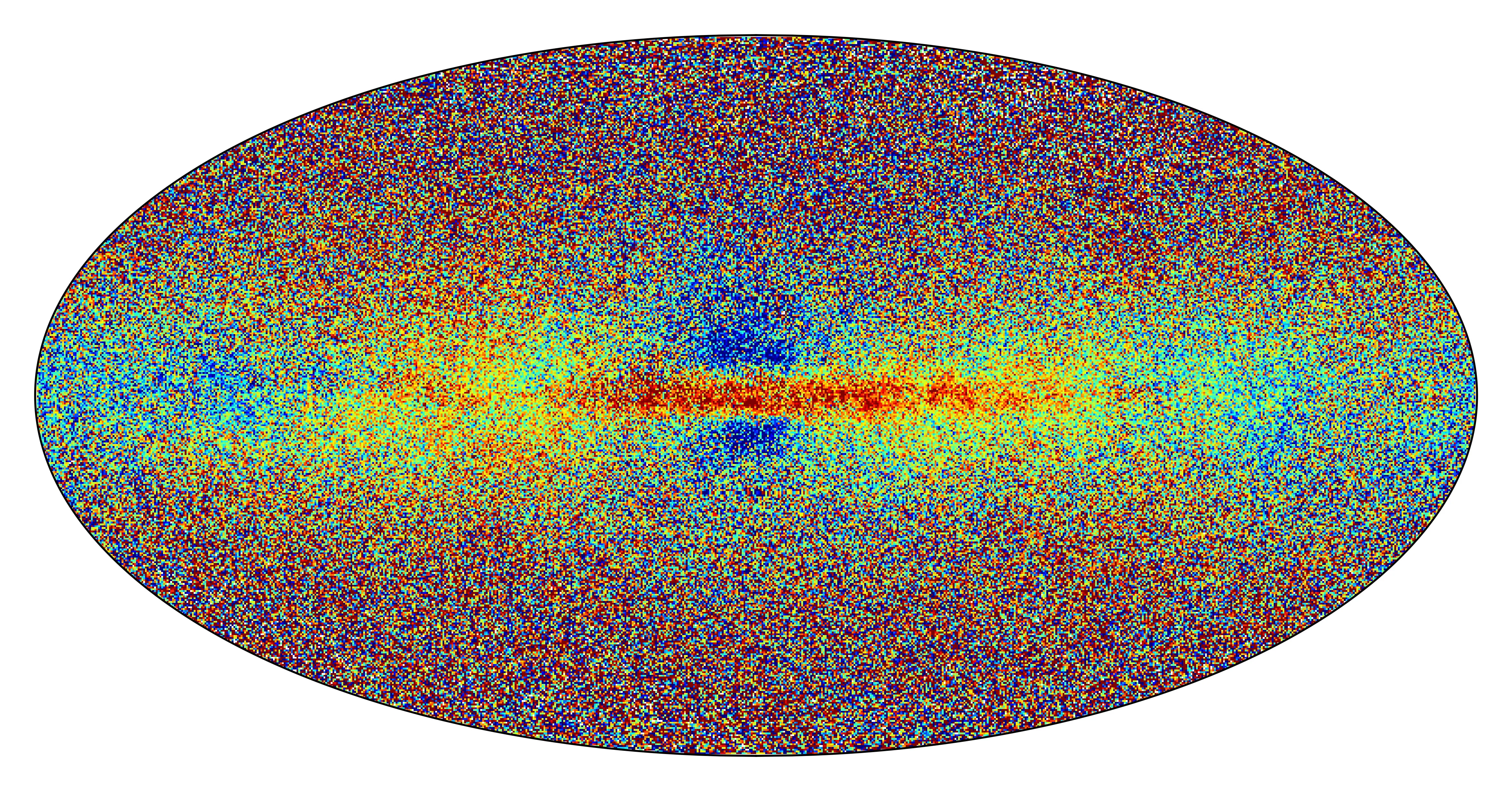
This color-coded map shows the heavy element abundances of more than 6 million stars within the Milky Way. Stars in red, orange, and yellow are all rich enough in heavy elements that they should have planets; green and cyan-coded stars should only rarely have planets, and stars coded blue or violet should have absolutely no planets at all around them. Just 1 billion years after the Big Bang, a significant number of stars with the right abundance of heavy elements to possess rocky planets around them should begin forming.
Credit: ESA/Gaia/DPAC; CC BY-SA 3.0 IGO
We can estimate, then, that the earliest forms of life can come into existence just 1 billion years after the hot Big Bang begins: a time where the Universe was just 7% of its present age. In order for intelligent life to arise, a significantly longer amount of time must pass: an amount of time that we cannot estimate just yet, as we only have one example — the example of our own planet — to draw from as far as information concerning “how long it takes, given the existence of life, for intelligent life to arise.” On our world, it took between 3.8 and 4.5 billion years for that process to occur; elsewhere in the Universe, it could have perhaps happened more swiftly.
Without even a second example of life, much less intelligent life, in the Universe, all we can do is speculate about how long that process is likely to take. If evolution proceeded more quickly and more efficiently on other worlds, perhaps it might even be possible for life to go from its simplest forms to the complex, differentiated, intelligent, and even tool-using macroscopic life we’re familiar with today in as little as 1-2 billion years. In the grand cosmic lottery of life, we don’t know:
- what the other prizes are,
- what the odds of winning each prize are,
- or whether humanity is even the grand prize.
Nevertheless, even with our profound ignorance, we can start from the assumption that life first arises 1 billion years after the Big Bang, and that intelligent life first arises 2 billion years after the Big Bang. Then from that assumption, we can begin considering the main question: what would those early life forms see in their night sky?
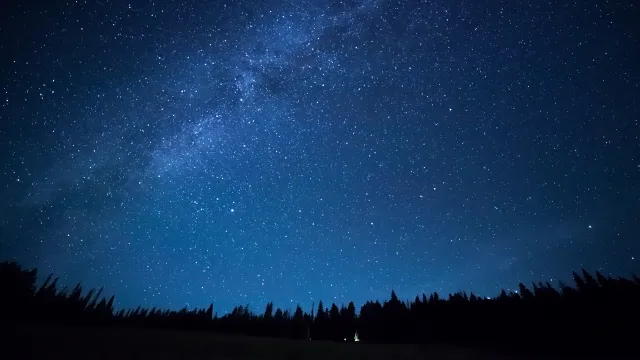
Under ideal dark sky conditions, the unaided human eye can see up to 6000 stars at once, and up to 9000 stars total if they could see the full sky at once, unblocked by the Earth itself. Much longer ago, when the star-formation rate was far greater and galaxies were much closer together, the night sky might have looked akin to what you see above: with many more stars, as well as some prominent spiral, elliptical, and irregular galaxies, illuminating the night sky on a moonless night.
Credit: callisto / Adobe Stock
Being a rocky planet that orbits around a luminous star, they’re very likely to have a night side to their…