From legacy workflows to AI-ready UX: why enterprise design needs more than a design system

From legacy workflows to AI-ready UX and why enterprise design needs more than a design system
Enterprise UX is evolving rapidly, yet most organizations are still attempting to modernize decade-old workflows with tools that only solve half the problem. A polished UI kit, a robust design system, or a newly integrated AI assistant will not magically fix a broken experience. If the underlying business logic remains fragmented, ambiguous, and reliant on unwritten rules, your modern stack will simply produce polished tech debt.
The core challenge for design leadership today is not aesthetic. It is structural. It requires dissecting legacy operational logic, capturing the institutional memory beneath it, and translating that context into system architectures that work seamlessly for both human operators and AI agents.
Legacy is not technical debt but institutional memory
Legacy software is routinely dismissed as obsolete clutter. But from a systems design perspective, these old architectures are living repositories of business rules, hard-fought compliance checks, and edge cases forged over years of real-world strain. They survive because they encode how work actually gets done, including the manual workarounds, audit trails, and approvals that never made it into a formal PRD.
Modernization does not mean burning down that institutional knowledge. The most effective enterprise design strategy respects existing operational mechanics. The goal is not to erase complexity, but to audit it, distinguishing between essential domain logic and accidental operational friction. A senior design leader looks at a legacy workflow and identifies where the software is forcing users to memorize system behaviors instead of designing the interface to handle those behaviors inherently.
Modernization is workflow engineering
A modern interface layered on top of an outdated process is still an outdated product. Visual refreshes cannot cure deep-seated operational flaws like redundant data entry, ambiguous object ownership, unhandled error states, or inconsistent decision trees.
Good enterprise UX is fundamentally about reducing cognitive and operational load. That requires asking rigorous questions about how data and decisions move through a pipeline:
• Where do users routinely lose momentum or duplicate effort?
• Which edge cases break the happy path, and why are they handled poorly?
• Which steps are legally mandated, and which are merely legacy habits?
When design leadership interrogates these mechanics, UX ceases to be a cosmetic wrapper and becomes a driver of system architecture.
Components are nouns. Workflows need verbs.
This is precisely where AI tools break down in enterprise environments. You can feed an LLM your design system, your component tokens, and your UI library, and it will still output disjointed, unshippable UI.
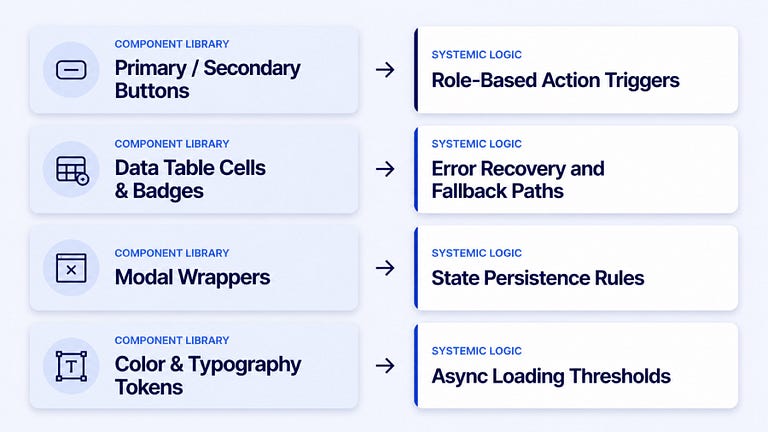
Why? Because a design system gives AI a list of nouns: buttons, modals, tables, badges. It fails to supply the verbs. A component library cannot tell an AI agent:
• How navigation hierarchy should adapt to specific user roles or permission levels
• Which spacing parameters are rigid layout boundaries versus flexible containers
• How a dense telemetry dashboard should degrade gracefully during network latency or data loss
• Why a primary action in an audit workflow requires two-step confirmation while a standard view draft does not
These systemic rules, UX patterns, and edge-case behaviors rarely exist inside Figma components. They live in unrecorded design reviews, buried Slack threads, or the implicit mental models of senior staff. When AI lacks this connective tissue, it guesses. And it guesses inconsistently every time.
The systemic gap
Missing context produces inconsistent AI output, every time.
Encoding intent: DESIGN.md
To bridge this gap, enterprise teams must treat design intent as machine-readable infrastructure. One of the most effective ways to achieve this is through a version-controlled DESIGN.md file maintained directly alongside the code base.
A structured DESIGN.md unifies two distinct layers of truth:
1. Machine-readable tokens. Direct values for layout spacing, color semantic usage, elevation, and typography scales.
2. Behavioral heuristics. Clear, programmatic rules defining how components interact, how state transitions behave, and how layout systems respond when an edge case strays from the happy path.
A design system documents what was built. A DESIGN.md documents how the system thinks.
For AI-assisted engineering workflows (using tools like Cursor, Claude, or custom MCP servers), this markdown-driven context is transformative. It provides an accessible, lightweight source of truth that feeds directly into LLM context windows, eliminating handoff guesswork and ensuring AI agents generate code that adheres to your architecture’s core operational logic.
Pattern consistency and semantic microcopy
A robust contextual framework must govern both interaction patterns and interface language.
Interaction patterns. Enterprise platforms repeat core workflows hundreds of times. A table-to-modal selection pattern, a batch-action confirmation, or an inline error state must behave identically across every module. Reinventing core interaction models across different feature teams creates cognitive fatigue and increases error rates.
Semantic microcopy. Interface terminology dictates user trust. In complex or regulated software, labeling an action “Submit” instead of “Confirm & Log” isn’t a stylistic preference. It’s a clarity issue. Language is a foundational layer of the system architecture, not a final coat of paint.
Context engineering over screen-level iteration
The most common mistake in modern software design is jumping directly into high-fidelity UI generation before establishing the underlying logic.
Two teams using identical AI tools, identical design tokens, and identical component libraries will produce wildly different outcomes based on the quality of their upstream thinking. AI can instantly synthesize UI elements, but it cannot infer business domain rules, user constraints, or safety tolerances.
The primary responsibility of enterprise design leadership is no longer pushing pixels or managing component inventories. It is system legibility: the discipline of mapping legacy logic, formalizing edge-case behavior, and translating complex domain constraints into clear, machine-readable guidelines that empower human developers and AI agents alike.
Your component library documents what you built. Your DESIGN.md documents how your system behaves. Your context engineering determines whether legacy complexity remains technical debt, or becomes the foundation for a modern, fault-tolerant platform.
Hi I’m Cristina, Design Leader based in Copenhagen. I write about creative leadership, design culture, and the moments that shape us as professionals especially the quiet ones that build confidence and clarity. My work bridges UX, brand, and strategy across digital products. Forever learning, mentoring, and helping designers find their voice in rooms built for noise.
From legacy workflows to AI-ready UX: why enterprise design needs more than a design system was originally published in Bootcamp on Medium, where people are continuing the conversation by highlighting and responding to this story.

 点赞
点赞 收藏
收藏 点踩
点踩 分享
分享