Trump Turns Up the Heat on RFK Jr. to Cut Back Childhood Vaccines

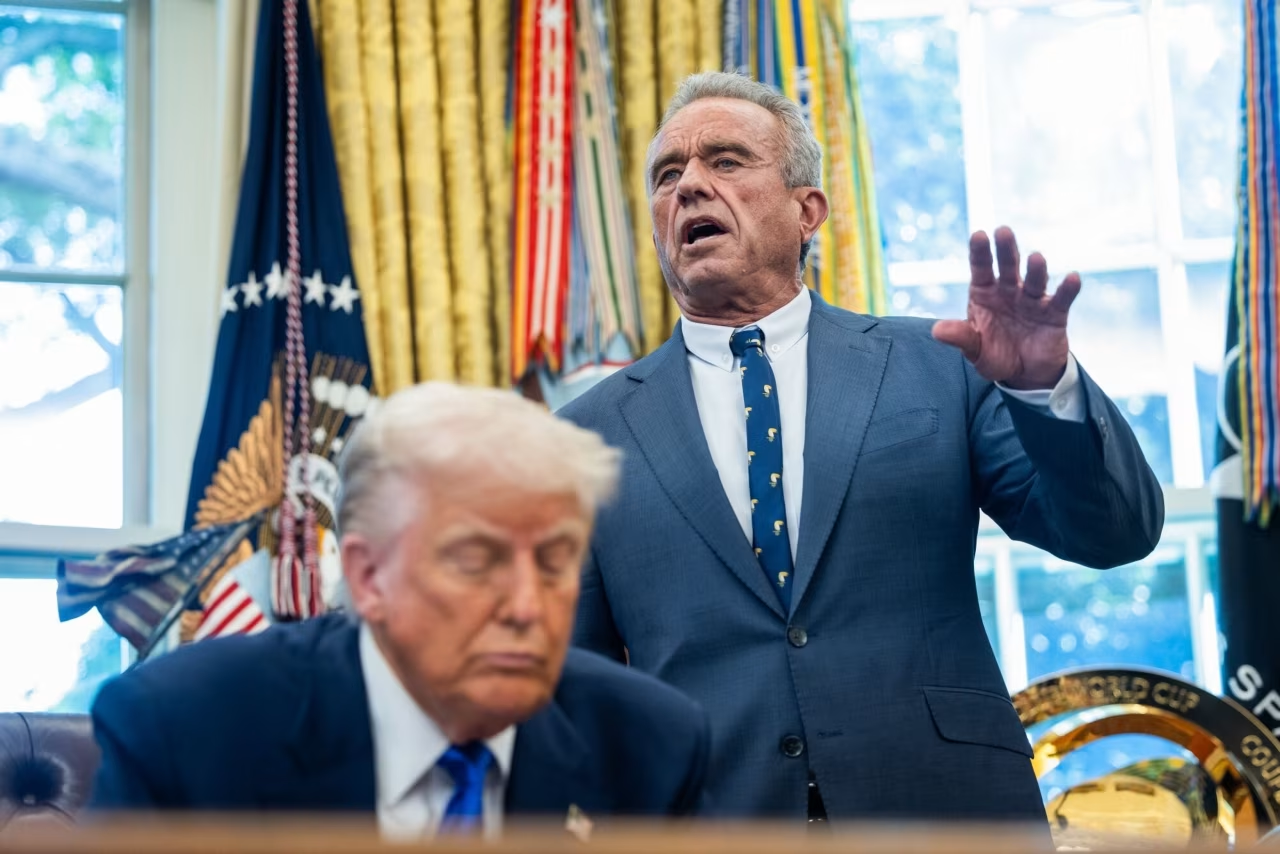
WASHINGTON—At a May lunch at the president’s golf course in northern Virginia, President Trump asked Health and Human Services Secretary Robert F. Kennedy Jr., why he wasn’t doing more to probe the alleged connection between vaccines and autism, according to people familiar with the matter. The health secretary had the yips, Trump told Kennedy, according to one of the people.
Kennedy was taken aback. Even though he has long been known to be skeptical of vaccinations, he had been asked by White House political advisers to tone down his vaccine efforts ahead of the midterms, the people said.
Now, it was the commander in chief who was pushing to make the study of vaccines and autism more of a priority. The president steers nearly every conversation with his health secretary back to the issue, some of the people said.
Chief among the president’s desires: Do more to reduce the number of shots that federal guidelines recommend for children, according to people familiar with the matter. They said the president hopes to then see autism rates drop, even if any such effect could take years.
The issue has been an ongoing point of tension between the two men. In a mid-June meeting in the Oval Office, the president vented to Kennedy that he wasn’t doing enough, people familiar with the matter said.
The president has made clear he thinks he has given Kennedy enough time and is disappointed the health secretary hasn’t accomplished more in the past year and a half, the people said.
Kennedy will be a failure if he doesn’t make progress on the issue, the president has told aides, some of the people said.
Trump signed an executive order at the end of May demanding Kennedy’s agency cut back the number of recommended vaccines in the childhood schedule, saying the U.S. was out of step with other nations. Some top health officials were confused and surprised by the order, because they were following an earlier message from the White House to ease up on their vaccine efforts.
The president has expressed frustration over a court decision that blocked cuts to the vaccine schedule that the health secretary tried to implement in January, the people said. Trump has urged Kennedy to take on what they both consider to be an activist judge in the case—prompting Kennedy in June to petition an appeals court for a quicker decision.
White House spokesman Kush Desai said countless parents with questions and concerns about “America’s skyrocketing autism rates have long been ignored if not mocked.” He said that changed the day President Trump took office. “The Trump administration is committed to leaving no stone unturned to finally address these concerns with Gold Standard Science,” he said.
“Secretary Kennedy and President Trump are aligned in their commitment to confronting the chronic disease epidemic affecting America’s children through rigorous, gold-standard science,” said HHS spokeswoman Emily Hilliard.
Trump has long mused publicly and privately about whether vaccines cause autism, despite reassurances from scientific advisers in his first term that they don’t and the widespread conclusion among scientists that there is no valid reason for concern.
Scientists in mainstream academic settings also say there is no scientific justification for dramatically paring down the childhood vaccine schedule. They say vaccines today are more precise and stimulate the immune system with fewer antigens than vaccines in the past while protecting against more diseases.
Trump has talked about his particular interest in the vaccine for measles, mumps and rubella, known as MMR. He has said he would like to break up the combination shot into separate shots, though scientists have said there is no scientific reason to do that and that it could result in missed shots. Multiple scientific studies have shown no connection between the MMR vaccine and autism, including a 2019 Annals of Internal Medicine study of more than 600,000 children in Denmark and a 2021 Cochrane review of 138 studies.
Autism is a neurodevelopmental disorder that affected roughly 1 in 31 8-year-olds in the U.S. in 2022. Estimates from the Centers for Disease Control and Prevention give the number of children identified with autism spectrum disorder in 2000 as about 1 in 150. Scientists have yet to pinpoint a definitive cause for the rise in rates. Some have suggested that genetics, older parents or better screening and diagnosis systems are likely behind the rise in cases.
The president now hopes alleviating autism could be part of his legacy, people familiar with the matter said. He has told his health secretary that doing so should be Kennedy’s most important health policy priority, other people familiar with the matter said.
The president is generally supportive of vaccines for adults, including Covid and flu shots, which he received last fall. He often complained in past years that he didn’t receive enough credit for his first administration’s effort to boost Covid vaccine development, Operation Warp Speed. But he has remained skeptical of childhood shots.
In the 2000s, Trump gave to and fundraised for autism nonprofits that linked the condition to vaccines. “If I were President I would push for proper vaccinations but would not allow one time massive shots that a small child cannot take – AUTISM,” he posted on social media in 2014.
Ahead of his first term in office, Trump met with Kennedy at Trump Tower, and Kennedy emerged to tell reporters that the president-elect intended to appoint him to lead a commission on vaccines—an effort that didn’t happen.
Trump has said an unnamed friend’s child became autistic after receiving a vaccine and that he knows three people whose children had adverse reactions to vaccines, sometimes becoming emotional about the topic, people familiar with the matter said.
“I really believe Donald Trump cares about this vaccine issue,” said Del Bigtree, a prominent antivaccine activist who ran communications for Kennedy’s independent presidential bid. “I think he’s seen it hit close to home in some way.”
The president has indicated that he is open to the idea that the rise in autism rates may have multiple causes. In September, Trump and Kennedy warned the public about what the men said was a potential link between autism and Tylenol taken during pregnancy.
Behind the scenes, Kennedy had been promising he would deliver an answer on autism. When a new study on Tylenol by one of Harvard’s top public health researchers was released, he saw it as something that could be presented to the president, according to people familiar with the matter.
“Ideally, you don’t take it at all,” Trump said of Tylenol at the press conference. He also encouraged parents to space out vaccines and complained about doctors’ visits in which “they pump the baby, load it up with stuff.”
“I’ve been so into this issue for so many years,” he said.
Prior to the event, Trump’s health advisers had tried to persuade him to moderate his statements on Tylenol, people familiar with the matter said, and they were much more cautious in their language. “The association is an ongoing area of scientific debate and clinicians should be aware of the issue in their clinical decision-making,” then-Commissioner of the Food and Drug Administration, Dr. Marty Makary, said in a letter to physicians.
Longtime Trump pollster Tony Fabrizio last winter found that vaccine skepticism was unpopular with voters, while people were more interested in Kennedy’s efforts to improve the quality of food and agriculture. In June, another survey showed more than 80% of adults said they trust health information from their own doctors while only 34% said they trusted it from Kennedy, according to health research nonprofit KFF.
White House and Health department aides recommended Kennedy focus instead on more appealing topics, such as removing dyes from food, ahead of the midterm elections.
Kennedy and his staff got on board with the new focus, with top adviser Calley Means…

 点赞
点赞 收藏
收藏 点踩
点踩 分享
分享