The 20 biggest cosmic discoveries of the last 20 decades


It’s hard to fathom just how far we’ve come in our understanding of the Universe over the past 200 years. Back in the early 1800s, we didn’t even know how far away the stars were, what they were made of, or how they worked. We didn’t know what the Universe was, how big it was, or even what the laws were that governed it. We were up to seven planets in the Solar System, with Uranus being discovered in 1781, and had uncovered several asteroids: objects in between the orbits of Mars and Jupiter. We didn’t know the nature of the Milky Way, or whether there was anything at all beyond it. And we didn’t know if the Universe was infinite and eternal, or finite across either space or time.
All of those things have changed and more. Today, we not only know how stars and galaxies work, but can retrace our cosmic history back billions of years: to the Big Bang and even the inflationary period that came before it. We know not only of the matter that we ourselves are made out of, but also radiation, neutrinos, plasma, dark matter, and even dark energy. We see the Universe not only in visible light, but in wavelengths beyond what our eyes can see, as well as in particles and gravitational waves, too. Although these scientific advances have occurred through slow and careful research, there are giant leaps we’ve taken as well.
From 200 years ago until today, here are 20 great achievements and discoveries from the past 20 years that have truly opened up the Universe to humanity.
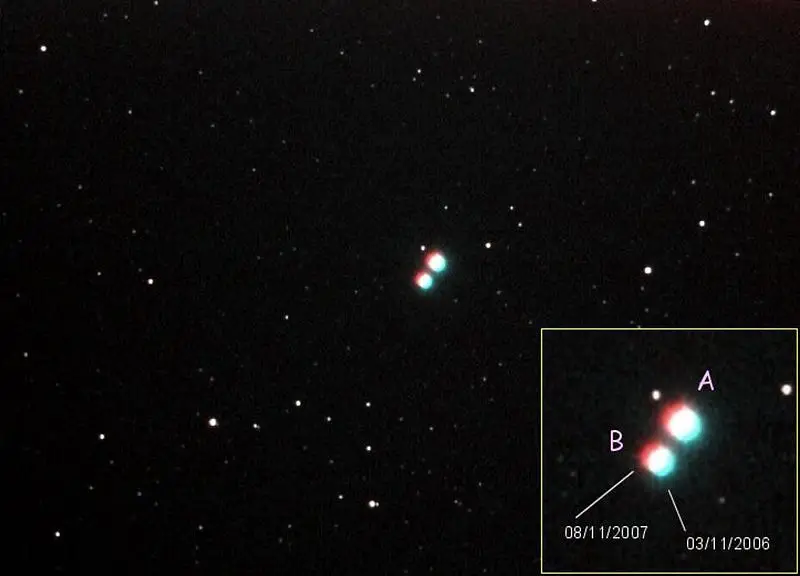
61 Cygni was the first star to have its parallax measured and published (back in 1838), but also is a difficult case due to its large proper motion. These two images, stacked in red and blue and taken almost exactly one year apart, show this binary star system’s fantastic speed. If you want to measure the parallax of an object to extreme accuracy, you’ll make your two ‘binocular’ measurements simultaneously, to avoid the effect of the star’s motion through the galaxy. Gaia is exceptionally good at characterizing the orbits of nearby stars with small separations from their companion, but faces more challenges with more distant, wider binary systems. Credit: Lorenzo2/Astrofili forums
1830s: Parallax is discovered. If the Earth truly orbited around the Sun, then it should be possible to see the closest stars shift their apparent positions relative to the more distant background stars as the Earth changes its relative position by up to 300 million km over a calendar year. After centuries of not being able to see a parallax at all, Friedrich Bessel finally does it: for the star 61 Cygni in 1838. We later learn that Thomas Henderson observed Alpha Centauri in 1832-1833 and saw a parallax, but was too afraid to publish his findings until after Bessel did so, with Henderson only publishing his results in 1839. The Earth truly does orbit around the Sun.
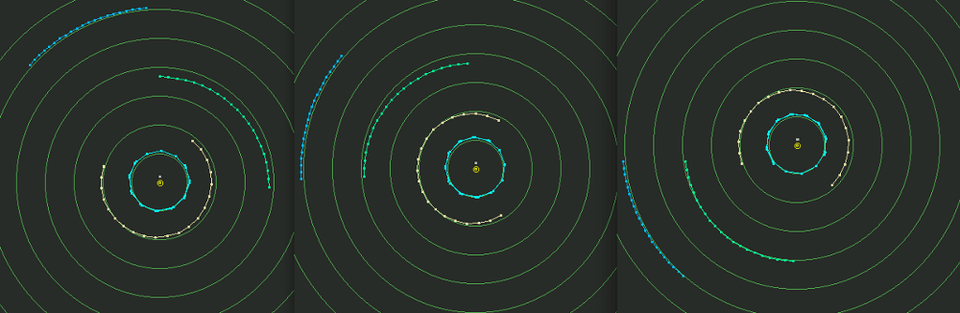
1840s: Neptune is discovered. With a seventh planet to test Kepler’s laws against, astronomers noticed a major anomaly: it appears to violate Kepler’s 2nd law. Instead of making an ellipse that “sweeps out equal areas in equal times,” it first moves too fast, then goes at the right speed, and then moves too slowly. Several theorists explore the idea that a more distant, eighth planet is gravitationally tugging on Uranus, but Urbain Le Verrier gets it right and sends his predictions to the Berlin observatory, where Johann Galle and Heinrich d’Arrest discover Neptune the same night the letter arrives: September 23, 1846. It is the first-ever discovery of matter through its gravitational effects alone: “dark matter.”
For decades, Uranus was observed to move too quickly (left), then at the correct speed (center), and then too slowly (right). This would be explained within Newton’s theory of gravitation if there were an additional, outer, massive world tugging on Uranus. In this visualization, Neptune is in blue, Uranus in green, with Jupiter and Saturn in cyan and orange, respectively. Credit: Michael Richmond/Rochester Institute of Technology
1850s: the Carrington Event occurs. Arguably the most important event in the history of solar astronomy and heliophysics, astronomer Richard Carrington was tracking a large, irregular sunspot when it suddenly made a “white light flare,” with unprecedented brightness, that lasted about 5 minutes. 17 hours later, the largest geomagnetic storm ever recorded on Earth occurred, with aurorae coming down to the equator, and early electrified systems (like telegraphs) activated and caught fire: the first electrical grid disruption. Solar astronomy has advanced tremendously since then, but a Carrington-like event today would be a multi-trillion dollar disaster. We have, frighteningly, put no substantive countermeasures in place at all.
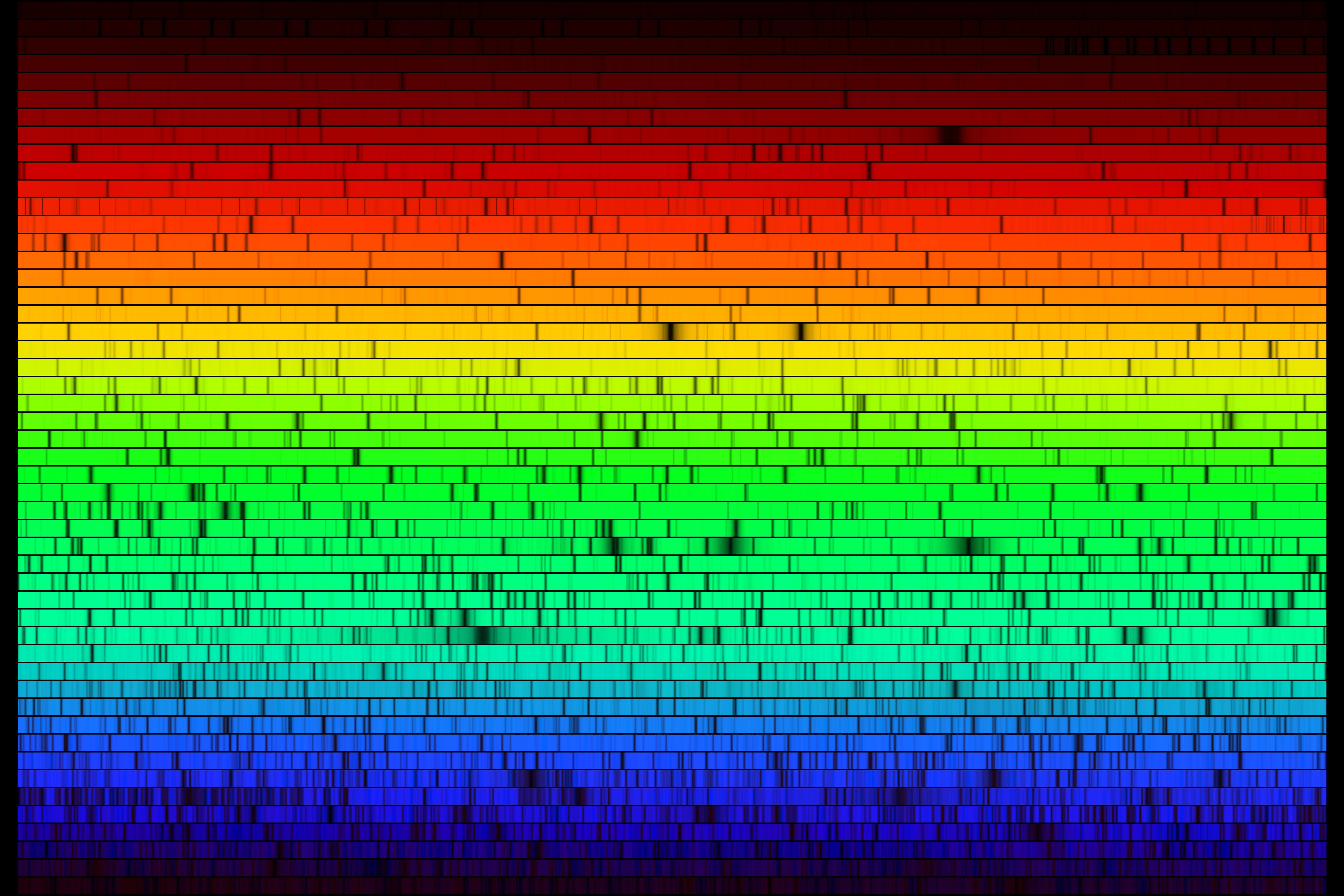
1860s: spectroscopy enables the discovery of helium. In the early 1860s, astronomer William Huggins applied the technique of spectroscopy to starlight for the first time: splitting light into its component wavelengths. Just a few years later, in 1868, astronomers Pierre Janssen and Norman Lockyer detect an unknown spectral line in the Sun’s atmosphere: the first detection of helium, discovered in space before it was isolated here on Earth. (The first time this would occur for any element.) Today, spectroscopy is used to identify all sorts of atomic, ionic, and molecular fingerprints, but the 1860s marked the first time it was ever used for cosmic purposes, and with profound results.
The visible light spectrum of the Sun, which helps us understand not only its temperature and ionization, but the abundances of the elements present. The long, thick lines are hydrogen and helium, but every other line is from a heavy element that must have been created in a previous-generation star, rather than the hot Big Bang. Credit: N.A.Sharp, NOAO/NSO/Kitt Peak FTS/AURA/NSF
1870s: stellar classification is pioneered. Although today we understand the complex relationship between a star’s color and temperature, as well as the relationship between spectral lines, composition, and ionization, it was a long, slow process that took us several decades before we settled on our modern scheme of it. But stellar classification began in the 1870s with the work of Angelo Secchi. Secchi created the foundational four classes:
- I: of white and blue stars with thick hydrogen lines,
- II: of yellow stars with prominent metal lines,
- III and IV: orange, red, and carbon-rich stars,
dividing stars into classes based on measurable properties like color and spectra line prominence. Astronomer Hermann Vogel would shortly thereafter unify two of Secchi’s classes and subdivided categories to track fine differences in lines, also in the 1870s: the birth of stellar classification.
1880s: nebular and galactic astrophotography begins. Although photography had been around for decades, and the first photograph of stars was taken way back in the 1850s, it was the combination of telescopes and cameras that first began revealing structures in deep-sky objects too faint for the human eye to detect. Representing a huge improvement in the amount of detail that we were aware of in the Orion Nebula and, most spectacularly, the Andromeda nebula (now the Andromeda galaxy, including the discovery of its spiral arms), it set the stage for all of modern long-exposure astronomy, from photographic plates to today’s modern digital images.
This 1888 image of the Andromeda Galaxy, by Isaac Roberts, is the first astronomical photograph ever taken of another galaxy. It was taken without any photometric filters, and hence all the light of different wavelengths is summed together. Every star that’s part of the Andromeda galaxy has not moved by a perceptible amount since 1888, a remarkable demonstration of how far away other galaxies truly are. Although Andromeda is a naked-eye object under even modestly dark skies, it was not recorded until the year 964, and was not shown to be extragalactic until 1923. Credit: Isaac Roberts
1890s: the discovery of the Lor…. Arguably the most important step on the road to relativity, the Lorentz transformations brought the earlier concept of the invariance of the speed of light (from Maxwell’s equations), the null results of the Michelson-Morley experiment, and the concept of length contraction (from FitzGerald) together, predicting time dilation for the first time and correctly detailing how velocities sum together when close to the speed of light: in defiance of Newton’s laws. This would pave the way for Einstein’s development of first special relativity and then general relativity, which would lead to our modern picture of reality in the 20th century.