Bowling alone, yes. But watching sports is another thing.

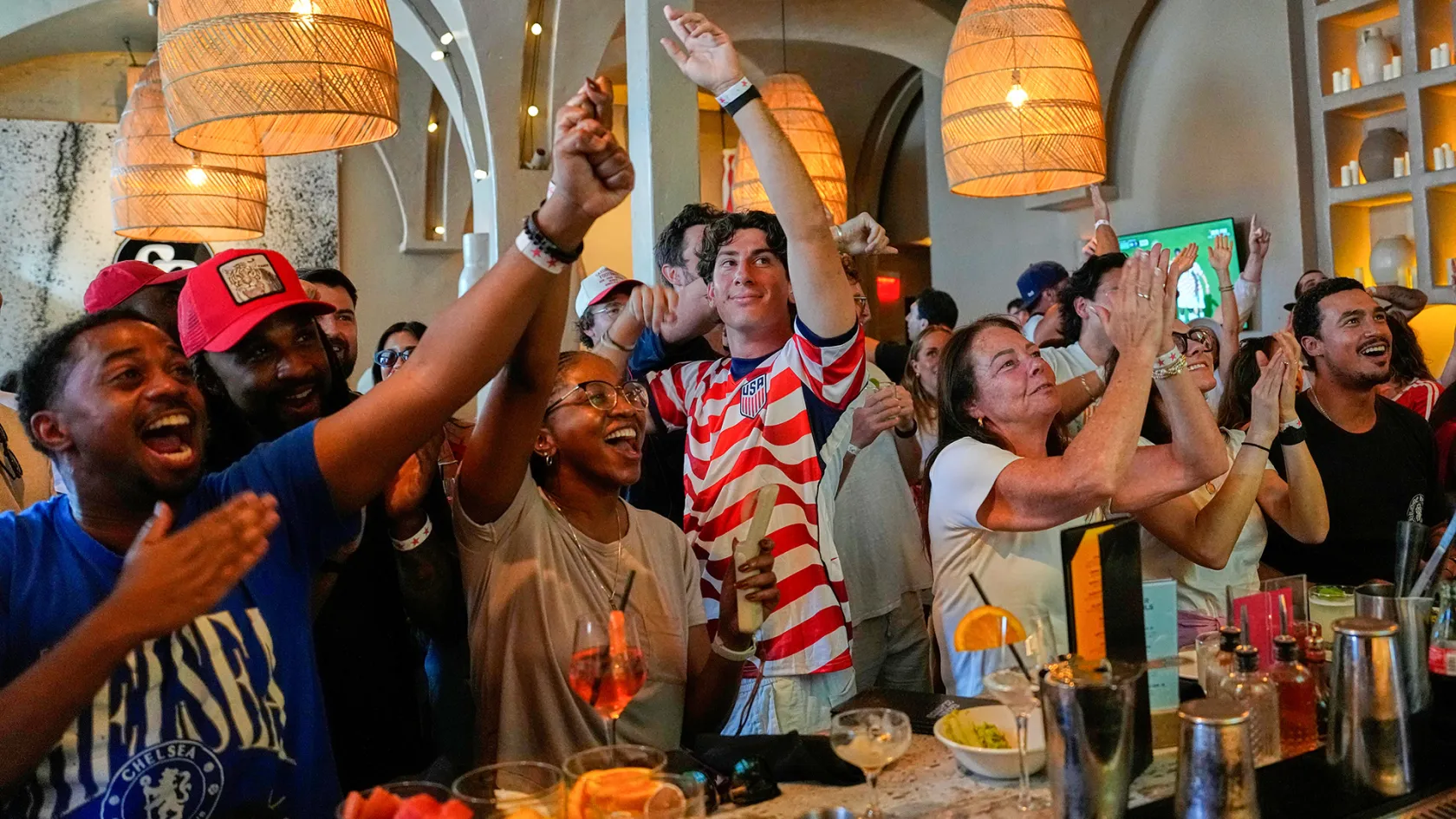
Soccer fans gather in a Los Angeles bar to watch the July 1 World Cup match between the U.S. and Bosnia.
AP Photo/Andre Penner
Bowling alone, yes. But watching sports is another thing.
Max Larkin
Harvard Staff Writer
July 15, 2026
7 min read
Kennedy School team says shared fandom has promise as undervalued social ‘medicine’ for division, isolation
The state of the American social fabric — enormous, diverse, and rent by stark partisan divides — is daunting enough that it can be hard to think about, let alone try to mend.
At the Harvard Kennedy School, two social scientists are advancing the proposition that sports fandom, a powerful social phenomenon and force, may have a role to play in improving lives and strengthening societies.
That proposition is probably controversial. It’s certainly underexplored.
So a new project, launched by Professor Todd Rogers and doctoral student Audrey Feldman aims to fill the gap, with its first wave of findings set to publish in the months ahead.
Leaving aside the billion-dollar business, fandom is an undeniable social fact. In the U.S., nearly three-quarters of people say they follow a pro sports team, and the majority of those consider their fandom to be an important part of their identity.
(And on the week of the World Cup final, it’s noteworthy that 51 percent of people globally are fans of soccer alone. Americans are a bit less ardent (27 percent), but 40 percent planned to watch at least some of the games.)
Yet Rogers, Weatherhead professor of public policy at HKS, and Feldman have found that sports receive remarkably little scholarly attention. In top journals across the social sciences, only about 1 in 800 articles concerned sports.
The Fandom and Social Connection Initiative aims to change that.
Backed by a gift from FOX Sports and seeking partners among professional sports leagues, Rogers and Feldman have embraced the work as both an…

 点赞
点赞 收藏
收藏 点踩
点踩 分享
分享