A Force From The Milky Way May Have Shaped The Continents on Earth

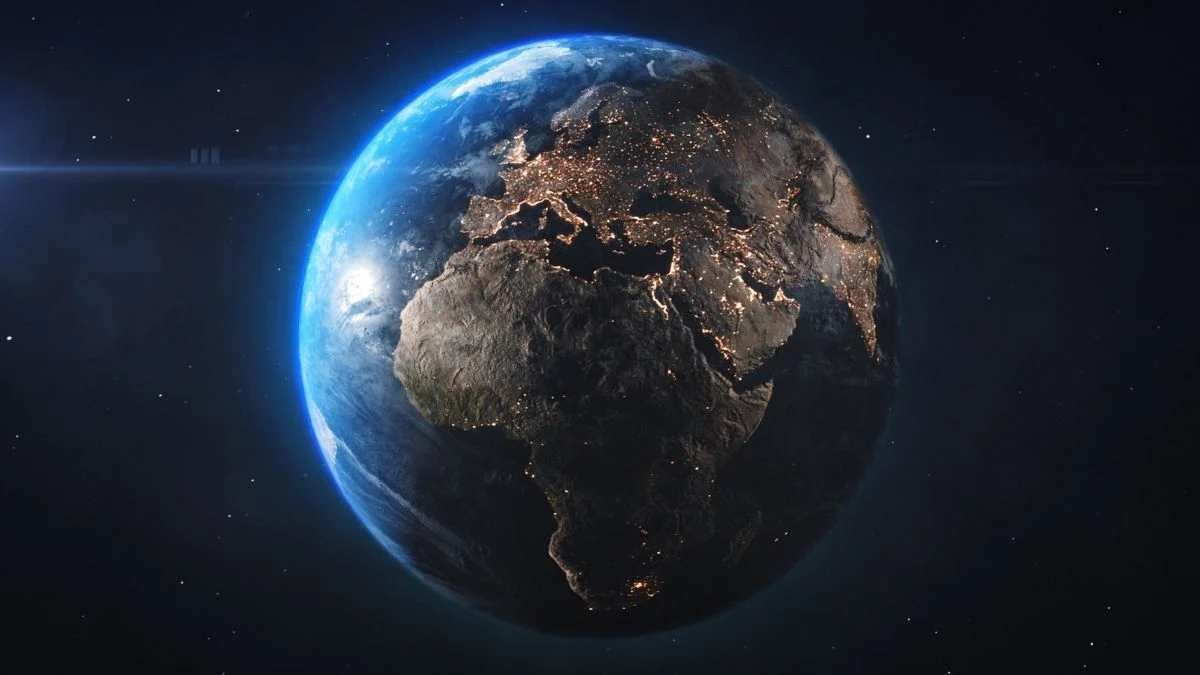
(fotograzia/Moment/Getty Images)
In the beginning, there was moosh.
At the dawn of the Solar System, young Earth was little more than a squishy ball of half-molten rock. Somehow, over hundreds of millions of years, parts of that rocky soup thickened into the first continents – the foundations of every landscape we know today.
Most scientists think the answer lies entirely beneath our feet, in the restless geology of our own planet.
But according to a team led by geologist Chris Kirkland of Curtin University in Australia, Earth may not have worked alone.
They argue that the growth of the continents was influenced by something far bigger: the Solar System's long journey through the Milky Way's spiral arms.
It's an audacious idea – but one the researchers say is etched in some of Earth's oldest minerals, tiny crystals of zircon that formed billions of years ago.
"Geology has perhaps drawn the boundary around the Earth system too tightly," Kirkland told ScienceAlert.
"The real question is not whether Earth is connected to the wider galaxy, but whether those connections left a geological signal strong enough for us to detect."
Earth's history did not unfold in a vacuum.
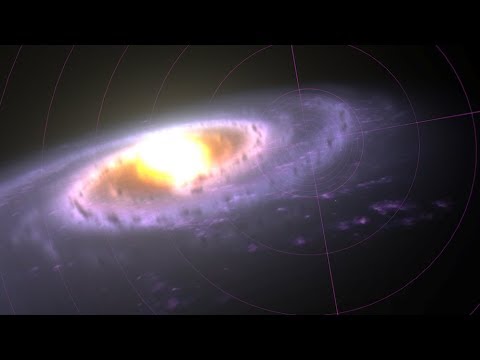
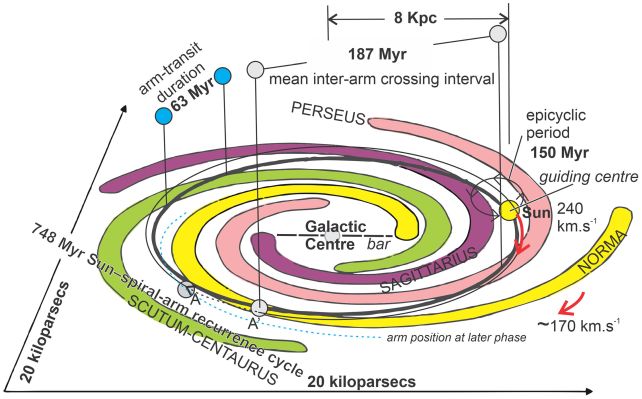
As the Solar System orbits the center of the Milky Way every 250 million years or so, it repeatedly passes through the galaxy's slower-moving spiral arms roughly every 150 to 200 million years – denser galactic structures where gas and dust accumulate, and new stars are born.
Those encounters may not have left Earth unscathed.
The Solar System is surrounded by the Oort Cloud, a vast spherical shell of icy bodies extending thousands of times farther from the Sun than Pluto. Many of the Solar System's long-period comets are thought to originate there.
A diagram of the Sun's journey around the center of the Milky Way. (Kirkland et al., Earth Planet. Sci. Lett., 2026)
As the Solar System moves through the galaxy's spiral arms, gravitational interactions could dislodge Oort Cloud objects and send them…

 点赞
点赞 收藏
收藏 点踩
点踩 分享
分享