Ask Ethan: Should we stop worrying about vacuum decay?

When we gaze out into the abyss of space, it seems like the most peaceful, serene of sights. Night after night, the planets and our Moon migrate predictably — like clockwork — while the stars, the Milky Way, and even extragalactic objects hardly change at all over time. Sure, there are occasional cataclysms, including stars that die and new lights that briefly appear before fading away, as the shining stars burn through their fuel, evolve, and sometimes even interact. But space itself, although it’s expanding, seems like it’s the most stable thing of all: the “stage” upon which the play of the Universe unfolds.
Things seem safe for us for two major reasons: everything that we know of that’s potentially dangerous is very, very far away, and that signals, even greatly energetic ones with the potential to cause harm, can only propagate at the speed of light. That doesn’t just include neutrinos, high-energy radiation, and the blast waves from events like supernovae, but potentially the greatest catastrophe of all: vacuum decay. Decaying from a false vacuum state of the Universe to a lower-energy state would be a world-ending (and more) catastrophe: one that we wouldn’t even see coming until it, and its consequences, arrived. For that reason, should we stop worrying about it entirely? That’s what Yair Givoni wants to know, writing in to ask:
“If a false vacuum decay bubble formed out there, outside of the observable Universe, and this bubble propagates no faster than the speed of light, it will never reach us. So why worry?”
Although it’s up to each individual to decide what is and isn’t worth worrying about, you asked me, and I think there are plenty of good reasons to not only worry, but to think about solutions to what might become the biggest problem we’d ever encounter. Here’s why.
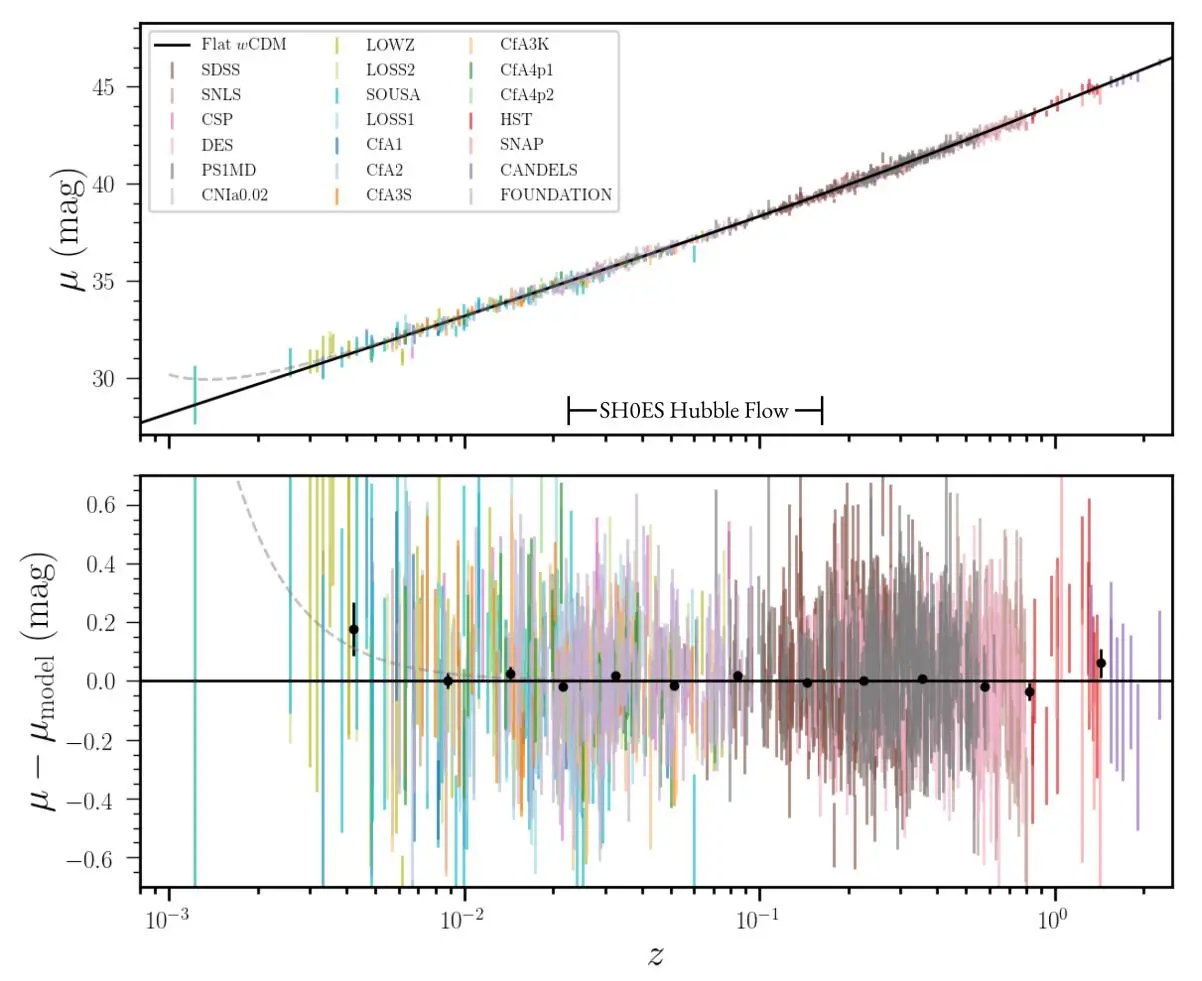
This graph shows the 1550 supernovae that are a part of the Pantheon+ analysis, plotted as a function of magnitude versus redshift. The supernova data, for many decades now (ever since 1998), has pointed toward a Universe that expands in a particular fashion that requires something beyond matter, radiation, and/or spatial curvature: a new form of energy that drives the expansion, known as dark energy. The supernovae all fall along the line that our standard cosmological model predicts, with even the highest-redshift, most far-flung Type Ia supernovae adhering to this simple relation. The slight, upward curve to the graph beginning above a redshift of z = 0.2 provides strong evidence for dark energy.Credit: D. Brout et al./Pantheon+, Astrophysical Journal, 2022
Back in the 20th century, one of the major goals of cosmology was to determine — once and for all — what the Universe itself was actually made of. We knew that matter and radiation were part of the story: the part that includes us. We knew that there was some type of dark matter out there, and far too much of it, from its gravitational effects, to just be “normal matter” that’s dark and non-luminous. We knew that neutrinos were out there, but were far too low in mass, as well as far too fast-moving in the early Universe, to account for what we saw.
Then, in the 1990s, the first strong evidence began to come in, from exploding stars located hundreds of millions or even billions of light-years away, that supported a picture of the Universe that didn’t just have dark matter within it, but a new form of energy that caused the expansion of the Universe to accelerate rather than slow down: dark energy. This dark energy, nearly 30 years after its initial discovery, remains consistent (despite tensions suggested by the latest large-scale structure data ) with a cosmological constant: a constant, positive, non-zero form of energy, uniformly inherent to space itself at all locations.
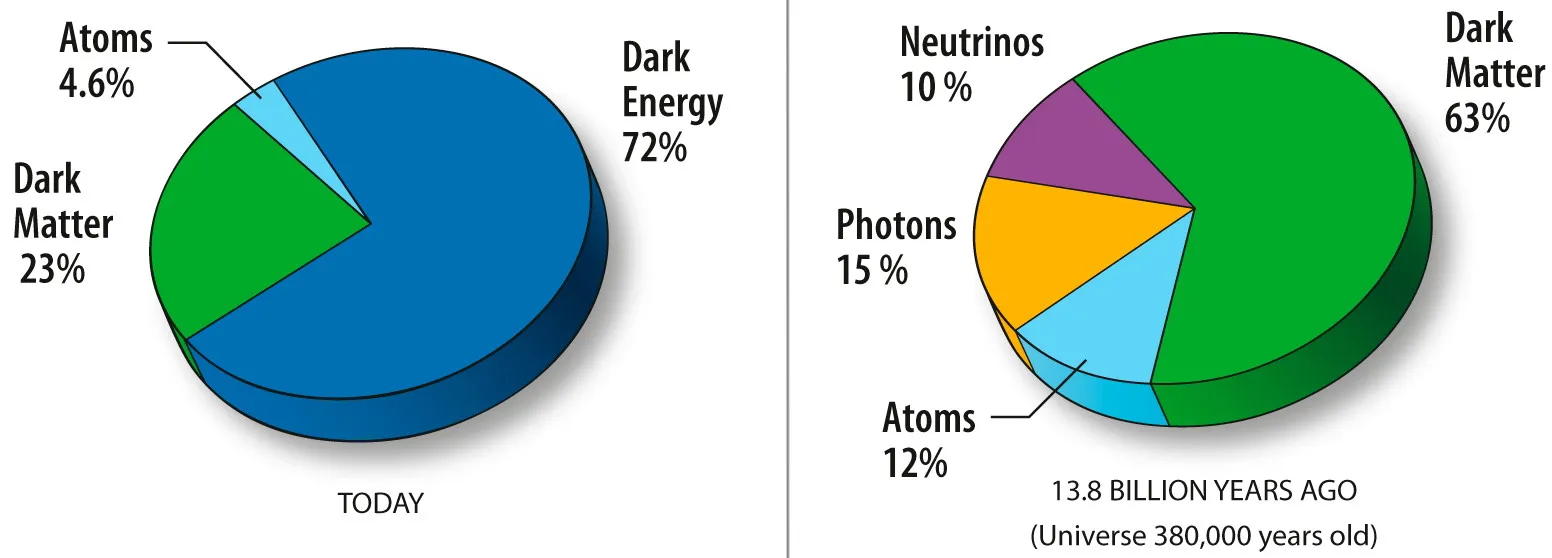
The matter and energy content in the Universe at the present time (left) and at earlier times (right). Note how dark matter and dark energy dominate today, but that normal matter is still around. At early times, normal matter and dark matter were still important, but dark energy was negligible, while photons and neutrinos were also quite important. The expansion rate is determined by the actual, instantaneous value for density, not by the distribution of the pie chart.Credit: NASA/WMAP science team, modified by E. Siegel
Today, based on far superior data than was available in the 20th century and from many independent lines of evidence, we not only have validated the presence of dark energy, but have determined that it’s the dominant form of energy in the Universe: something, as Nobel Laureate Adam Riess reminded us in a 2024 interview, that you can only discover once. Initially, there were large uncertainties as to what the behavior of this dark energy was, including:
whether it would weaken, or get less dense, as the Universe expands,
whether it would rise in strength, or intensity, over time, leading to a Big Rip scenario,
whether it was spatially homogeneous, or the same everywhere, or whether it would clump up the way matter does,
whether it showed signs of evolution across either space or time,
and whether it deviated from the predictions of a cosmological constant in any way.
Today, here in 2026 — nearly three full decades after the first evidence indicating its presence was revealed — the answer to all of these questions appears to be “no.”
That means that dark energy, in the context of our theory of gravity, Einstein’s general relativity, behaves as a cosmological constant. That term has a counterpart in our “other” way of making sense of the physical Universe: through quantum field theory. In every quantum system, there’s a lowest-energy state, also known as the system’s zero-point energy. You might think that the value of that zero-point energy would always be zero, but in fact that’s not the case at all.
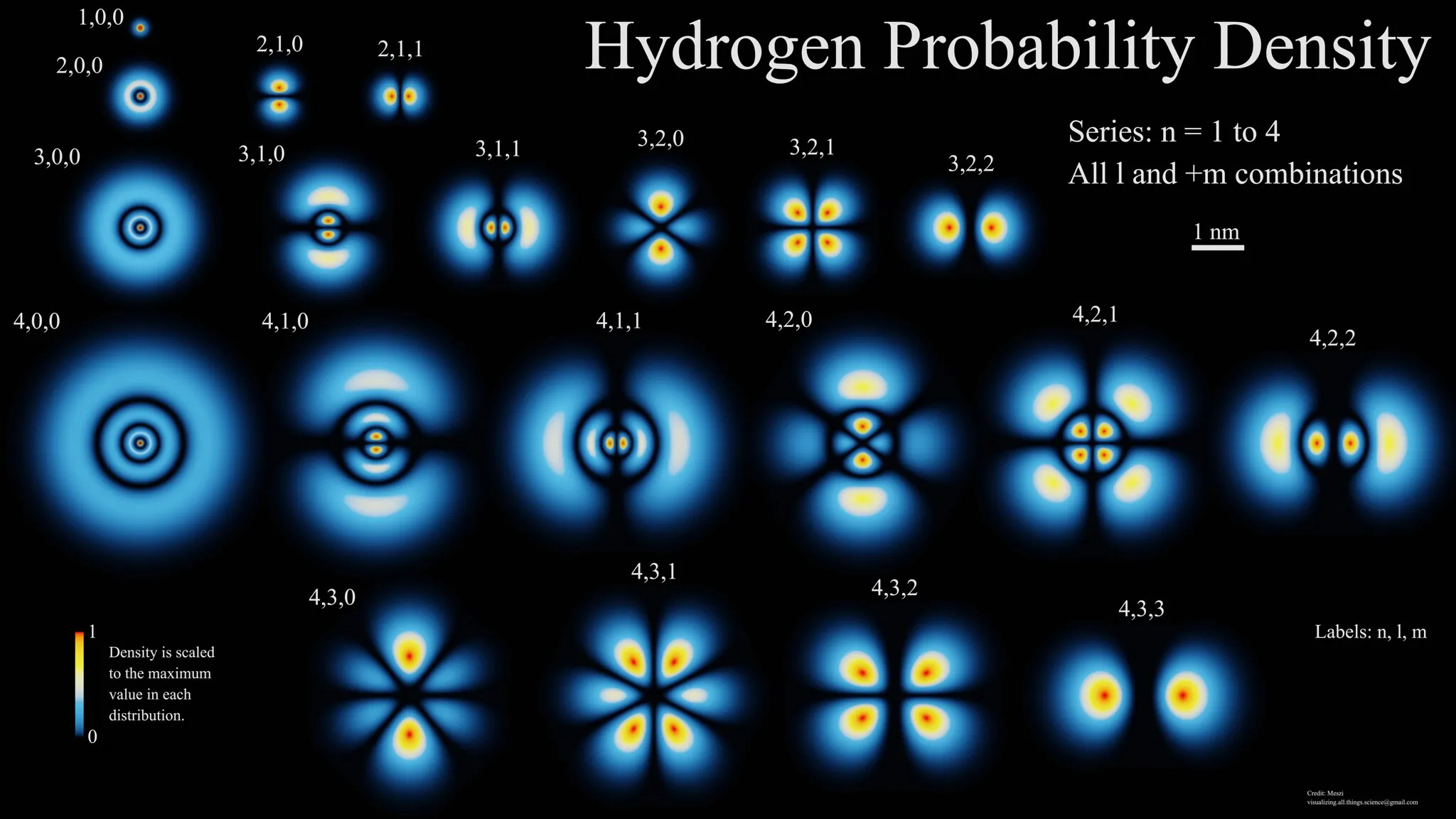
The lowest energy level (1S) of hydrogen (top left) has a dense electron probability cloud. Higher energy levels have similar clouds, but with much more complicated configurations and covering a much larger volume of space. For the first excited state, there are two independent configurations: the 2S state and the 2P state, which have different energy levels due to a very subtle quantum effect. The ground state of hydrogen, at top left, has a zero-point energy that is finite, positive, and non-zero: a property it shares with many quantum systems.Credit: Visualizing all things science/flickr
Consider, for example, the humble hydrogen atom, shown above. In its lowest energy state, known as the ground state, the electron orbits the atomic nucleus in a cloud-like configuration. However, the electron isn’t at rest at the atom’s center, co-located atop the nucleus itself, but instead has a rather rapid motion (indicating kinetic energy), an indeterminate position that’s “smeared out” due to Heisenberg uncertainty, and a finite, positive, non-zero amount of energy to it. This was discovered more than 100 years ago, and represented an early version of evidence that not every system can be reduced to a zero-energy state.
It turns out that this can be extended to even a system containing nothing more than empty space itself, as empty space still contains quantum fields (and the laws of physics) within it. There is nothing that mandates that the ground state, or zero-point energy, of empty space itself must be zero. That value could be finite and positive, zero, or finite and negative. It’s only by measuring the expansion of the Universe, and how that expansion rate evolves, that we can reconstruct what’s in our Universe, and determine the value of this zero-point energy.
As observations overwhelmingly indicate, that value is small — the energy equivalent of a handful of protons per cubic meter of space — but finite, positive, and non-zero.
A scalar field φ in a false vacuum. Note that the energy E is higher than that in the true vacuum or ground state, but there is a barrier preventing the field from classically roll…

 点赞
点赞 收藏
收藏 点踩
点踩 分享
分享