Carving Up the TPU

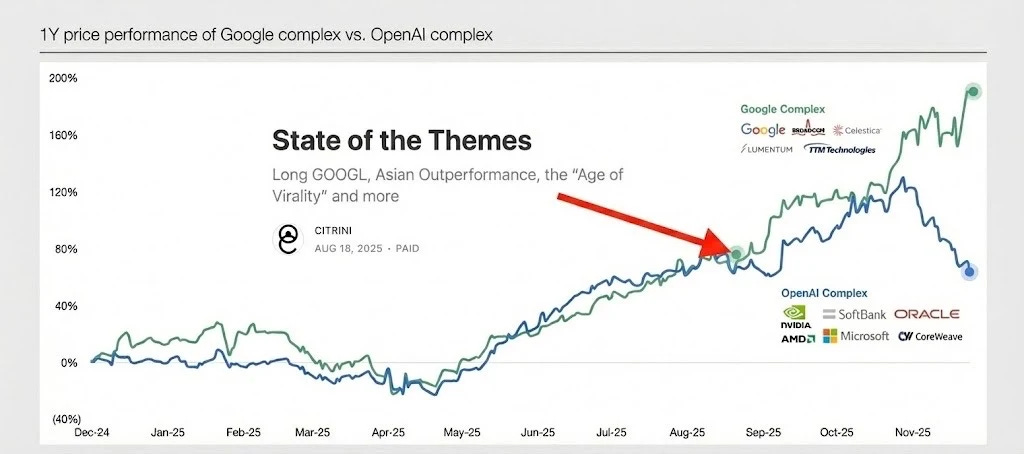
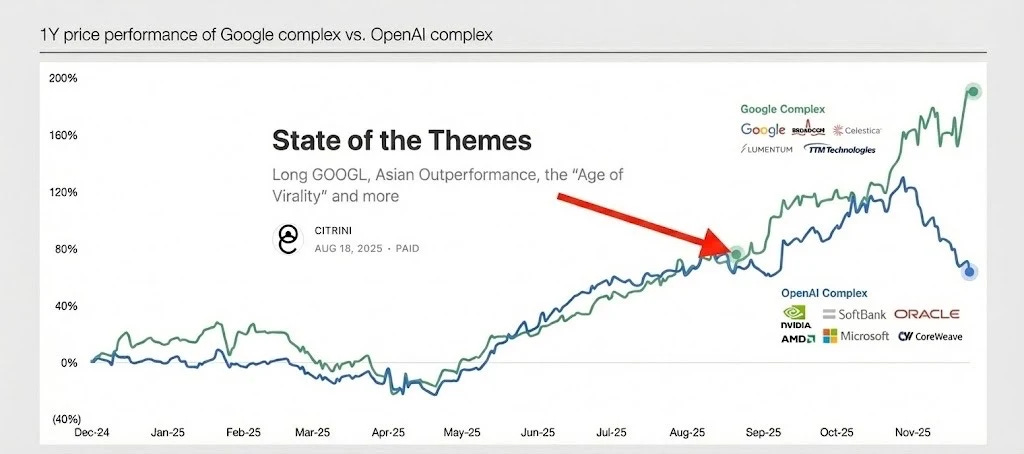
The first words of our August State of the Themes AI section were direct: Long GOOGL.
We elaborated…
OpenAI is compute-constrained. Without their own datacenters or their own chips, they are at significant disadvantage to Google, which not only is an ascendant hyperscaler but also a chip designer that has designed the only mass produced chip competitive with Nvidia’s core offering across many metrics and has optimized their entire research, training and inference pipelines for it
Google has low customer acquisition costs, best-in-class first party data, full vertical integration and TPUs enabling cheaper training
It’s clear that both the technical and market tailwinds favor Google, but the market does not seem to be pricing that in.
While the writing has been on the wall for some time, the market’s perception of Google has dramatically reversed over the past several months – transforming from an AI loser bleeding its search dominance to a stalking horse destined to undercut the most consensus AI winners.
We can see this shift occurred around the time we wrote up Google (or, perhaps, around the time the legal overhang lessened) on this chart from Coatue:
This sentiment has only accelerated in the past week with the release of Gemini 3. Not only is Google now firmly positioned at the cutting edge of frontier models, but it’s doing it on its own terms, or TPUs. It is indeed possible to train a frontier model without NVDA... that is, if you’re an ML-pioneering hyperscaler who has spent the past 10 years developing and optimizing for this custom silicon.
The announcements that both Anthropic and Meta are planning to implement TPU chips raise further questions about NVDA’s dominance. Surprisingly, META reportedly wants TPUs for training, not just inference. None of this information is truly new (see above) but the one-two punch, combined with growing skepticism of OpenAI seems to have culminated in a passing of the public torch.
While we are happy th…

 点赞
点赞 收藏
收藏 点踩
点踩 分享
分享