Is AI productivity growth in the room with us right now?

AI, according to Kevin Warsh, “is perhaps the most significant change in our economy in my adult lifetime.”
The new US central bank chair reached the age of majority in 1988, so it follows that AI is more significant for US economic interests than the break-up of the Soviet Union, the dotcom bubble, 9/11, China joining the WTO, globalisation, financialisation, the Great Recession, QE, and the Great Lockdown.
Of all of those things, AI most closely resembles QE: it’s a magical power to grow an economy without encouraging workers to ask for more money — but this time it’s off balance sheet. It’s the McGuffin that can appease POTUS and his desire for procyclical rate cuts, as Warsh spelled out in a WSJ op-ed last November:
AI will be a significant disinflationary force, increasing productivity and bolstering American competitiveness. Productivity improvements should drive significant increases in real take-home wages. A one-percentage-point increase in annual productivity growth would double standards of living within a single generation.
AI will be a significant disinflationary force, increasing productivity and bolstering American competitiveness. Productivity improvements should drive significant increases in real take-home wages. A one-percentage-point increase in annual productivity growth would double standards of living within a single generation.
It might work! But, after $725bn or thereabouts of sunk AI infrastructure costs, it’s reasonable to expect some kind of evidence by now of a return. Warsh added during an ECB forum panel earlier this month:
Over the last four quarters in the US, structural productivity is in the high 2 per cent range, so potential growth looks like it’s trended up [while] the labour market’s hours worked are relatively flat. History says we go from periods of low productivity to periods of high productivity. Nothing is in the bank at this time of consequence, but if the last four quarters are an indication, which is really largely before the advent of the new surge in what artificial intelligence can do, there’s reason to be optimistic.
Over the last four quarters in the US, structural productivity is in the high 2 per cent range, so potential growth looks like it’s trended up [while] the labour market’s hours worked are relatively flat. History says we go from periods of low productivity to periods of high productivity. Nothing is in the bank at this time of consequence, but if the last four quarters are an indication, which is really largely before the advent of the new surge in what artificial intelligence can do, there’s reason to be optimistic.
Is there, though? Are there reasons for optimism in the AI adoption surveys, or in US productivity data?
According to Barclays economists, no:
[O]ur bottom line is that AI adoption appears gradual and steady rather than rapid and transformative, with most households and businesses still reporting limited exposure to the technology. At the same time, evidence of a structural pickup in productivity growth remains surprisingly fragile: Aggregate productivity growth has improved during the post-pandemic period, but there is a strong rationale to attribute much of this improvement to cyclical variation in utilization rather than a sustained acceleration in productive capacity. We also find little compelling evidence in the available industry-level data that industries adopting AI more rapidly are already experiencing stronger productivity growth.
[O]ur bottom line is that AI adoption appears gradual and steady rather than rapid and transformative, with most households and businesses still reporting limited exposure to the technology. At the same time, evidence of a structural pickup in productivity growth remains surprisingly fragile: Aggregate productivity growth has improved during the post-pandemic period, but there is a strong rationale to attribute much of this improvement to cyclical variation in utilization rather than a sustained acceleration in productive capacity. We also find little compelling evidence in the available industry-level data that industries adopting AI more rapidly are already experiencing stronger productivity growth.
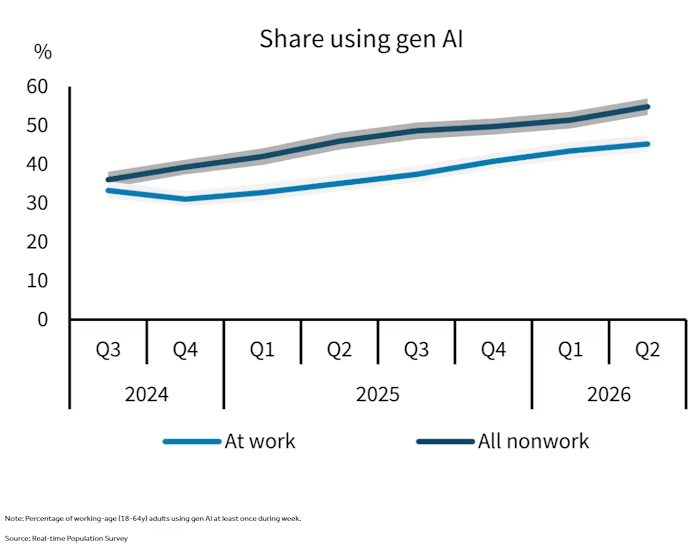
Starting with adoption, Barclays uses the St Louis Fed’s nationwide Real-time Population Survey of working-age US adults. The most recent survey shows that while AI has found its way into work routines for 45 per cent of respondents...
© Barclays
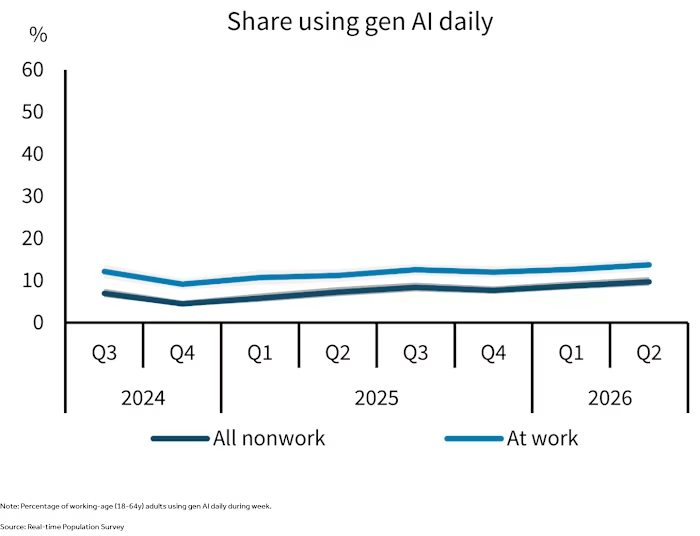
... the proportion who use AI daily in their work is much smaller, at just one-in-ten, and has been flatlining:
© Barclays
The other way to look at AI adoption is by usage time. Assuming an eight-hour workday, the average AI adopter has gone from roughly 20 minutes of usage in late 2024 to around 30 minutes by mid-year 2026, the RPS survey shows.
Approximately a third of AI usage is for timesavers, respondents report. The implication is that time saved per working day has risen from about seven minutes in 2024 to about 10 minutes in 2026. Across a nation’s workforce, that’s a decently valuable efficiency. What’s not known is whether the workers are using their extra 2 per cent of work time per day to be more generally productive, or to verify and fix whatever the AI has produced, or to slack off.
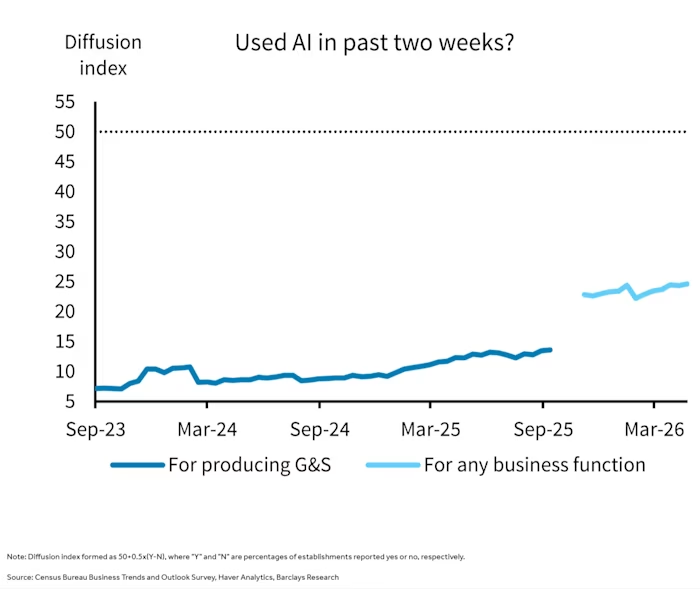
The Census Bureau’s bi-weekly Business Trends and Outlook Survey has been compiling the same sort of data for corporations, albeit with a change of wording in November that abandoned any precept that AI usage would be for something productive. Its most recent survey shows just 21 per cent of businesses were knowingly using AI, 69 per cent reported no use, and that 11 per cent weren’t sure either way:
© Barclays
Warsh’s argument isn’t undermined by the slow uptake. In one sense, it’s strengthened. US business-sector productivity has improved in recent years, on aggregate, which might be because of the benefits awarded to chatbot early adopters.
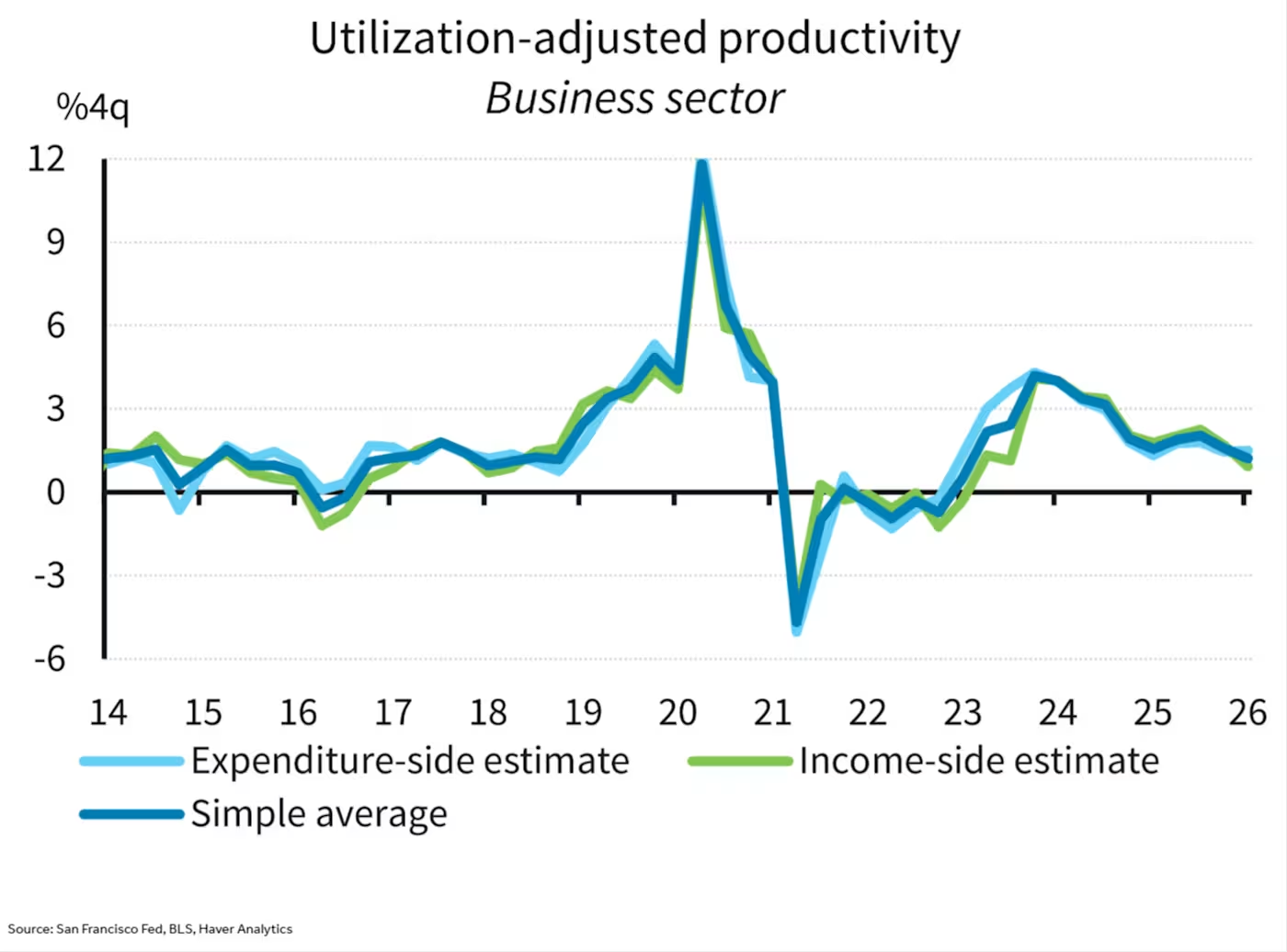
Alternatively, it might all be Covid noise. Hunkering down followed the Great Resignation and quiet quitting. We’re now heading back to some sort of normality in the labour market, where the evidence for structural productivity growth has been modest at best, Barclays says:
[T]he post-pandemic period was characterized by an unusual sequence of extreme labor shortages, aggressive hiring, precautionary labor hoarding, then normalization as businesses shed their excess workers. Swings from labor hoarding (which weighs on productivity) to rationalization (which improves it) can leave imprints on measured productivity that have little to do with technological progress or capital deepening.In our view, such shifts in utilization have likely played an outsized role in recent years. During 2022-24, labor hoarding appears to have depressed measured productivity as firms retained workers despite moderating demand. More recently, that drag has been unwinding as utilization gradually normalizes back toward its structural trend, which provides a mechanical boost to measured productivity growth.
[T]he post-pandemic period was characterized by an unusual sequence of extreme labor shortages, aggressive hiring, precautionary labor hoarding, then normalization as businesses shed their excess workers. Swings from labor hoarding (which weighs on productivity) to rationalization (which improves it) can leave imprints on measured productivity that have little to do with technological progress or capital deepening.
In our view, such shifts in utilization have likely played an outsized role in recent years. During 2022-24, labor hoarding appears to have depressed measured productivity as firms retained workers despite moderating demand. More recently, that drag has been unwinding as utilization gradually normalizes back toward its structural trend, which provides a mechanical boost to measured productivity growth.
© Barclays
Big-picture, AI adoption has been very uneven between industries. Companies in finance, IT, education, management consulting and professi…

 点赞
点赞 收藏
收藏 点踩
点踩 分享
分享