How to Be a Lichen: Adaptive Strategies for the Vulnerabilities of Being Human from Nature’s Tiny Titans of Tenacity

How to Be a Lichen: Adaptive Strategies for the Vulnerabilities of Being Human from Nature’s Tiny Titans of Tenacity 图片 1
How to Be a Lichen: Adaptive Strategies for the Vulnerabilities of Being Human from Nature’s Tiny Titans of Tenacity 图片 2
How to Be a Lichen: Adaptive Strategies for the Vulnerabilities of Being Human from Nature’s Tiny Titans of Tenacity 图片 3

When I was a child, little delighted me more than the magical green garlands draping from the pine trees, which I made into wreaths and mustaches to roam the mountains of Bulgaria as a miniature Orlando. I had no idea that Usnea longissima is just one of more than 20,000 known species of lichen — almost twice as many as birds.

In the lifetime since, I have collected and photographed lichen all over the world, from the spruces lining the wild shores of Alaska to the stone walls lining the rural roads of Ireland, from Basquiat’s grave in Brooklyn’s Green-Wood Cemetery to my oldest friend’s young husband’s tombstone in London’s Brompton Cemetery. And because anything you polish with attention will become a mirror, I have come to see that lichen knows many things we spend our lives learning — about adversity, about belonging, about love.

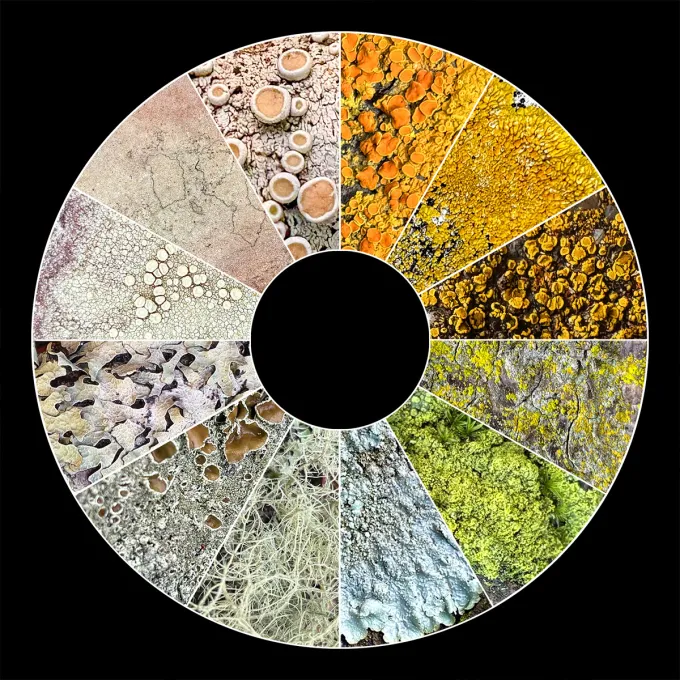
Color wheel of lichen I have encountered around the world. Available as a print and more, benefitting The Nature Conservancy.

Here are some instructions for living gleaned from nature’s tiniest titans of tenacity:

Contain multitudes without inner conflict. Linnaeus classified lichens as plants — a notion no one questioned until Peter Rabbit creator Beatrix Potter undertook her little-known scientific studies and made the revolutionary discovery that lichens are part algae and part fungus, with a sprinkling a bacteria — three kingdoms of life in a single organism, not warring for dominance but working together to make it one of the most resilient life-forms in nature and a keystone of many ecosystems. They are what that the German microbiologist and botanist Heinrich Anton de Bary was studying when he coined the word symbiosis, which is the technology evolution invented for unselfing.

Roots are overrated — invent other structures of belonging. Lichens don’t have a root system to draw nutrients and moisture from the ground. Instead, they alchemize sunlight into sugar, using their plant part to photosynthesize and their fungal part t…

添加评论
点赞收藏
点踩分享查看原文
评论
?
参与讨论