A cosmic first: separated sibling stars reunited by supernovae

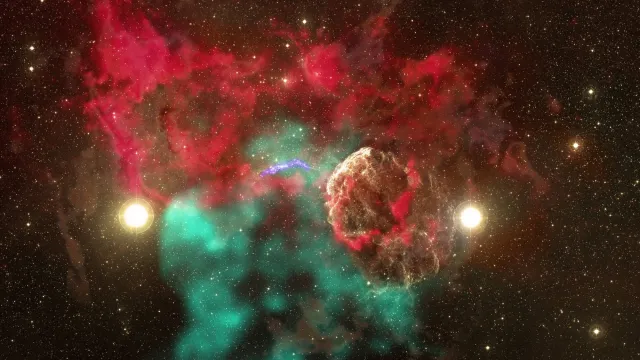
Out there in the Universe, a similar cosmic story plays out time and time again: the stellar life cycles. A massive, cold cloud of gaseous material, under the power of its own self-gravitation, begins to contract. As clumps within that gas get denser, the cloud fragments, with each fragment collapsing on its way to become a protostar. The most massive and dense clumps, initially, attract surrounding matter the fastest, growing into the most massive of these new stars, where around 50% of all such stars wind up developing in multi-star (binary, trinary, or higher multiplicity) systems.
When a star forms with more than about 8-10 solar masses, initially, it’s destined to die in a core-collapse supernova explosion: one of the most energetic cataclysms that occurs within our Universe. And yet, despite the fact that:
binary systems are common,
stars of similar masses are often found together (especially at high masses),
and that the highest-mass stars are the shortest-lived ones before dying,
we’ve never witnessed or traced back a “sibling supernova” event: where two core-collapse supernovae occurred from the same original system. In a remarkable new study led by Stanford scientist Miltiadis Michailidis, two different supernovae have just been linked — through their gamma-rays — across the same great molecular cloud complex. We may have just witnessed the first pair of sibling stars, separated when the first went supernova, reunited when the second went supernova just a little bit later. Here’s the story.
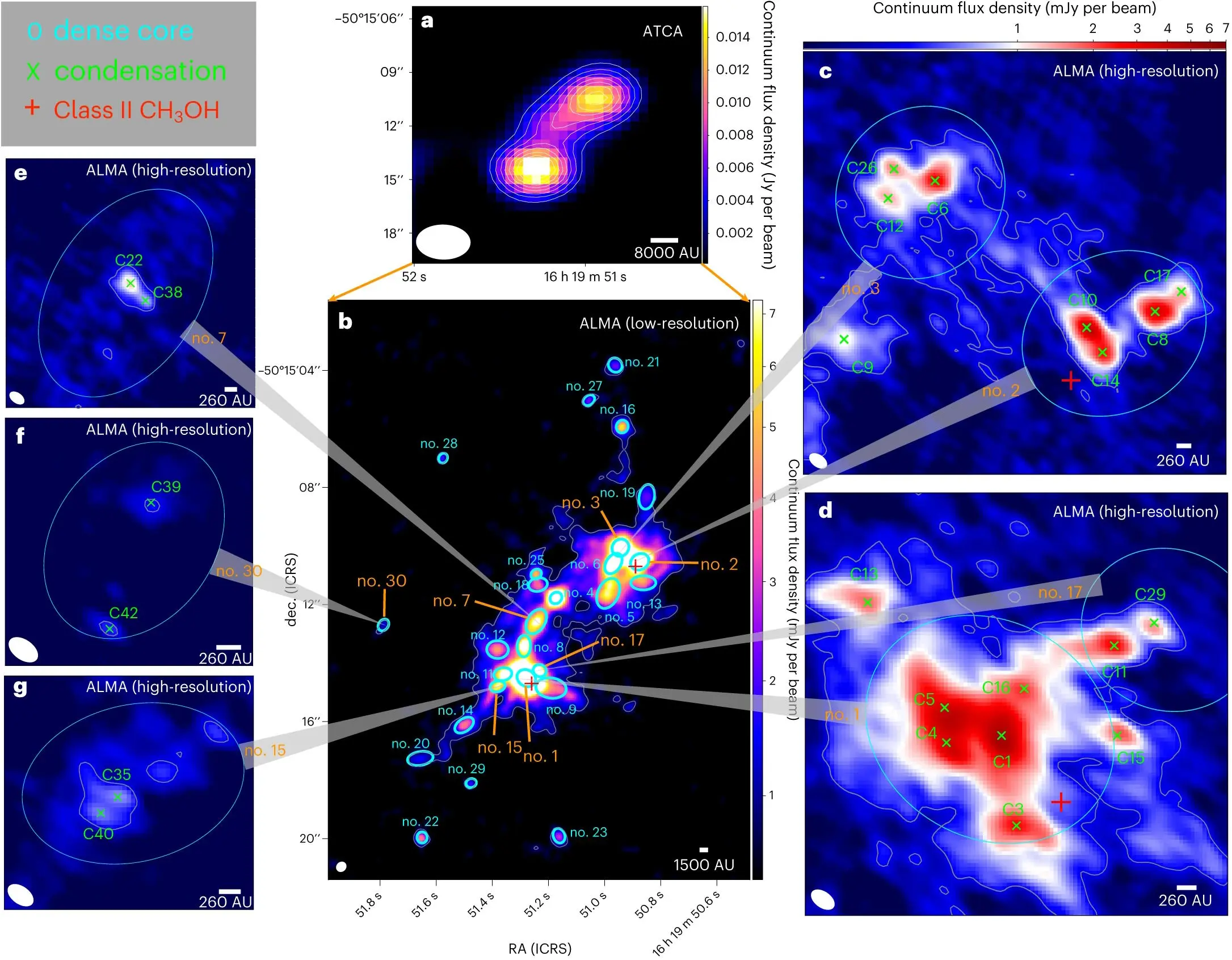
The dense cores of protostar cluster G333.23–0.06, as identified by ALMA, show strong evidence for large levels of multiplicity within these cores. Binary cores are common, and groups of multiple binaries, forming quaternary systems, are also quite common. Triplet and quintuplet systems are also found inside, while, for these high-mass clumps, singlet stars turn out to be quite rare. It is expected that the stars forming in nebulae all throughout the Universe, including in the Eagle Nebula, have similar clumpy, fragmented properties.Credit: S. Li et al., Nature Astronomy, 2024
What you see, above, is an actual image of many protostellar cores forming within the same obscured star-forming region. This is one of the highest-resolution images of protostars still being formed within a dusty, obscured region of a star-forming nebula: only revealed because of the incredible power of the ALMA observatory. Later on in life, we can see the newborn star clusters that emerge, as well as the singlet, binary, trinary, and higher multiplicity systems that eventually emerge from those dense stellar nurseries.
Of the stars that form, it’s the highest-mass ones that burn through their fuel the fastest, and that die in a core-collapse supernova after the smallest amount of time elapses. For a high-mass binary that forms, that means the more massive star dies first, with its supernova blast wave expected to “kick” its companion across interstellar space. However, if the less massive star is close to the more massive one in mass and lifetime, only a short amount of time might elapse before it goes supernova, too. If the remnant from the first supernova hasn’t faded away, these two supernova remnants — from stars that were initially siblings — could overlap, leading to a magnificent reunion.
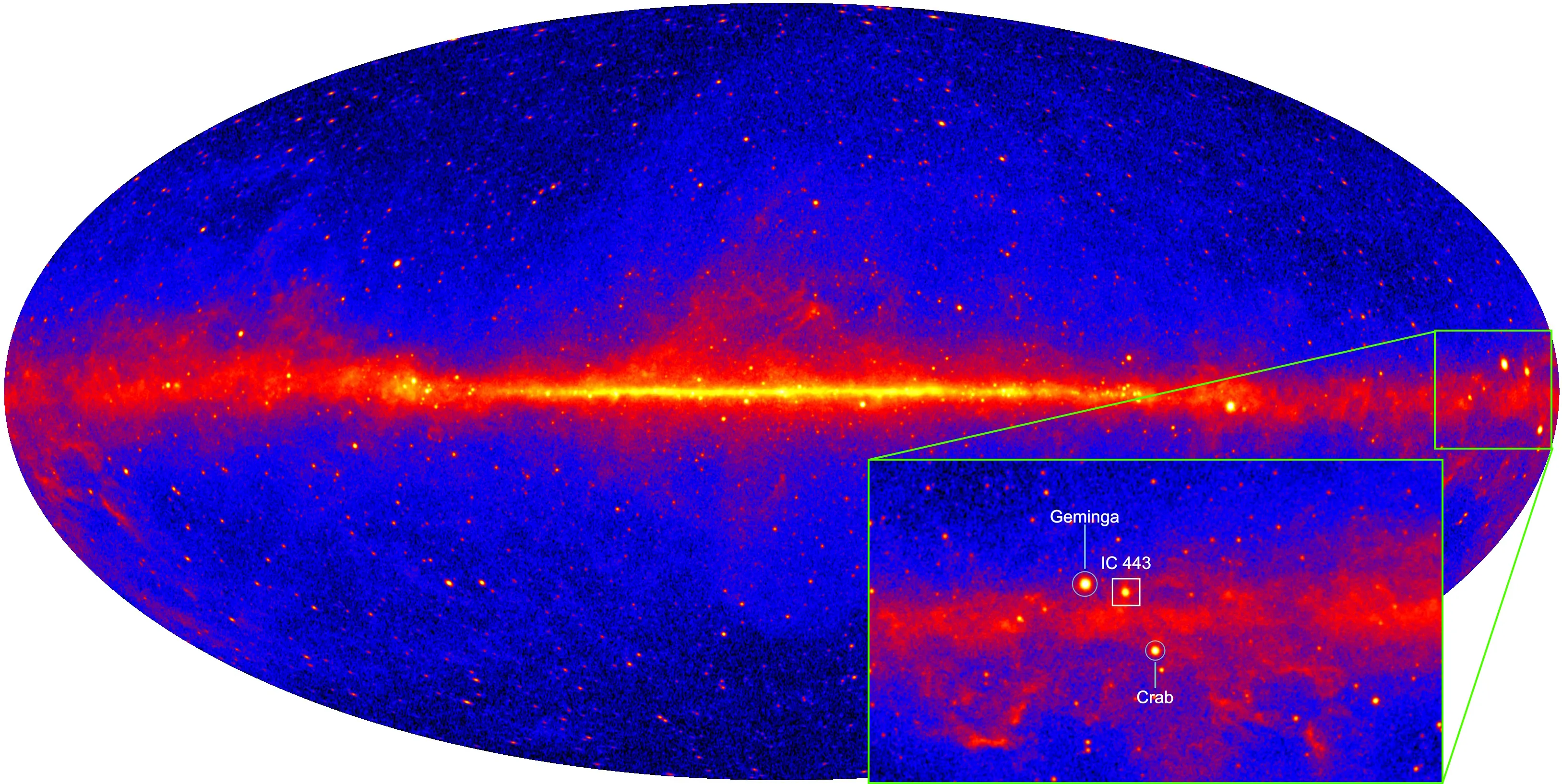
With over 15 years of Fermi/LAT data now available to cover the gamma-ray sky, high-resolution and sensitive maps can be uncovered. Over on the far right of the image, located almost 180 degrees opposite to the location of the galactic center, the region containing IC 443 is located: blown up in the inset, and the subject of a recent study that reveals two overlapping supernova remnants in the same patch of sky.Credit: NASA/DOE/Fermi LAT Collaboration
The way to look for such an event isn’t visually, with the type of light that our eyes can see, but rather at the highest energies of all: through gamma-rays. The Fermi Gamma-Ray Space Telescope, launched by NASA in 2008, is our greatest, most sensitive, highest-resolution gamma-ray telescope to ever open its eyes on the Universe, giving us an unprecedented view of our galaxy (and beyond) at the highest energies of all. Pulsars, black holes, and supernova remnants stand out at these energies, with one specific region pointed almost directly away from the galactic center containing several notable gamma-ray sources within it:
IC 443, a bright supernova remnant also known as the Jellyfish Nebula,
the Crab nebula, a pulsar inside of a supernova remnant, andGeminga, one of the brightest and closest pulsars of all.
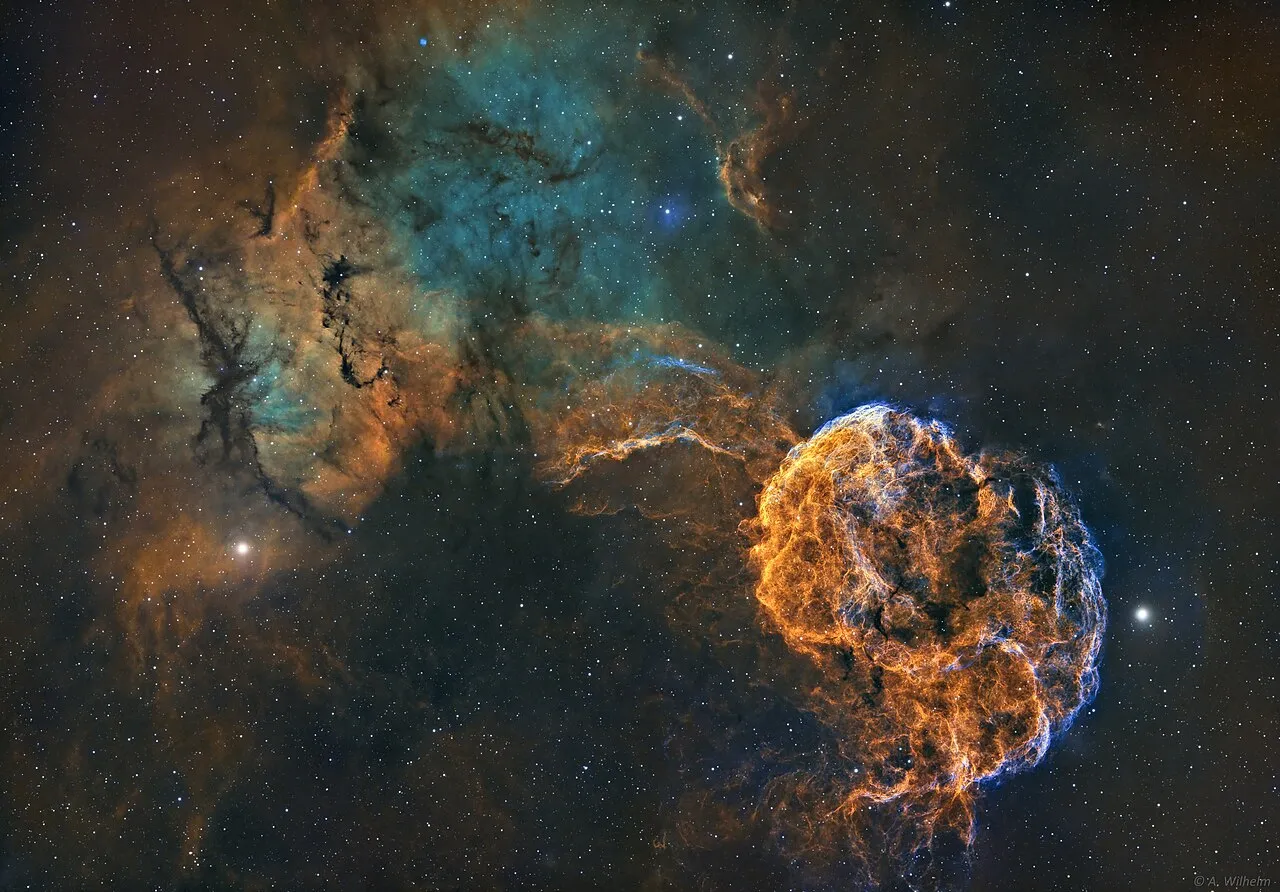
If you take a close look at IC 443 and the region around it in a variety of wavelengths, however, you’ll find that it isn’t just an isolated supernova remnant out there in deep space, but rather is interacting with its environment. There’s a nearby star-forming region filled with ionized hydrogen, Sharpless 249, that the supernova remnant interacts with, as well as another nearby supernova shell: G189.6+3.3.
This view of the Jellyfish Nebula, also known as IC 443, is a prominent and recent supernova remnant in the direction opposite to the galactic center. Nearby the Crab Nebula and the Geminga pulsar in space, it turns out to be a part of a much larger complex, whose features are revealed by multiwavelength studies of this region.Credit: Siderevs nuncivs/Wikimedia Commons
With not just Fermi data, but also including data from Planck and MWISP in the microwave/radio, from the Digitized Sky Survey in the optical, from WISE in the infrared, from Swift in the ultraviolet, and from eROSITA in the X-ray, we can see the vast scale at which IC 443 interacts with its surroundings. The greater the number of different data sets we fold in, the greater the amount of detail emerges not only within this region of space, but the greater the details we can reconstruct about the interactions between different sources of energy and different regions within this volume of our Milky Way.
Because there are multiple supernova remnants within this one region of space — remnants that may be separated by many light-years in space but only by a few tens of thousands of years in terms of time-of-detonation — there’s a remarkable scenario that’s worth considering. Could it be possible that:
there was, initially, a binary system of high-mass stars,
where the first, more massive star exploded,
sending the companion journeying rapidly away from it through space,
where, tens of thousands of years later, the second star exploded,
and finally, the remnants expanded and interacted,
reuniting these companions in the aftermath of their demise? A multiwavelength view of this region is certainly suggestive of precisely that scenario.
As more and more data gets added to the initial optical data set (yellow), additional features start to emerge. In reds and browns, long wavelength radio and infrared data is added in, In teal, higher-energy light is added in: localized atop IC 443. And then, in an extended fashion, additional high-energy photons are seen, particularly in the gamma-ray part of the spectrum. It’s the analysis from this data that first revealed the hidden presence of a second, earlier supernova event.
Credit: NASA Goddard Space Flight Center and M. Michailidis et al. 2026; orange,
brown: radio, ESA/Planck and MWISP; yellow: optical, DSS; red: infrared, NASA/
WISE; violet: ultraviolet, NASA/Swift; teal: X-rays, SRG/eROSITA
It isn’t generally appreciated why this is the case, or why gamma-rays are such an important puzzle piece in putting this picture together. Even with the incredible energies that go into a core-collapse supernova, including nuclear processes like electron capture, neutrino production, and a high-energy blast wave, none of those events produce radiation at the highest energies: gamma-rays. Instead, there are only two mechanisms that can get you there:
high-energy proton collisions with interstellar gas,
o…

 点赞
点赞 收藏
收藏 点踩
点踩 分享
分享