Homer Haunted, by Henry Power
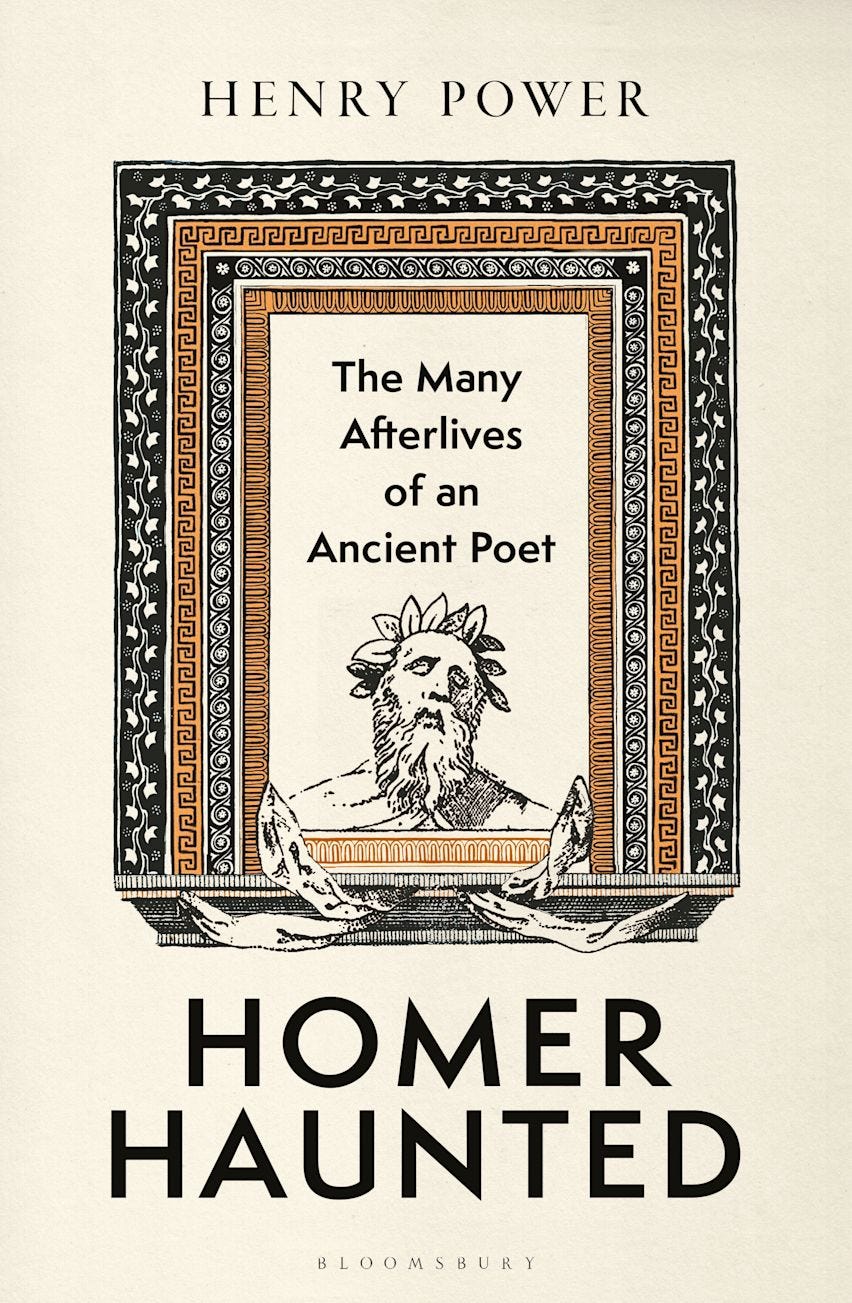
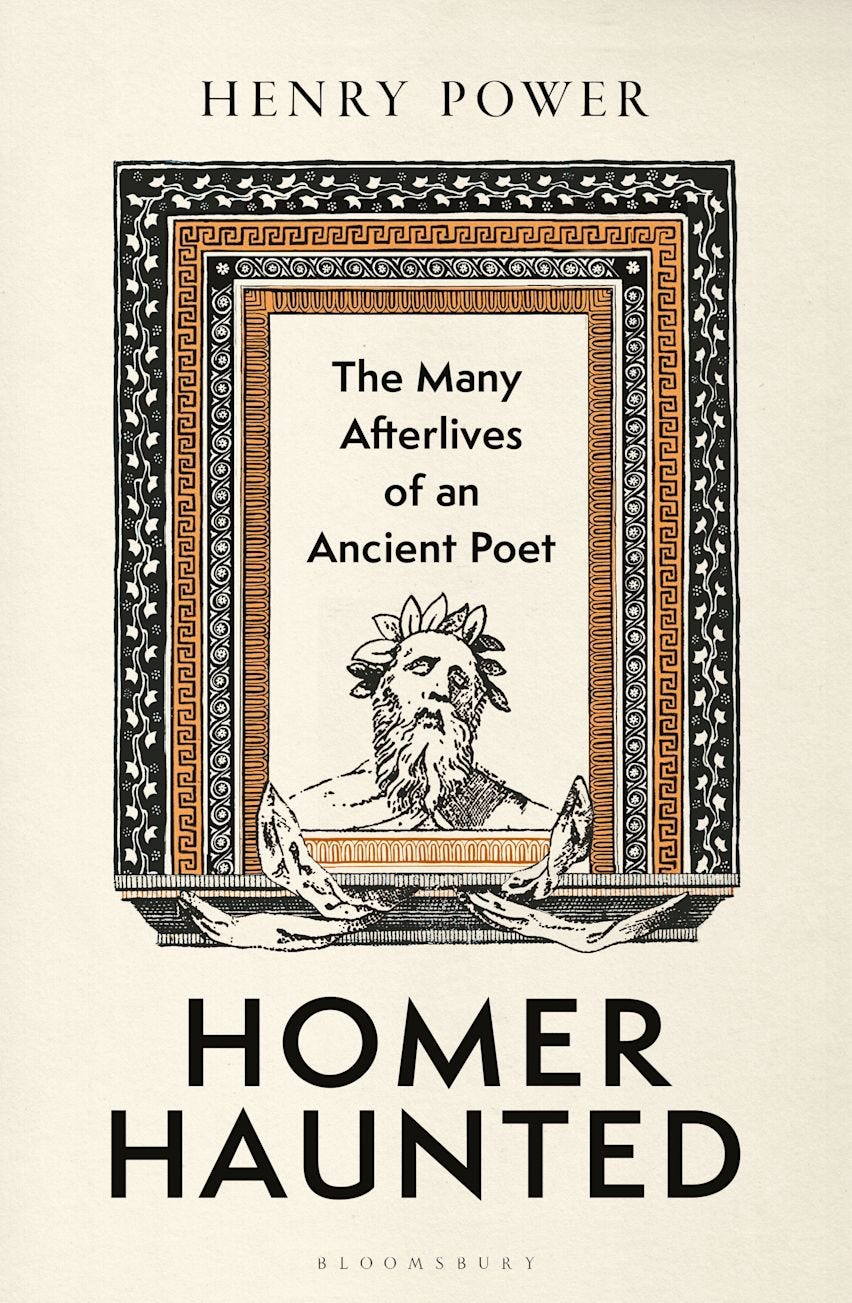
Homer Haunted is a swift, lively, and informative book about the way English poets have translated Homer. It begins with George Chapman and ends with three living writers. Henry Power, an English professor at Exeter, is especially compelling about Alexander Pope and Christopher Logue, two great Homer translators. Indeed, I loved how much this book loves Pope, whose phenomenal accomplishments and influence on later poets are as inescapable as they ought to be. Anyone who wishes to understand how Homer has been understood by the English poets will learn from and enjoy this book.
There are wonderful accounts of writers like Matthew Arnold and Elizabeth Barrett Browning. Power is a keen explicator of Logue’s techniques not just of “imagism” but of his use of camera language, quotations from popular culture, instructions, the addition of words like “consider” and “imagine” to Homeric images. He quotes very nicely, and has a knack for telling a story without letting the book get dragged under by the modern impulse for all narrative non-fiction to become a chain of anecdotes that cannot bear the weight of their conclusions.
The most surprising part of this book, for me, was discovering the sheer weird variety of translations undertaken by Victorians, who produced: an Anglo-Saxon-style Homer, one in Spenserian stanzas, one as an Icelandic saga, and a version that was cast in the language of the King James Bible. Here is the extract of the Saxon Homer that Power quotes:
Thus saying gallant Hector stretched his arms towards the infant. But back into the bosom of the nurse with dapper girdle The child recoiled with wailing, scared by his dear father’s aspect, In terror dazzled to behold the brass, and crest of horsehair, Which from the helmet’s topmost ridge terrific o’er him nodded. Then did his tender father laugh, and laughed his queenly mother
And here is a passage in which Power explicates some of the borrowings in Pope’s translation of the Iliad when all the men are lined up on the beach outside Troy. (The passage in question is in the footnote, very good stuff.) 1
What Pope doesn’t mention is how many poets he has drawn on to translate the nightpiece. Here are just a few of the poems in Pope’s patchwork: The conscious swains have wandered over from Pope’s earlier poem, ‘Windsor Forest’. Tip with silver recalls the moment when Romeo swears to Juliet ‘by yonder blessed moon... /That tips with silver all these fruit-tree tops’. The arms of the Trojan warriors, umbered by the fire, recall the scene around the campfires on the night before Agincourt, as described in Henry V: ‘Fire answers fire, and through their paly flames/Each battle sees the other’s umbered face.’ Heaven’s clear azure is taken from the first book of Paradise Lost, where Satan’s feet move ‘Over the burning marl, not like those steps/On heaven’s azure’. The strange use of the deep serene glances back to Milton’s famous description of his blindness: ‘So thick a drop serene hath quenched their orbs.’ Pope heard thousands of voices in Homer, and he lets us hear them in his translation. To read it is to be surrounded by echoes of Shakespeare and Milton, and of hundreds of poets whose names are barely remembered now, but whose words survive here. All the fruits gathered on Pope’s childhood reading-rambles are preserved in these translations, just as the Homeric poems themselves preserve the songs and experiences of a whole culture. Samuel Johnson wrote admiringly that Pope had bequeathed ‘a treasure of poetical elegances to posterity’ in his Homer.
Power is at his best when he gets into literary details like this, such as when he explains this passage from Middlemarch:
“You will say anything, Fred, to gain your point.” “Well, tell me whether it is slang or poetry to call an ox a leg-plaiter.” “Of course you can call it poetry if you like.” “Aha, Miss Rosy, you don’t know Homer from slang. I shall invent a new game; I shall write bits of slang and poetry on slips, and give them to you to separate.”
The joke is that Homer often describes cattle as eilipous (“circling in their gait”) and that “leg-plaiter” was Midlands slang for the way oxen put one leg in front of the other. Power’s love of the details of ordinary life in the nineteenth century novel is well-linked to the Homeric concern with such details.
The last third of the book is given to poets of the twentieth century. Some of these, like H.D., are highly deserving of this interest. I had not known of her Homeric writing and hope now to read it. But the overall balance felt strange to me when there is no chapter for Chaucer, Henryson, or Shakespeare. No doubt, they are not translators of Homer, but Power takes (persuasively) a capacious view of “translation”, which comes alive in his discussion of how the epic impulse lived more in novels than in poetry in the nineteenth century. There might be room to discuss the way that non-fiction took over from epic poetry, too. Carlyle and Darwin were the English epic writers after Milton and Wordsworth. These are quibbles, but good books are the ones most worth the quibbling.
Power is at his worst in the small moments when modern orthodoxies are preached, not for any purpose of illustrating Homer, or advancing Power’s own argument, but merely to recite the acceptable doctrine of his milieu. He ought to have remained more purely literary. Sometimes this is just Power signaling to the right people that he is the right person. That is fair enough, though why he needs to make feminist commentary about traditional rituals on a Greek island at a wedding he attended, or to signal that he does not share his grandfather’s imperial ideas, is unclear. Likewise, H.D.’s account of meeting Ezra Pound has to be doubted. To say “she allows his overbearing nature to shine through” her account of their meeting is, in turn, to allow modern ideology to cast its shadow on the story. We might simply try believing her!
Some of this is trivial, such as when Power dissects Samuel Johnson’s impersonation of a kangaroo to illustrate what a “strictly delineated” view of his own culture Johnson had, linking this to his views about Scotland. Perhaps Scotland was just as “marginal” to Johnson as Borneo. But he lived in a very different set of conditions to us! There is something equally parochial in Power’s inability to read Johnson’s impression of a kangaroo without interpolating these judgements. Sometimes an impersonation of a kangaroo is just an impersonation of a kangaroo.
Some of it is less trivial. Insisting on the fact that Balboa did not “discover” the Pacific because thousands of others had seen it before him presents things backwardly. The fact of colonization— and of Keats’s poem —requires discovery of an existing world by strangers. To the stranger, these ancient places will be new. Power’s story is about those discoveries. (No-one requires to be told that Keats was not the first person to discover Homer or Chapman!) He ought to stay inside that perspective, unless by stepping aside he can better help us understand it. As it is, these asides have the bathos of a health and safety announcement.
Notably, he does not feel required to do the same thing when it comes to Pope’s religion: in that case the stated facts are enough. Catholic rights are no longer a live issue, and so Power doesn’t need to comment. Perhaps this is the price of doing business. Perhaps Power believes these things so deeply that they animate his work. But no conclusion is drawn, no argument made. He is, no doubt, to be congratulated on his liberalism. But it matters not to the reader who wishes to learn about Homer and his translators. Some readers might reasonably object that they signed up for a lecture on Homer in English poetry, not whatever other lectures Power wishes to deliver.
To call the teaching of English poetry in the Empire a tool of conquest is relevant in the chapter on Derek Walcott, as it relates directly to Walcott’…

 点赞
点赞 收藏
收藏 点踩
点踩 分享
分享