UK businesses are not deepening their use of AI, suggests ONS data

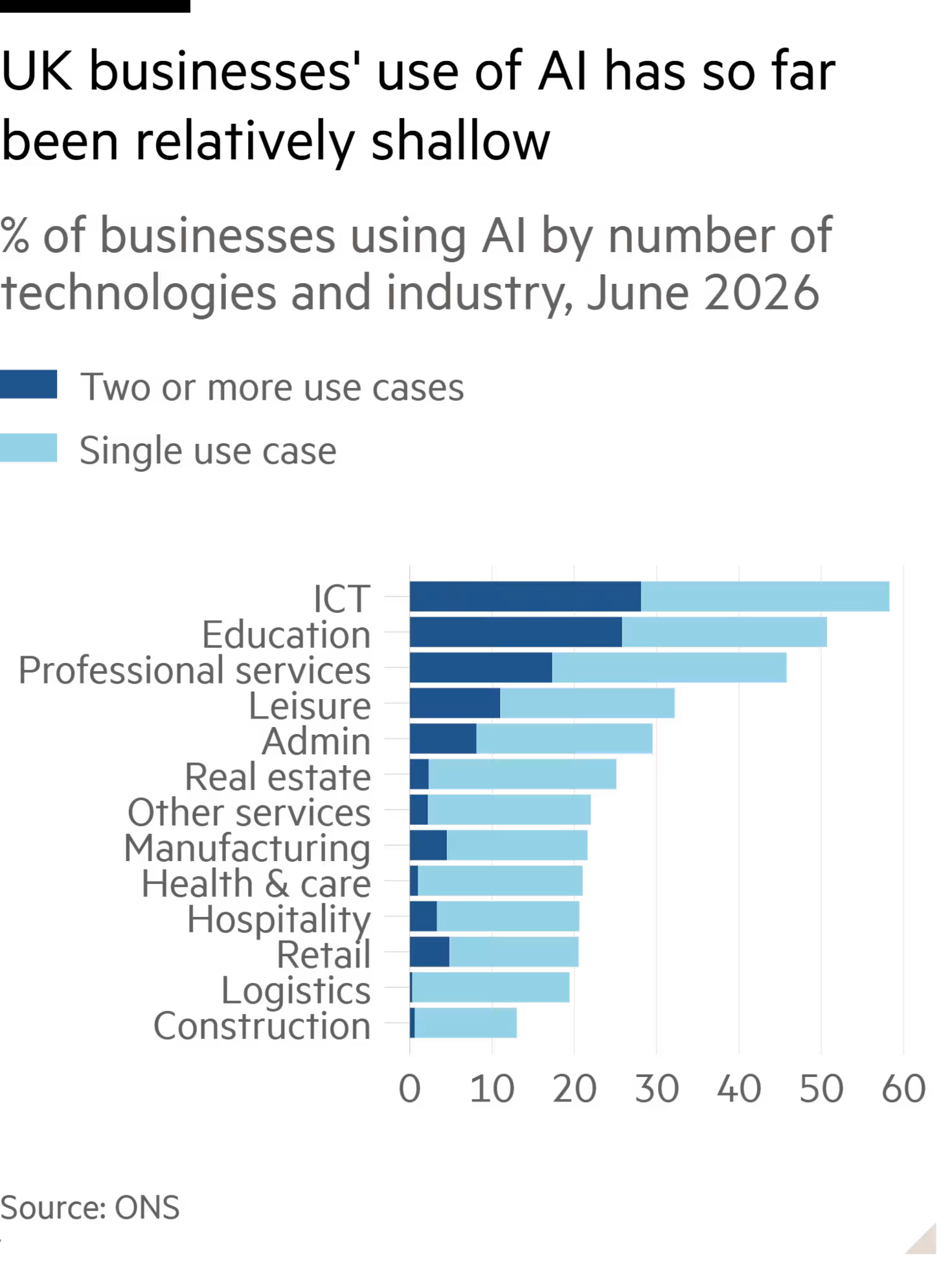
UK businesses are failing to exploit the potential of AI, according to official data showing that most businesses have not deepened their use of the technology in the past two years despite rapidly advancing capabilities.
While overall take-up of AI has widened, the average number of AI tools being used by businesses has risen only modestly since 2023, from 1.4 to 1.6, analysis by the Office for National Statistics showed on Monday.
The statistics agency said this pointed to “limited transformative impacts for most AI-adopting firms”. Large language models were the most widely used technology, followed by visual context creation.
About 35 per cent of UK businesses with more than 10 employees report using AI, up from 12 per cent in September 2023. The proportion rises to 48 per cent among large companies, the data showed.
But only a tenth of businesses using AI in their operations said they were doing so “extensively”, while 15 per cent said more than half their employees used AI as part of their daily work.
The data also suggested that businesses were more likely to see AI as a means of cutting costs than as a route to develop new products or reach new markets — which could yield greater gains over time.
Sixty per cent of businesses responding to a regular ONS survey said they were using AI in pursuit of greater operational efficiency, with fewer than one in five saying they were using AI to develop new products or services.
Raoul Ruparel, director of Boston Consulting Group’s Centre for Growth, said in a post on X that the focus on efficiency savings was “expected, but far from the most likely approach to generate long-term returns” — though he also noted that microbusinesses, those with fewer than 10 employees, were more likely to look for “more revenue-generating use cases”.
The data comes as economists puzzle over the reasons for a recent improvement in the UK’s perennially poor productivity growth. Some argue the economy is seeing the first signs of an AI-fuelled renaissance, while others say an improvement in GDP per hour worked may simply reflect the job cuts seen in low-wage sectors over the past two years.
But the ONS analysis shows that the use of AI is relatively low in retail and hospitality, the sectors where job losses have been most apparent.
In most sectors, free tools were the most widely used — except in tech, professional services and construction, where companies were more likely to pay for external software or develop their own in-house models.
The ONS said there was limited evidence as yet of AI hitting overall employment: most businesses said either that its use had no impact on headcount, that the effect was uncertain or that it was not applicable.
Creative and design roles were an exception, however, with businesses using AI for visual content creation more likely to say there had been an impact on jobs.
Meanwhile, more than half of businesses using AI for image processing also said it had affected clerical and admin roles.

 点赞
点赞 收藏
收藏 点踩
点踩 分享
分享