EU tech tsar spars with justice chief over new online rule book

This article is an on-site version of our Europe Express newsletter. Premium subscribers can sign up here to get the newsletter delivered every weekday and fortnightly on Saturday morning. Standard subscribers can upgrade to Premium here, or explore all FT newsletters
Good morning. News to start: The EU’s tech chief has told the FT that AI has become a geopolitical weapon, arguing that makes Europe’s push to develop its own alternatives to US platforms even more critical.
Here, she tells our correspondent why she disagrees with her justice colleague’s approach to new online rules, and our Rome correspondent reports on Giorgia Meloni’s call to pardon a jeweller who murdered two thieves.
Europe Express is edited by Mari Novik. Read the previous edition here. Please send tips, thoughts and feedback to [email protected].
No overlap
EU’s tech chief Henna Virkkunen wants to ensure the upcoming Digital Fairness Act does not duplicate existing digital legislation, she told Barbara Moens, as the European Commission braces for an internal battle over how far the new rules should go.
Context: By the end of the year, the Commission is set to propose new digital fairness rules that could tackle issues including the addictive design of websites and apps, subscription traps and other “dark patterns” that lure people into spending money.
Justice commissioner Michael McGrath, who has championed the legislation inside the Commission, wants the new consumer protection law to give Brussels the power to fine companies that breach the rules, not only Big Tech companies already covered by the bloc’s digital legislation.
Also smaller online traders or video game makers should be fined, he told the FT earlier this month.
But some EU countries, including Poland, argue that the proposals risk overlapping with existing laws, such as the Digital Services Act, which polices content online for large platforms.
Virkkunen is also more circumspect.
“It is very important, of course, when we are looking at our digital rule book, that we are keeping it clear and also we are not duplicating the things and also we have to be able also to enforce the obligations that we are setting,” she said.
While she agreed consumer protection rules need updating, she stressed that the Commission would not create “any overlapping parts because we have at the same time this simplification effort going on”.
The Digital Fairness Act forms part of the EU’s broader push to improve online safety, particularly for minors. In September, the Commission will also introduce new legislation to ban the use of social media under the age of 13 and limit it for teenagers.
Social media platforms were not doing enough to check the age of users, Virkkunen said, adding that the Commission wanted to look at in particular which kind of features — such as addictive design or specific content — were harmful to minors.
“These online services are changing and developing all the time, and especially AI is taking a bigger role now in our online environment,” she said, for example referring to AI chatbots.
“So when we’re looking at that kind of harmful features for minors, it has to take into account also the technological developments.”
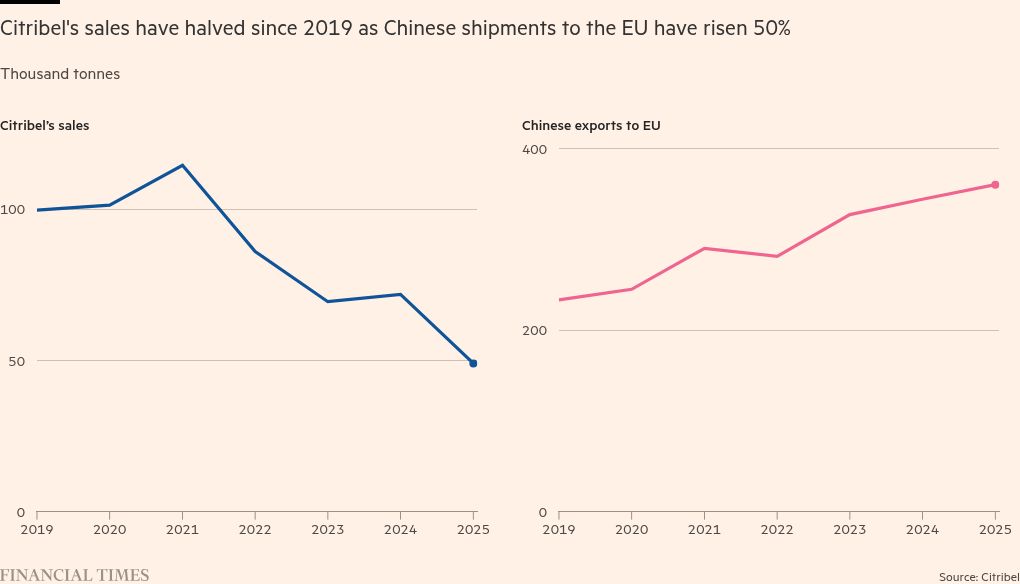
Chart du jour: Industrial erosion
A Belgian citric acid factory has become a symbol of Europe’s wider battle to defend its industrial base against China’s state-backed overcapacity.
Jeweller’s case
Italian Prime Minister Giorgia Meloni’s rightwing coalition has opened a new front in its tough-on-crime agenda, seeking a presidential pardon for a jeweller imprisoned for 14 years after killing two men who had just robbed his shop, writes Amy Kazmin.
Context: Mario Ruggero shot and killed two men in April 2021, chasing them as they fled the robbery, in a case that sparked fierce debate in Italy. Ruggero, his lawyers and supporters contended he acted in “legitimate self-defence”. The courts disagreed, ruling that as he had opened fire after the robbers had left the shop and were running away the killings could not be considered true self-defence.
Italy’s top court last week rejected Ruggero’s final appeal, confirming his sentence of 14 years and nine months. The jeweller, now 72, turned himself in after releasing a social media video urging his supporters to fight against a justice system he called incapable of responding to “rampant crime”.
Meloni has since told an Italian newspaper Ruggero’s sentence is “disproportionate” and confirmed she had instructed her justice minister Carlo Nordio to begin the process of seeking a presidential pardon.
Deputy prime minister Matteo Salvini has visited Ruggero in prison, while his far-right League party wants to broaden the legal definition of what constitutes legitimate self-defence.
Meloni’s Brothers of Italy party, meanwhile, wants to make it impossible to seek compensation on behalf of someone who suffers grave injuries — or loses their life — while committing a crime.
Elon Musk weighed into the fracas, calling Ruggero’s sentence “insane”. Responding to a post on X about the case, the billionaire wrote: “the judge and the prosecutor are the ones who deserve the sentence in this case.”
What to watch today
Commissioner Michael McGrath meets with the chair of the US Federal Trade Commission Andrew Ferguson in Washington.
Belgian National Day.
Commissioner Michael McGrath meets with the chair of the US Federal Trade Commission Andrew Ferguson in Washington.
Belgian National Day.
Now read these
Euro delay: The Czech Republic’s central bank chief warns his country against joining the Eurozone too early.
Botox boom: Swiss injectables maker Galderma is training thousands of doctors to administer jabs as the risk of botched procedures rises.
Export curbs: Chinese regulators are considering tightening export controls on AI and semiconductor technologies as the US-China rivalry in cutting-edge AI intensifies.
Euro delay: The Czech Republic’s central bank chief warns his country against joining the Eurozone too early.
Botox boom: Swiss injectables maker Galderma is training thousands of doctors to administer jabs as the risk of botched procedures rises.
Export curbs: Chinese regulators are considering tightening export controls on AI and semiconductor technologies as the US-China rivalry in cutting-edge AI intensifies.
Recommended newsletters for you
Free Lunch — Your guide to the global economic policy debate. Sign up here
The AI Shift — John Burn-Murdoch and Sarah O’Connor dive into how AI is transforming the world of work. Sign up here
Are you enjoying Europe Express? Sign up here to have it delivered straight to your inbox every workday at 7am CET and on Saturdays at noon CET. Do tell us what you think, we love to hear from you: [email protected]. Keep up with the latest European stories @FT Europe

 点赞
点赞 收藏
收藏 点踩
点踩 分享
分享