Diraq Eight-Qubit Foundry Silicon Array


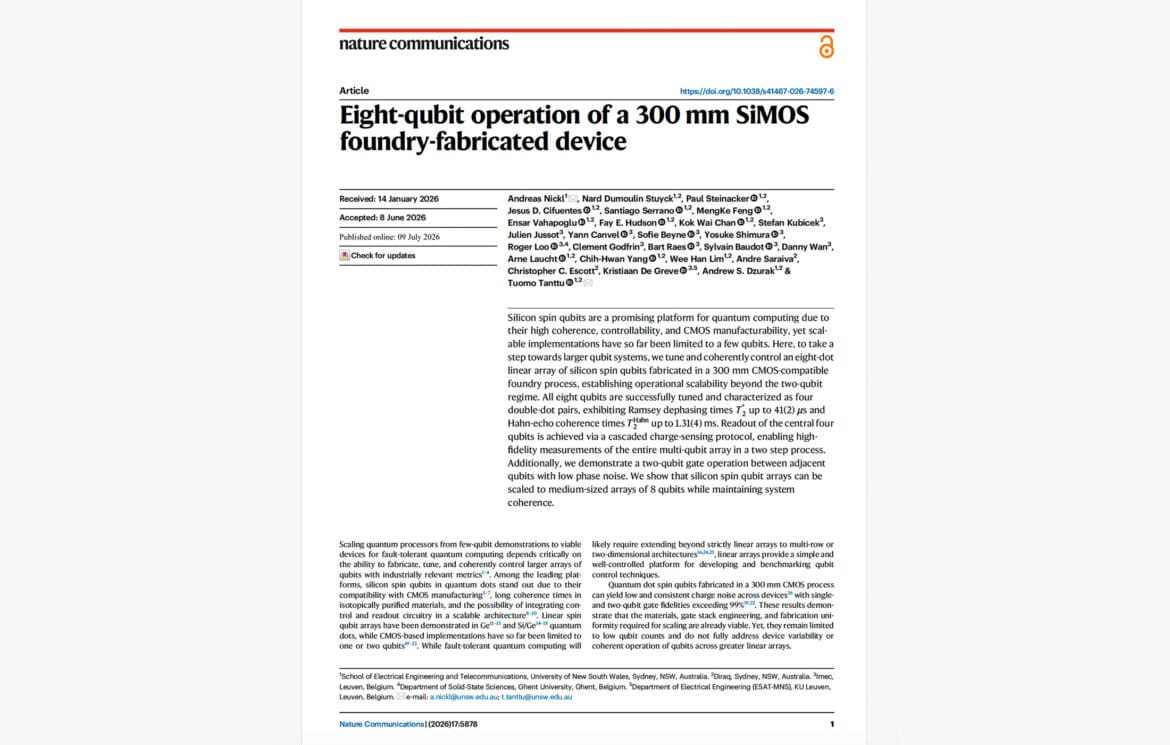
Table of ContentsMy AnalysisThe Unit-Cell Strategy, and Where the Hardware Pushed BackTwo Sensors for Eight Qubits: The Readout Result That ScalesCoherence Held at Eight Qubits. Fidelity Is the Next Test.Eight Qubits Against a Million-Qubit RoadmapWhat This Means for CRQC Timelines
July 9, 2026 — Researchers from UNSW Sydney, Diraq, and imec reported in Nature Communications that they tuned and coherently controlled a linear array of 8 silicon spin qubits fabricated on imec’s 300 mm CMOS pilot line in Leuven, Belgium. The paper, “Eight-qubit operation of a 300 mm SiMOS foundry-fabricated device,” led by Andreas Nickl and Tuomo Tanttu of UNSW Sydney and Diraq, with Diraq founder and CEO Andrew Dzurak among the senior authors, circulated as a preprint since December 2025.
The device is a chain of eight quantum dots defined by polysilicon gates at a 90 nm pitch on an isotopically enriched silicon epilayer carrying 400 ppm of residual 29 Si, with single-electron transistors (SETs) at each end for spin readout. Operating in a dilution refrigerator near 20 mK under a 0.5 T magnetic field, the team addressed each qubit individually through electron spin resonance and operated the array as four two-qubit unit cells. Each qubit’s spin-up and spin-down states are split by roughly 14 GHz under the applied field, and small differences in electron g-factors give each qubit a distinct resonance. Ramsey coherence times reached up to 41 µs (21 µs average across the eight qubits); Hahn-echo times reached up to 1.31 ms (0.7 ms average). Readout of the four central qubits used a cascaded charge-sensing protocol, in which a spin-dependent charge movement in one of the central pairs triggers a cascade of electron hops that the end SETs detect. A two-qubit controlled-phase (CZ) gate was demonstrated on one adjacent qubit pair, with low phase noise.
Set against last September’s result, the new work extends the same foundry process to an array four times larger while preser…

 点赞
点赞 收藏
收藏 点踩
点踩 分享
分享