Meta’s GEM: What the largest ads foundation model means for your marketing

Meta has been quietly building something significant. Most marketers haven’t fully grasped the importance because it has been wrapped in machine learning jargon and engineering blog posts.
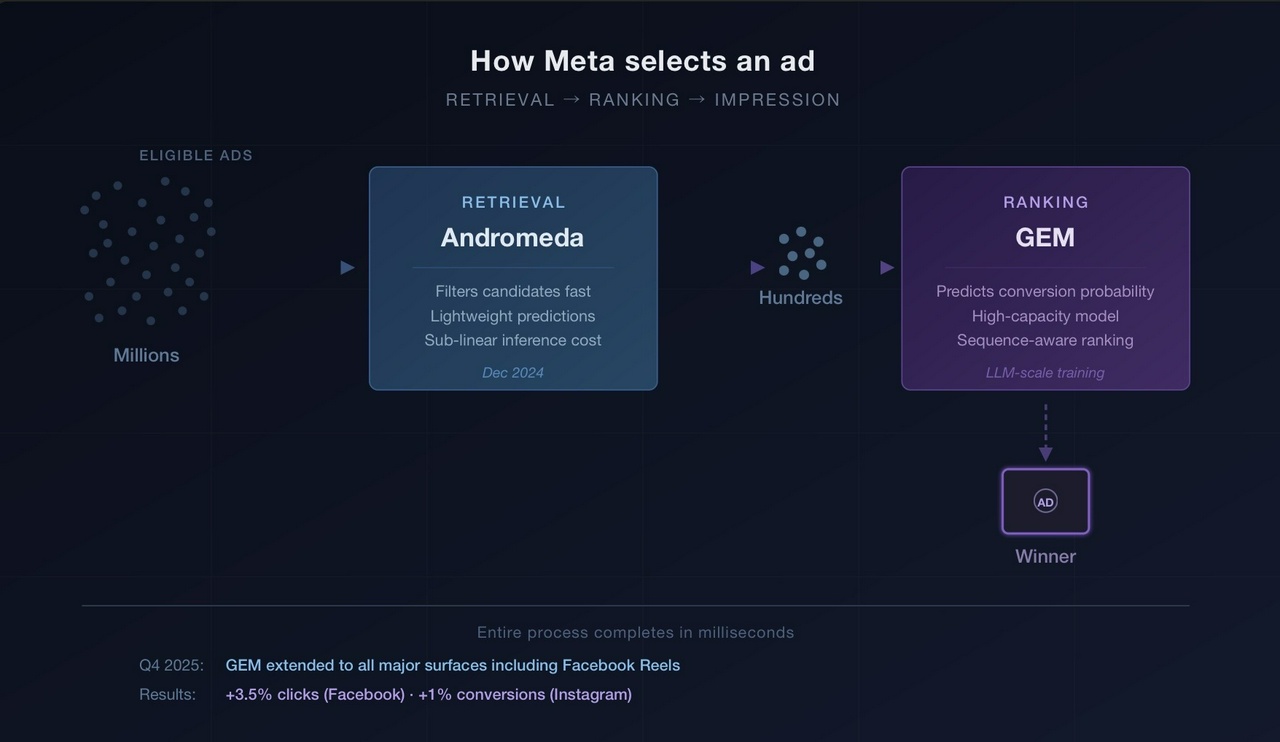
The Generative Ads Recommendation Model, which Meta calls GEM, is the largest foundation model ever built specifically for advertising recommendation. It’s live across every major surface on Facebook and Instagram, and the Q4 2025 numbers, a 3.5% increase in clicks on Facebook, more than 1% lift in conversions on Instagram, are worth paying attention to at Meta’s scale.
Eric Seufert recently published a deep technical breakdown of GEM drawing on Meta’s own whitepapers, a podcast interview with Meta’s VP of Monetization Infrastructure Matt Steiner, and the company’s earnings calls. His analysis is the most detailed public account of how these systems actually work, and what follows draws heavily on it. I’d recommend reading his piece in full, because Meta has been deliberately vague about the internals, and Seufert has done the work of triangulating across sparse sources to build a coherent picture.
That sparseness is worth mentioning upfront. Meta has strong commercial reasons to keep the details thin. What we’re working with is a combination of carefully worded whitepapers, earnings call quotes from executives who are choosing their words, and one arXiv paper that may or may not describe GEM’s actual production architecture. I think the picture that emerges is convincing. But we should be honest about the fact that we’re reading between lines Meta drew deliberately.
The retrieval/ranking split
If you’re going to understand what GEM changes, you need to grasp the two-stage model Meta uses to select ads. Seufert explains this well: first ad retrieval, then ad ranking. These are different problems with different systems and different computational constraints.
Retrieval is Andromeda’s job (publicly named December 2024). It takes the vast pool of ads you could theoretically se…

 点赞
点赞 收藏
收藏 点踩
点踩 分享
分享