Learning the invisible dance

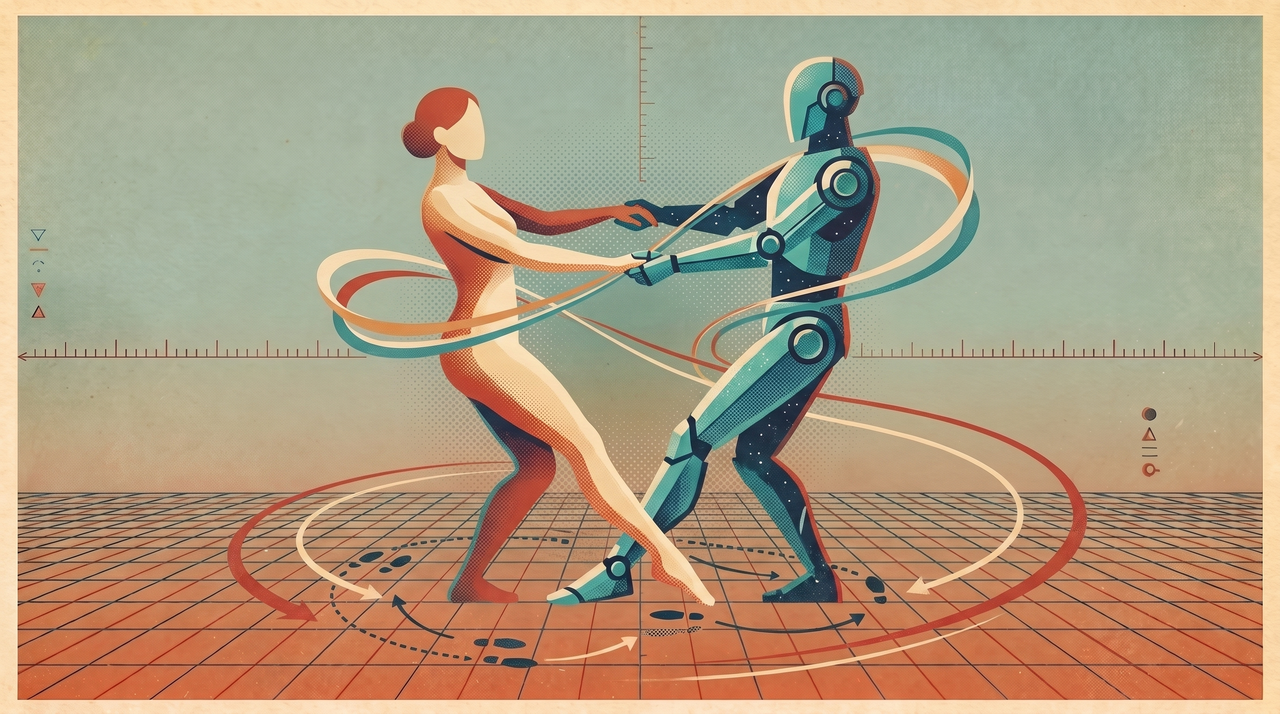
You live within a system you never signed a contract with. Every day, you make thousands of micro-decisions about how to behave, mostly without conscious thought. You pay an invoice on time, even if the supplier would never discover that you didn’t. You refuse to do business with someone who stiffed their last three partners, and you’d think twice about a colleague who didn’t. Nobody wrote these rules down. You absorbed them the way you absorbed grammar through exposure and correction.
A March 2026 paper from the Knight First Amendment Institute by Gillian Hadfield, Rakshit Trivedi, and Dylan Hadfield-Menell argues that this invisible social choreography is the core mechanism of democracy, not just an adornment. Furthermore, AI agents, such as those currently being developed to run businesses and manage supply chains, will undermine that mechanism unless they learn this dance too.
Democracy Is a Verb, not a document
The paper begins by challenging a common assumption. Most view democracy as a collection of documents, institutions, constitutions, elections, and courts. The authors contend that this is roughly akin to describing a marriage solely through its wedding vows. While the vows matter, the true essence of a marriage lies in the thousands of everyday acts of compromise and occasional irritation that sustain cooperation over decades.
Hadfield, Trivedi, and Hadfield-Menell utilise a theoretical framework called “normative social order” to make this precise. In their model, a society’s actual norms are the product of an interactive system. People don’t follow rules because they are written down; they follow them because they observe others doing so and see how violations are punished. Punishments don’t need to be severe, just a disapproving look, a refusal to do business, or a sarcastic comment at a dinner party. These micro-sanctions generate the gravitational field that keeps behaviour in orbit.
This is where the paper borrows a term from evolutionary the…

 点赞
点赞 收藏
收藏 点踩
点踩 分享
分享