Ragged Neighborhood Attention for Spatiotemporal Neural Denoising of Deep Monte Carlo Renderings

Ragged Neighborhood Attention for Spatiotemporal Neural Denoising of Deep Monte Carlo Renderings
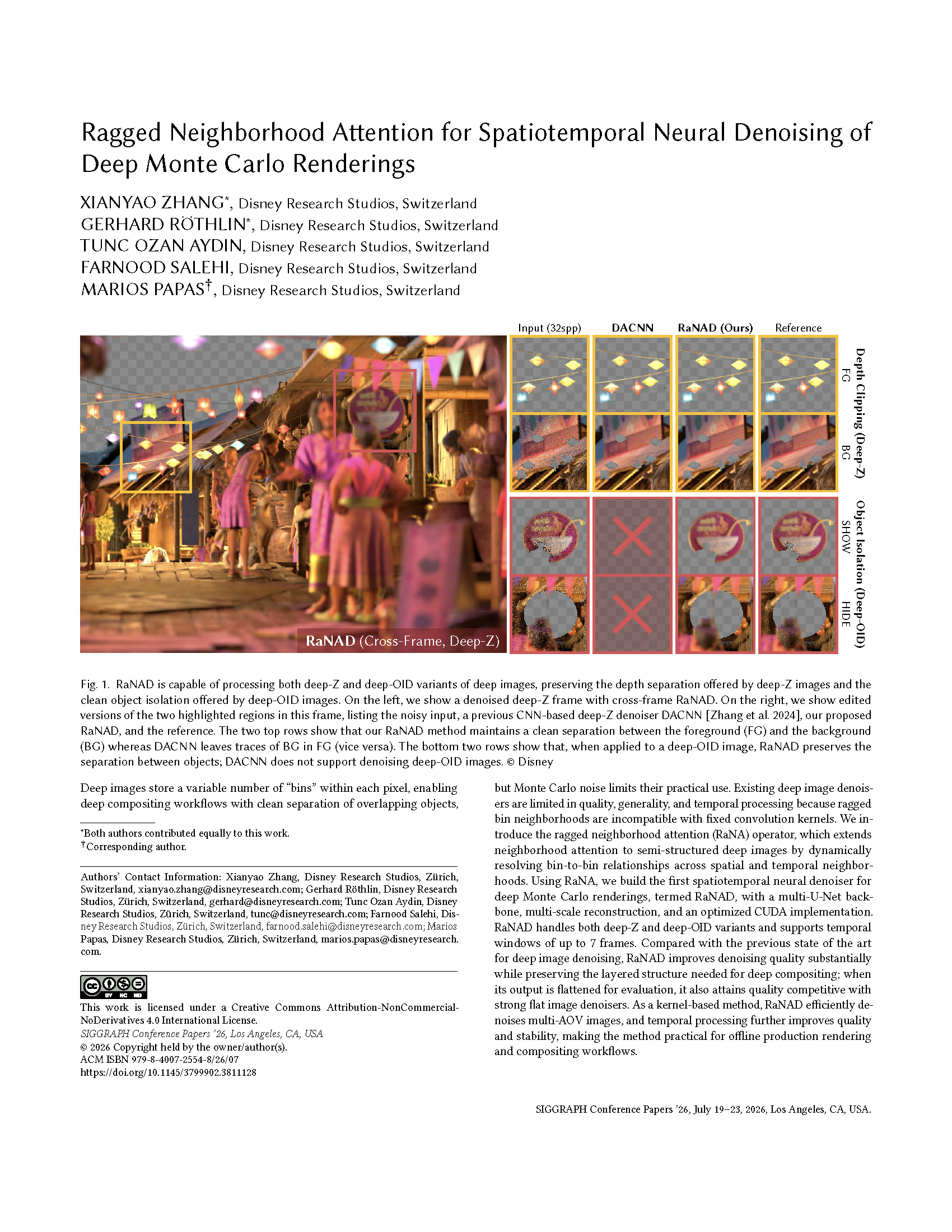
In this work, we introduce the ragged neighborhood attention (RaNA) operator, which extends neighborhood attention to semi-structured deep images by dynamically resolving bin-to-bin relationships across spatial and temporal neighborhoods.
July 16, 2026
SIGGRAPH (2026)
Authors
Xianyao Zhang (DisneyResearch|Studios)
Gerhard Röthlin (DisneyResearch|Studios)
Tunç Ozan Aydin (DisneyResearch|Studios)
Farnood Salehi (DisneyResearch|Studios)
Marios Papas (DisneyResearch|Studios)
Ragged Neighborhood Attention for Spatiotemporal Neural Denoising of Deep Monte Carlo RenderingsDownload Publication PDFDownload Supplemental PDF
Abstract
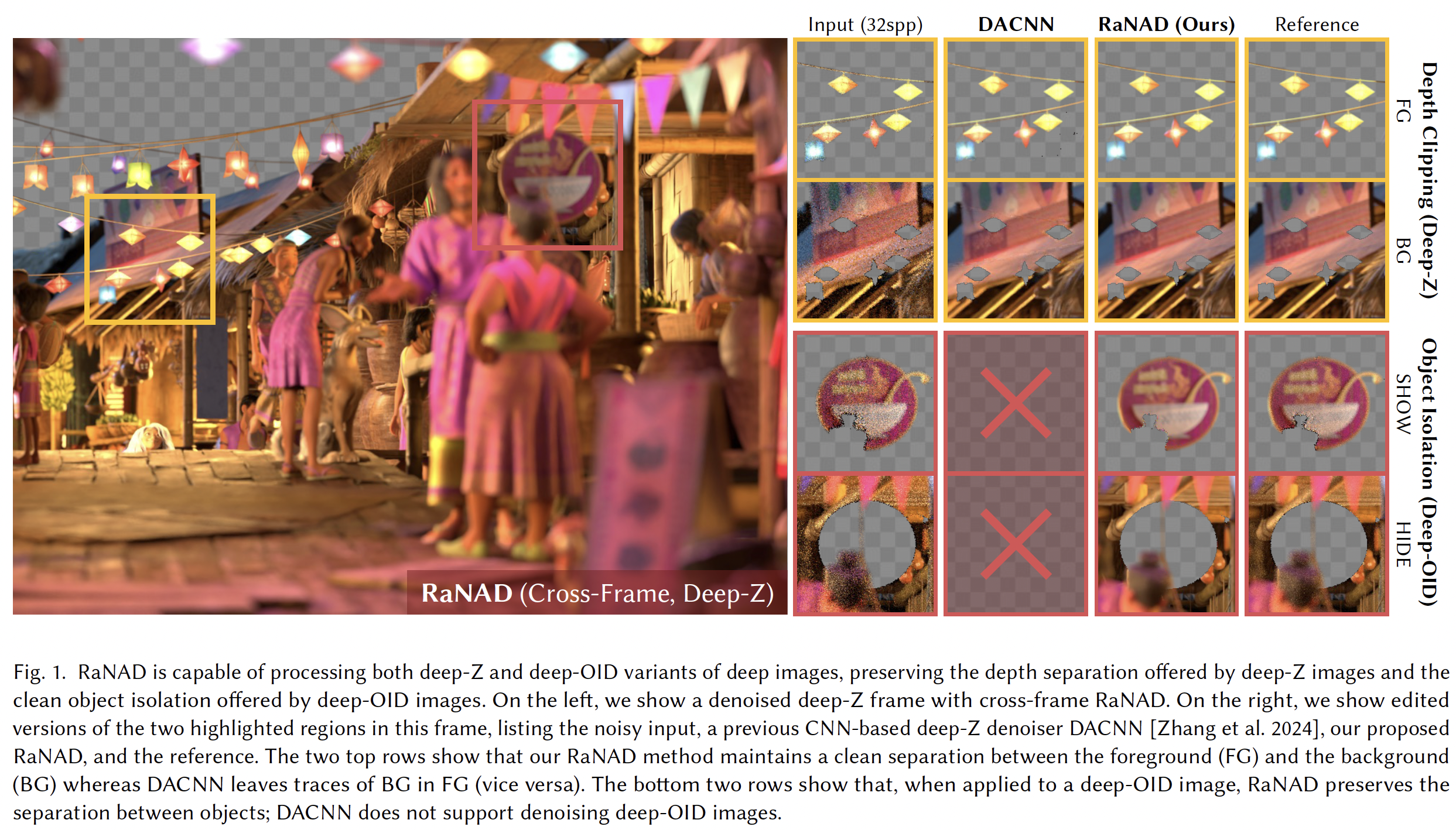
Deep images store a variable number of “bins” within each pixel, enabling deep compositing workflows with clean separation of overlapping objects, but Monte Carlo noise limits their practical use. Existing deep image denoisers are limited in quality, generality, and temporal processing because ragged bin neighborhoods are incompatible with fixed convolution kernels. We introduce the ragged neighborhood attention (RaNA) operator, which extends neighborhood attention to semi-structured deep images by dynamically resolving bin-to-bin relationships across spatial and temporal neighborhoods. Using RaNA, we build the first spatiotemporal neural denoiser for deep Monte Carlo renderings, termed RaNAD, with a multi-U-Net back-bone, multi-scale reconstruction, and an optimized CUDA implementation. RaNAD handles both deep-Z and deep-OID variants and supports temporal windows of up to 7 frames. Compared with the previous state of the art for deep image denoising, RaNAD improves denoising quality substantially while preserving the layered structure needed for deep compositing; when its output is flattened for evaluation, it also attains quality competitive with strong flat image denoisers. As a kernel-based method, RaNAD efficiently de- noises multi-AOV images, and temporal processing further improves quality and stability, making the method practical for offline production rendering and compositing workflows.
Copyright Notice
The documents contained in these directories are included by the contributing authors as a means to ensure timely dissemination of scholarly and technical work on a non-commercial basis. Copyright and all rights therein are maintained by the authors or by other copyright holders, notwithstanding that they have offered their works here electronically. It is understood that all persons copying this information will adhere to the terms and constraints invoked by each author’s copyright. These works may not be reposted without the explicit permission of the copyright holder.
Research at DisneyHomeResearchPeopleCareersPublicationsOutreachAbout Us
LegalPrivacy PolicyCalifornia Privacy RightsChildren's Online Privacy PolicyTerms of Use
MORENews

 点赞
点赞 收藏
收藏 点踩
点踩 分享
分享