Dynamical frame reconstruction in FSI: multi-frame projection explored?
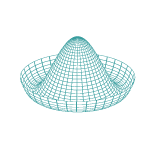
I'm investigating whether the following conceptual approach to fluid-structure interaction has appeared in the literature, or if there is a known fundamental reason it has not.
Setup: A deformable body $\mathcal{Y}(t) \subset \mathbb{R}^3$ evolves under fluid loading. The fluid environment is omnidirectional—flow impinges from all directions $\theta \in S^2$ simultaneously.
Proposed method:
1. For each flow direction $\theta \in S^2$ and each time $t$, construct a plane $\Pi_\theta(t)$ that is parallel to the body's instantaneous local tangent plane.
2. Project the body onto this plane: $\mathcal{P}\theta(t) = \mathrm{proj}{\Pi_\theta(t)}(\mathcal{Y}(t))$.
3. On the projected region, define pointwise fluid properties. At each point $\mathbf{p} \in \mathcal{P}\theta(t)$, a vector $\vec{W}\theta(\mathbf{p},t)$ (fluid velocity) and a scalar $\rho_\theta(\mathbf{p},t)$ (density). The pair $(\vec{W}, \rho)$ encodes the local fluid state.
4. Compute the directional force by integrating over the projected region:
$\vec{F}\theta(t) = \int{\mathcal{P}\theta(t)} \rho\theta(\mathbf{p},t) \, \vec{W}_\theta(\mathbf{p},t) \, dA(\mathbf{p})$
5. Sum over all directions to obtain the total force:
$\vec{F}{\text{total}}(t) = \int{S^2} \vec{F}_\theta(t) \, d\Omega(\theta)$
6. Advance the body by a small time step $\varepsilon$ using $\vec{F}_{\text{total}}$, obtaining a new configuration $\mathcal{Y}(t+\varepsilon)$.
7. Repeat: the new configuration implies new parallel planes $\Pi_\theta(t+\varepsilon)$, new projections $\mathcal{P}_\theta(t+\varepsilon)$, new pointwise vectors, new forces.
Key feature: The observation frame (the plane $\Pi_\theta$) is not fixed, nor is it attached to the body's center of mass. It is reconstructed from scratch at every time step, based on the body's instantaneous geometry and the flow direction. The force computation therefore depends on the full history of geometric configurations through the iterative reconstruction of frames.
Distinction from existing methods:
• ALE (Arbitrary Lagrangian-Eulerian): Uses a single moving frame, typically aligned with the bulk motion. Local geometric changes are handled through mesh deformation, not through explicit re-projection onto a family of direction-dependent frames.
• Panel methods: Discretize the surface into panels, but the force computation is usually for static or prescribed motion, not with iterative frame reconstruction driven by the instantaneous configuration.
• Fast multipole / vortex particle methods: Use pointwise interactions, but in a fixed or globally transformed space, not in a family of locally parallel frames that are rebuilt at each step.
• Surface stress integration: Computes force via $\int_{\partial\mathcal{Y}} \boldsymbol{\sigma} \cdot \hat{n} \, dA$, which encodes all directions and local geometry in a single tensor. The question is whether the explicit decomposition into direction-dependent projections offers any conceptual or computational advantage, or if it is fundamentally redundant.
My questions:
1. Does this "dynamical frame reconstruction with multi-frame projection and pointwise decomposition" appear in the FSI or related literature (e.g., geometric mechanics, shell theory, integral geometry)?
2. Is the projection step $\mathcal{P}\theta(t) = \mathrm{proj}{\Pi_\theta(t)}(\mathcal{Y}(t))$ subject to known information-loss issues when the 3D surface curvature is significant, making the force computation inconsistent with direct surface stress integration?
3. If the approach is computationally equivalent to (but more expensive than) standard surface stress methods, is there any regime—such as highly deformable thin structures with rapid geometric changes—where the explicit frame reconstruction might offer conceptual clarity or numerical advantages over mesh-based methods?
Any references, conceptual pointers, or critical observations would be appreciated.

 点赞
点赞 收藏
收藏 点踩
点踩 分享
分享