Is this delay-coupled oscillator formulation for a 3D phononic lattice physically correct?
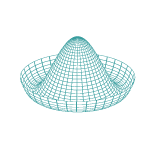
I'm modeling a 3D lattice of piezoelectric resonators,
where each node is coupled to its nearest neighbors
with a propagation time delay (representing finite
wave speed between nodes), and driven by thermal noise.
The governing equation for node $i$ is:
$\frac{d^2u_i}{dt^2} + \gamma\frac{du_i}{dt} + \omega_i^2 u_i = \sum_{j} K_{ij} \cdot u_j(t - \tau_{ij}) + F_{th}(t)$
Where:
• $u_i$ = displacement of resonator $i$
• $\gamma$ = damping coefficient
• $\omega_i$ = natural frequency of resonator $i$
• $K_{ij}$ = coupling strength to neighbor $j$
• $\tau_{ij}$ = propagation delay to neighbor $j$ (based on distance and wave speed in the medium)
• $F_{th}(t)$ = thermal (Langevin) noise force
Questions:
1. Is this a correct formulation of a delay-coupled oscillator network, or am I missing terms (e.g. second-order delay effects, retardation corrections)?
Context: I'm investigating whether constructive/destructive interference patterns in such a lattice could represent computational states (an analog optimization process). Just want to confirm the underlying oscillator model is physically sound before going further.

 点赞
点赞 收藏
收藏 点踩
点踩 分享
分享