
LA’s New Mayor Could Solve the DSA’s Image Problem


First New York. Now Los Angeles.
By Erika D. Smith
Published: 2026-11-08T21:00:03+08:00
First New York. Now Los Angeles.
Soon, the two most populous and influential cities in the US will be led by members of the Democratic Socialists of America. That’s something that would’ve seemed almost impossible even a few years ago — like Democrats being elected to lead Texas.
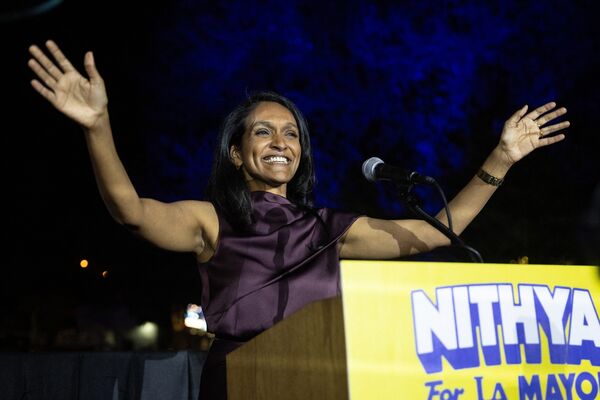
But on Thursday, LA’s 73-year-old incumbent mayor, Karen Bass, conceded to her 45-year-old opponent, City Councilmember Nithya Raman. “While this is not the outcome we hoped for,” Bass told supporters, “the people of Los Angeles have spoken.”
To say the tight-knit group of political, business, union and nonprofit leaders who supported Bass is shocked would be an understatement. But they shouldn’t be. Why Raman got elected isn’t all that different from why DSA-aligned Zohran Mamdani got elected mayor of New York last year. It’s a story of generational change. And it’s about a diverse coalition of mostly younger voters embracing a more in-your-face style of progressive, outsider politics in hopes of quickly solving problems that establishment politicians like Bass have let fester for too long.
But what happens next, now that Raman will join Mamdani as one of the highest-profile democratic socialists in the US, could make for a far more interesting story with national political implications. Together as mayors, they will have an opportunity to not only reset but improve the narrative around the DSA in the minds of voters — and do it before 2028, when one of its members, Representative Alexandria Ocasio-Cortez, may run for president.
Right now, polling shows about half of all voters nationally have an unfavorable opinion of “socialism” or “democratic socialism,” though they can’t agree on what either term means.
There also isn’t much consensus on what the politicians who identify as socialists or democratic socialists actually stand for. When the Washington Post polled voters about it earlier this year, for example, their definitions ranged from helping ordinary Americans with universal health care and economic equality to demanding wealth redistribution and government control.
Republicans have, of course, added their own definitions to the mix. Trump, in particular, likes to throw around words like “Marxism” and “communism.” I also imagine many Americans associate the DSA — and the progressive left in general — with criticism of the Israeli government and with taxing billionaires, though both of those positions have become almost mainstream Democratic dogma at this point.
However, Raman and Mamdani take a different approach to democratic socialism. Their focus, when it comes to governance, is on making the public sector more effective, efficient and responsive to the needs of working people, many of whom are fed up with unaffordability and want a better quality of life.
Both talk incessantly about fixing potholes, streetlights, sidewalks and other neglected infrastructure that cause daily aggravations for residents, who are also voters. It is, in many ways, a throwback to the 20th-century era of “sewer socialism,” when politicians launched massive projects to expand the public sewage and parks systems, in addition to housing, in Milwaukee.
As Mamdani said in October at a gathering of mayors during the UN General Assembly: “If politics cannot deliver on the block where you live, why would you trust it to deliver anywhere? If you are making a New Yorker’s life a little smoother, so too you are making their journey to believe in government’s ability to deliver for them.”
Raman often gets compared with Mamdani. But she isn’t as politically progressive as he is. An MIT-trained urban planner, Raman based her campaign on bureaucracy-shredding policy tweaks, not aspirational goals such as free buses. Then again, Raman’s biggest promise — to “build a city that works” — actually does sound aspirational in Los Angeles. That’s because much of the city does feel hopelessly broken, given the homeless encampments that never seem to go away and the piles of trash that never seem to get picked up.
“We have had enough of establishment politics,” Raman said to a roar of applause during her election night speech. “This campaign has made it clear that the days of our broken status quo are over.”
To address the high cost of housing in a city where most people rent and almost 30% of all renters are severely cost-burdened, Raman campaigned on dramatically increasing the supply of housing by helping private developers build more of it. And she would let them do it in every neighborhood, regardless of whether residents object to the projects.
That’s easier said than done. It would represent a major departure from how establishment Democrats have long handled this issue, which is why there’s a housing shortage so acute in LA that tens of thousands of homeless people sleep on the street each night.
Bass, in particular, has been known to cave to neighborhood groups and scale back projects. She campaigned on a more modest plan to build mostly more affordable housing and mostly along busy corridors where residents would have no reason to object.
To address concerns about gentrification and displacement, Raman has promised to establish an Office of Tenant Protections and, as a member of the City Council, helped cap the rent, much like the rent freeze that Mamdani promised during his campaign and recently turned into an actual policy.
Janeese Lewis George, the incoming DSA-aligned mayor of Washington, has proposed similar plans, arguing that private-sector building “paired with policies to protect residents, really is critical.”
In some ways, what Raman, Mamdani, Lewis George and Seattle’s DSA-aligned Mayor Katie Wilson are doing is blurring the standard political binary of progressive and moderate. They are taking a pragmatic approach to populism.
“Focusing on the needs of the vast majority of American people who are struggling in the richest country on Earth, while the very rich are getting richer. Man, you don’t need a Ph.D. in economics or political science to figure that out,” Vermont Senator Bernie Sanders, the OG democratic socialist, recently told Politico. “That is the issue. How do we create a decent standard of living for all of our people?”
It’s quite possible that if voters come to associate democratic socialism with politicians who prioritize such results-oriented governance, rather than with leftist ideologues focused on controversial issues, they will have a more positive opinion of the DSA.
Voters merely want politicians who will make government work for them. Bass pitched herself as an experienced executive who, despite the city’s bungled handling of the fires that leveled the Pacific Palisades last year, would be best equipped to handle the big things coming LA’s way, including the 2028 Olympics. But many voters came to doubt the mayor’s ability to handle the little things affecting the quality of their day-to-day lives. The unanswered calls to the city about darkened streetlights. The trash piling up in an alley attracting rodents.
That may be the real story of why Bass lost the race for mayor. Los Angeles voters, like supporters of democratic socialism and the DSA, are depending on Raman to do better.
More From Bloomberg Opinion:
- LA Is Becoming the New Home of West Coast Progressivism: Erika D. Smith
- Rubio’s Latin American Project Keeps Taking Hits: Juan Pablo Spinetto
- Schumer’s Biggest Challenge Will Be Wrangling Overzealous Democrats: David Drucker
Want more Bloomberg Opinion? OPIN . Or subscribe to our daily newsletter.
To contact the author of this story:
Erika D. Smith at erikadsmith@bloomberg.net
To contact the editor responsible for this story:
Tracy Walsh at twalsh67@bloomberg.net