
Election Interference Didn’t Simply Disappear on Its Own


It would be wrong to say there wasn’t any federal interference in the midterm elections. The electoral landslide was simply so thorough that the dangers experts had warned about never came to pass.
By Mary Ellen Klas
Published: 2026-11-08T21:00:04+08:00
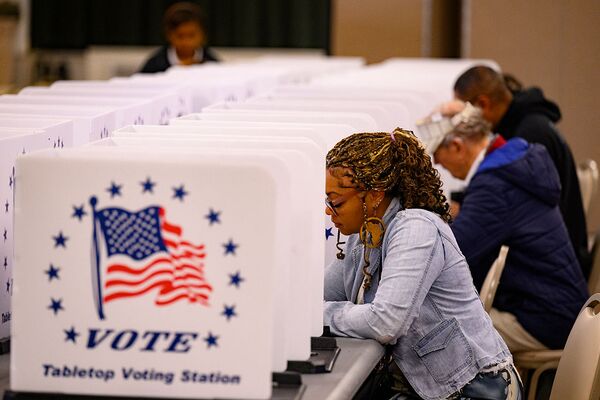
It would be wrong to say there wasn’t any federal interference in the midterm elections. The electoral landslide was simply so thorough that the dangers experts had warned about never came to pass.
Some votes are still being counted, and certification deadlines have yet to arrive, but one thing is clear: The nation’s decentralized system of state-run elections withstood a stress test from the most powerful man in the world.
President Donald Trump never stopped relitigating his 2020 election defeat and resurfacing voter-fraud conspiracy theories. In the run-up to the midterms, he used every power of his office to try to influence the results. He failed.
“I am absolutely willing to accept those results, yeah,” Trump told The New York Times in a late-night telephone interview on Tuesday. (By Saturday, he was reposting comments questioning the outcome.)
But the peaceful conclusion to one of the most consequential elections in US history didn’t happen by accident. It involved nearly two years of organized effort by lawyers, advocates, Democratic attorneys general and election officials from both parties.
Upon his return to the White House, Trump and his allies stoked conspiracy theories, tried to federalize state-run elections, sowed chaos and fear about mail-in ballots, and spent months trying to discourage people from voting. Trump pressured Republican states to draw new congressional maps through mid-decade redistricting and pushed Congress to pass a restrictive voting law dubbed the SAVE Act. The Department of Justice filed lawsuits against 30 states seeking access to confidential voter records over allegations of noncitizen voting and threatened election officials with prosecution if they didn’t comply.
At least 34 federal district court decisions either temporarily halted or permanently blocked most of the administration’s efforts to interfere. But each one took enormous amounts of time, money and effort to litigate.
And advocates did not expect this drumbeat of court defeats to prevent the administration from trying to reject the outcome, said Jonathan Diaz, director of voting advocacy for the Campaign Legal Center, one of several groups that worked to challenge federal interference.
The groups feared that, if Trump didn’t like the results, officials would use unsubstantiated rumors to seize ballots. That the White House would dispute key races. That the DOJ would try to stop certification.
Those extraordinary intrusions didn’t happen largely due to a loss so decisive that Trump couldn’t fabricate a convincing hoax.
“It really was the voters who put the final nail in the coffin of the administration effort,” Diaz told me. “It is much harder to try to game the system and overturn the result of an election when you lose it by significant margins.”
There’s likely another reason the election interference efforts failed: Voters started to see what the administration was doing.
For the last decade, Trump and other election deniers have pushed conspiracies about election fraud without supplying any proof. Chief among these: that Democrats across the country had somehow secretly organized hundreds of thousands of noncitizens to register to vote in the midterms in a stealth attempt to rig the results. The Department of Homeland Security even claimed more than 250,000 potential noncitizens were on the voter rolls in California, New Jersey, Nevada and Pennsylvania. When state officials checked, they found that wasn’t true.
The administration pushed that claim until the day of the election. But in the end, voters trusted the process enough to show up in almost unprecedented midterm numbers. (According to the University of Florida Election Lab, 123 million voters cast ballots.)
There is still plenty of work to do to shore up election integrity in the US. Some prominent election deniers went down in defeat — such as Texas Attorney General Ken Paxton, who lost his US Senate bid, and the Republican candidates for secretary of state in Nevada and Arizona. But 99 election deniers were elected to office, including the Republican governors of Florida, Alabama, Idaho, South Carolina and Tennessee.
It’s time they heed the blistering words of Thomas Galvin, a Republican member of the board that runs elections in Maricopa County, Arizona — a once-conservative state where Democrats have just captured trifecta control of government.
“To my fellow Republicans who have been trafficking these lies for the last six years, you need to stop,” Galvin wrote on Thursday. “Because you have led to the destruction of the Republican Party here in Arizona, and frankly around the country.”
This week, the US election system demonstrated its resilience. The American people demonstrated their trust in it. Once, that wouldn’t have been a big deal — but in 2026, it is.
More From Bloomberg Opinion:
- Can We Please End These Gerrymandering Wars Now?: Mary Ellen Klas
- Schumer’s Biggest Challenge Will Be Wrangling Overzealous Democrats: David Drucker
- A Cornered Trump Is a More Volatile Trump: Timothy L. O’Brien
Want more Bloomberg Opinion? OPIN . Or subscribe to our daily newsletter.
To contact the author of this story:
Mary Ellen Klas at maryeklas@bloomberg.net
To contact the editor responsible for this story:
Sarah Green Carmichael at sgreencarmic@bloomberg.net