
Bank Crisis Drives an Ex-President to Wrest Power Back From His Protege
 3


Paraguay’s bank crisis has given ex-president Horacio Cartes the opportunity to claw back the power and influence that he had ceded to his own protégé.
By Ignacio Olivera Doll and Manuela Tobias
Published: 2026-11-07T23:00:00+08:00
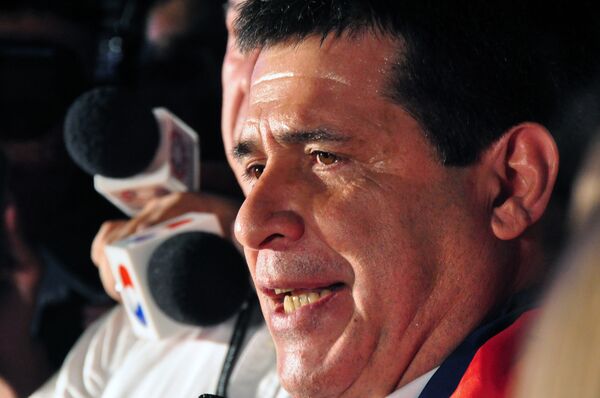
Paraguay’s bank crisis has given ex-president Horacio Cartes the opportunity to claw back the power and influence that he had ceded to his own protégé.
The tobacco magnate, who served as the country’s president from 2013 to 2018, had until last year been sanctioned by the US over accusations of “significant corruption.” A health scare in February left Paraguayans to believe the once-influential figure’s time in the sun was over. By May, he was ready to take on his political rivals once again.
“Even though several of you wanted to see me dead, I’m alive,” said Cartes, now 70. “You’re going to have to put up with me for a long time.”
And now, it’s his former protégé, ex-President Santiago Peña, 47, who is now under house arrest — and Cartes who is once again handpicking Paraguay’s next president.
For many Paraguayans, the collapse of Ueno Bank, which this week triggered the country’s biggest financial crisis in more than two decades, was the culmination of an internal political battle that had escalated dramatically over the previous several months between Peña and Cartes.
Ueno’s troubles were already an open secret for months in Paraguayan financial circles, having grown at breakneck speed duringPeña’s rise to the presidency and his time in office. The bank — Peña previously held a stake in its parent company — benefited from regulatory decisions and a large influx of deposits came from public-sector institutions.
The crisis accelerated when senators aligned with Cartes sought central bank information about the lender, exposing its books to greater scrutiny until regulators seized the bank early Tuesday. The move froze the savings of one in three Paraguayans, sparking widespread protests.
Congress — led by party leader Cartes — unanimously voted to impeach Peña, but declined to do the same to Vice President Pedro Alliana, 52, making the kingmaker’s pick clear. Alliana was named president on Friday afternoon.
“They suspected Cartes’ power had begun to fade and that a new era was coming in Paraguay. But none of that was happening,” said Sebastián Acha, a former lawmaker who now heads consulting firm Pragma.
US Sanctions
In Asuncion, Cartes is so powerful that some Paraguayans don’t even utter his name when they have something bad to say. Instead, they refer to him by his initials or as “the man on Calle Espana,” the street where his mansion sits that effectively served as the headquarters of his presidency.
That’s why it became such a media spectacle when the US ambassador to Paraguay held a press conference in Asuncion in 2022 to announce sanctions against the man who had ruled the country from 2013 to 2018. He and his children were barred from entering the US.
Washington accused Cartes of a sweeping corruption scheme, and alleged he used his fortune to buy political influence by making monthly payments of as much as $50,000 to lawmakers. They also alleged Cartes had links to members of Hezbollah, which the US designates a foreign terrorist organization. In 2023, the ambassador held another conference to announce Treasury sanctions.
Still, none of that made much of a dent in local politics. Not long after the first press conference, Cartes was elected president of the Colorado Party, which controls both houses of congress and has ruled Paraguay for decades. Peña, an economist who served as Cartes’ finance minister, became president the following year.
The Trump administration lifted the financial sanctions in October 2025 without retracting the accusations, which Cartes denies. Peña has denied lobbying Washington on Cartes’ behalf, though the move was widely seen in Paraguay as something he had sought.
Paraguay has since become a key US partner in Latin America as US President Donald Trump seeks to expand his influence. Marco Rubio underscored that interest in 2024, when he became the first sitting US senator to visit the country in more than four decades, and the relationship has drawn greater attention since he became secretary of state.
Long anchored in security cooperation, ties have expanded into trade and investment. It’s also the only country in South America to formally recognize Taiwan, a longtime diplomatic position that’s led to a strained relationship with Beijing.
“There was a sense from the US government beyond Cartes’ own motivation to remove sanctions that keeping sanctions on the country’s most powerful politician just wasn’t pragmatic in carrying forward the strengthening bilateral relationship,” said Gregory Ross, a senior associate at Washington-based advisory firm McLarty Associates who specializes in Paraguay.
Colorado Party politics also help explain the reversal. At the time Cartes was sanctioned, a rival faction within the party was in power.
The sanctions were “a dramatic move but less disruptive to US-Paraguay relations,” said Benjamin Gedan, director of the Stimson Center Latin America Program in Washington. “Things get very different when Peña emerges as Paraguay’s next leader because he was allied with the Cartes faction.”
Business Empire
Long before he came to dominate Paraguayan politics, Cartes had built a business empire spanning tobacco, beverages, banking and agriculture. His presidency of local soccer team Club Libertad also gave him a national profile. By the time he entered politics, he already had the money, connections and name recognition to build a movement of his own.
His rise was meteoric. Cartes joined the Colorado Party in 2009, having never held elected office, and created the Honor Colorado faction the following year. The party cleared his path to the presidency by temporarily suspending a rule requiring candidates to have been members for 10 years.
His attempt to stay in power ended in crisis. In 2017, his allies pushed a constitutional change to allow presidential reelection. Protests ended with congress in flames and one demonstrator dead. Cartes abandoned the effort, but found another way to retain power: Peña, his former finance minister, became his political heir and eventually won the presidency in 2023.
This year, however, Peña and Alliana, also a longtime Cartes ally, began carving out their own faction within the party. For a time, they appeared to be gaining the upper hand. Governors and lawmakers rallied around them, and after Cartes’ candidate lost Asuncion municipal elections on Oct. 4, it seemed Cartes had succumbed. He said he would not present a candidate in the party primaries in an Oct. 18 statement.
Then Ueno gave Cartes an opening.
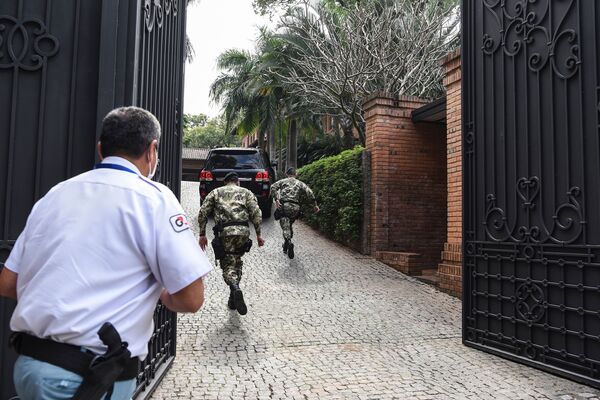
Lawmakers aligned with Cartes began demanding information about Ueno, including its related-party transactions and public-sector deposits. The scrutiny helped expose problems that ultimately led regulators to place the bank into resolution Tuesday, setting off a financial and political crisis. Just hours earlier, Alliana had publicly criticized Peña’s handling of the crisis, moving back toward Cartes.
“Cartes was believed to be stepping back from politics, going back to his business empire,” said Ross. “That has all changed within the past week.”
Cartes then backed efforts to remove his former protégé. Peña rapidly lost the support of his party, while Alliana survived an impeachment attempt and emerged as his successor.
“This is, in part, a fight for political leadership,” said Dionisio Borda, a former finance minister who advised Peña when he served as head of the ministry under Cartes. “Cartes has enormous influence over Paraguayan politics because he has deep pockets and a strong appetite for power. To a large extent, he still holds political power in Paraguay,”
Borda, however, places responsibility for Ueno’s collapse on Peña, calling it a “fraud against its customers” and pointing to the bank’s exponential growth fueled by public money, including some $850 million from the government and the state pension fund IPS.
“I always saw Peña as ambitious, but I never imagined his financial and monetary ambitions would go this far,” Borda said.