
A nanogel that helps a porphyrin sense copper in the presence of zinc


Porphyrins are among nature’s most important pigments. The name comes from the Greek word for purple, and the molecules are four small nitrogen-containing rings joined into a larger ring, with room at the centre for a metal atom. In the haemoglobin of blood that atom is iron; in the chlorophyll of plants it is magnesium. The German chemist Hans Fischer worked out these structures and synthesised haemin, the iron-containing part of blood pigment, earning the 1930 Nobel Prize in Chemistry.
The ability to hold a metal, and to change colour or glow in response, makes porphyrins attractive for chemical sensors. But many porphyrins dissolve poorly in water and stick together, distorting their signals. A recent study tackled this by building a porphyrin into a polymer, which also changed how quickly metals reach it.
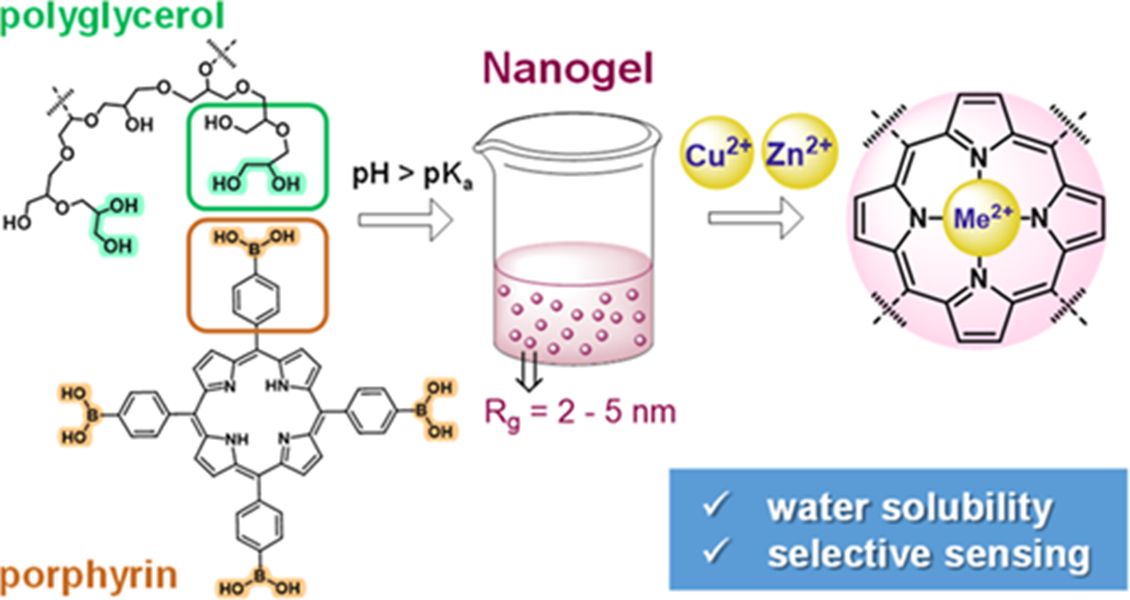
A polymer cage for a porphyrin
The polymer was polyglycerol, a branched chain covered in hydroxyl (–OH) groups that make it water-compatible. The porphyrin, called TPP-4B, was modified with four boronic acid groups. Boronic acids were first isolated in 1860 by the English chemist Edward Frankland, and they bond reversibly to pairs of neighbouring hydroxyl groups, forming links called boronate esters. This is favoured in basic solutions, and here the pH was 10.5.
One porphyrin carries four boronic acids, so it can tie together several points on a polymer chain. Dilute solutions and slow addition of the polymer kept the links forming mostly within single chains. The result is a unimolecular nanogel: one polymer molecule, held in a compact network by porphyrin cross-links, so the porphyrin is both structure and sensing element.
Two versions came from polymers with average molar masses of about 8,000 and 60,000 grams per mole: NG8k and NG60k. The larger polymer is also more branched. On average, NG8k has 0.8 porphyrins per polymer molecule and NG60k has 6.2.
Checking that single nanogels formed
To confirm that single nanogels, not giant tangled networks, had formed, the solutions were examined by small-angle X-ray scattering, which reveals the size and shape of dissolved particles from the way X-rays scatter. The nanogels kept the dimensions of their starting polymers, a few nanometres across, and their mass rose only by roughly a third, consistent with the added porphyrin. There was no sign of aggregation. NG8k behaved like a flexible polymer chain, while NG60k was a more compact particle, a difference already present in the starting polymers.
Taming the porphyrin in water
On its own, TPP-4B needed 10% of an organic solvent, dimethyl sulfoxide, to dissolve. Even then it stayed stable for 24 hours at 37 °C only in basic solution; at intermediate pH some was lost from solution, and at pH 4 it aggregated. The nanogels dissolved directly in water and remained stable at pH 5.7, 7.4 and 10.5, aggregating only at pH 4.
Fluorescence, the light a molecule emits after absorbing energy, also changed. Compared with the free porphyrin (measured with solvent present), the nanogels emitted more strongly, particularly NG60k, in a narrower band shifted slightly from 657 to 660 nanometres. This is consistent with the network restricting the porphyrin’s movement, so less energy is lost without producing light. Calculations and a simple model compound indicated that these changes stem from the porphyrin’s new surroundings, not from the boronate ester links.
Copper, zinc and the speed of response
A metal ion can slot into the porphyrin’s central cavity, changing the light it absorbs and emits. Of seven metal ions tested, only copper and zinc produced clear changes. Copper strongly reduces fluorescence, an effect called quenching. Zinc shifts the emission from 657 to about 615 nanometres while largely preserving its intensity. In the free porphyrin, however, both metals weakened the signal at 657 nanometres, so in a mixture their effects overlapped and the copper could not be measured reliably.
Inside the nanogels, both metals reacted more slowly, but by very different amounts. From the reported rate data, copper reacted roughly ten times more slowly in NG8k and forty times more slowly in NG60k than with the free porphyrin. Zinc was hit much harder: about a hundred times slower in NG8k, and in NG60k no consistent response could be measured. At 30 micromolar (millionths of a mole per litre), copper reacted about a hundred times faster than zinc in NG8k.
The slowdown is attributed to metals having to travel through the polymer network, which is denser in NG60k and holds more porphyrins per molecule; the hydroxyl groups may also hold metal ions temporarily. Why zinc is slowed so much more than copper is not established.
Exploting the difference in speed
This difference in speed can be exploited. After 24 hours, NG8k still showed a measurable copper response while contributing little zinc signal. Mixtures with known amounts of both metals were analysed using a copper-only calibration. At 5 to 10 micromolar copper, the estimates were close to the true values (for example 6 against 5), even with zinc present. At 1 to 3 micromolar the method overestimated, by as much as threefold.
NG60k performed worse. Its calibration was poorer because copper reacted so slowly, and its estimates deviated more. Too little confinement, as in the free porphyrin, gives no selectivity; too much blocks the copper as well.
Tell them apart
The study shows that a polymer can do more than keep a sensor dissolved: by controlling how quickly different ions reach it, the polymer helps the sensor tell them apart.
All sensing was done in a carbonate buffer at pH 10.5, a clearly basic solution, using prepared copper–zinc mixtures rather than real water samples. Stability at near-neutral pH does not show that they sense equally well there. For scale, the World Health Organization’s guideline for copper in drinking water is 2 milligrams per litre, about 31 micromolar. Effects of other dissolved substances remain untested.
Author: César Tomé López is a science writer and the editor of Mapping Ignorance
Disclaimer: Parts of this article may have been copied verbatim or almost verbatim from the referenced research paper/s.
References
- E. Gomez Urreizti, M. Sanchez, G. E. Pieslinger, P. Malo de Molina, R. Lund, C. Sanchez-Cano, and F. Barroso-Bujans (2026) Porphyrin-cross-linked unimolecular polyglycerol nanogels: confinement-controlled metalation and selective Cu2+ detection ACS Appl. Polym. Mater. doi: 10.1021/acsapm.6c03970
The post A nanogel that helps a porphyrin sense copper in the presence of zinc appeared first on Mapping Ignorance.