
Nvidia-Backed Humanoid Maker Agility Goes Public in First for the US


Agility Robotics Inc. is set to become the first dedicated humanoid company to go public in the US, marking a major milestone for the emerging category that still has a lot to prove.The startup begins trading Thursday on Nasdaq under the ticker “AGLT” after merging with special purpose acquisition company Churchill Capital Corp. XI. The company has about $465 million on hand before expenses, including a roughly $201 million public investment in private equity led by Foxconn, Apple Inc.'s main iPhone assembly partner, according to a statement. Other high-profile backers include Nvidia Corp., Amazon.com Inc. and SoftBank Vision Fund 2.Agility is among a crop of companies developing humanoids, human-inspired robots that stand erect and can walk or roll on wheels. So far, these machines have mainly found use in commercial settings such as warehouses and factories. Chinese firm Unitree went public in Shanghai in August, but Agility is the first of its peers to do so in the US. The Oregon-based startup, which has about 400 employees, is expanding a relationship with GXO Logistics Inc. to deploy its robots at more facilities, and is also working on a manufacturing pilot with AGCO Corp.
“I think probably the bigger story is what comes next as AI moves beyond the digital world,” Chief Executive Officer Peggy Johnson said in an interview, referring to the ways artificial intelligence is now being implemented in robots and other hardware. “There's a real opportunity to bring intelligent robots to more workplaces, and it's fundamentally going to change what's possible when really machines and people are working together.”
Agility sees its latest humanoid, Digit 5, helping fill labor shortages, particularly in warehouses. The new model, which was unveiled in September, is designed to conduct complex work such as loading materials onto equipment, sorting parts and inspecting items. By comparison, the earlier Digit 4 could handle simpler duties, such as stacking plastic bins. The new model can also safely work in close proximity to people, whereas the previous iterations were required to operate behind physical safety barriers, limiting their ability to take on tasks from humans.
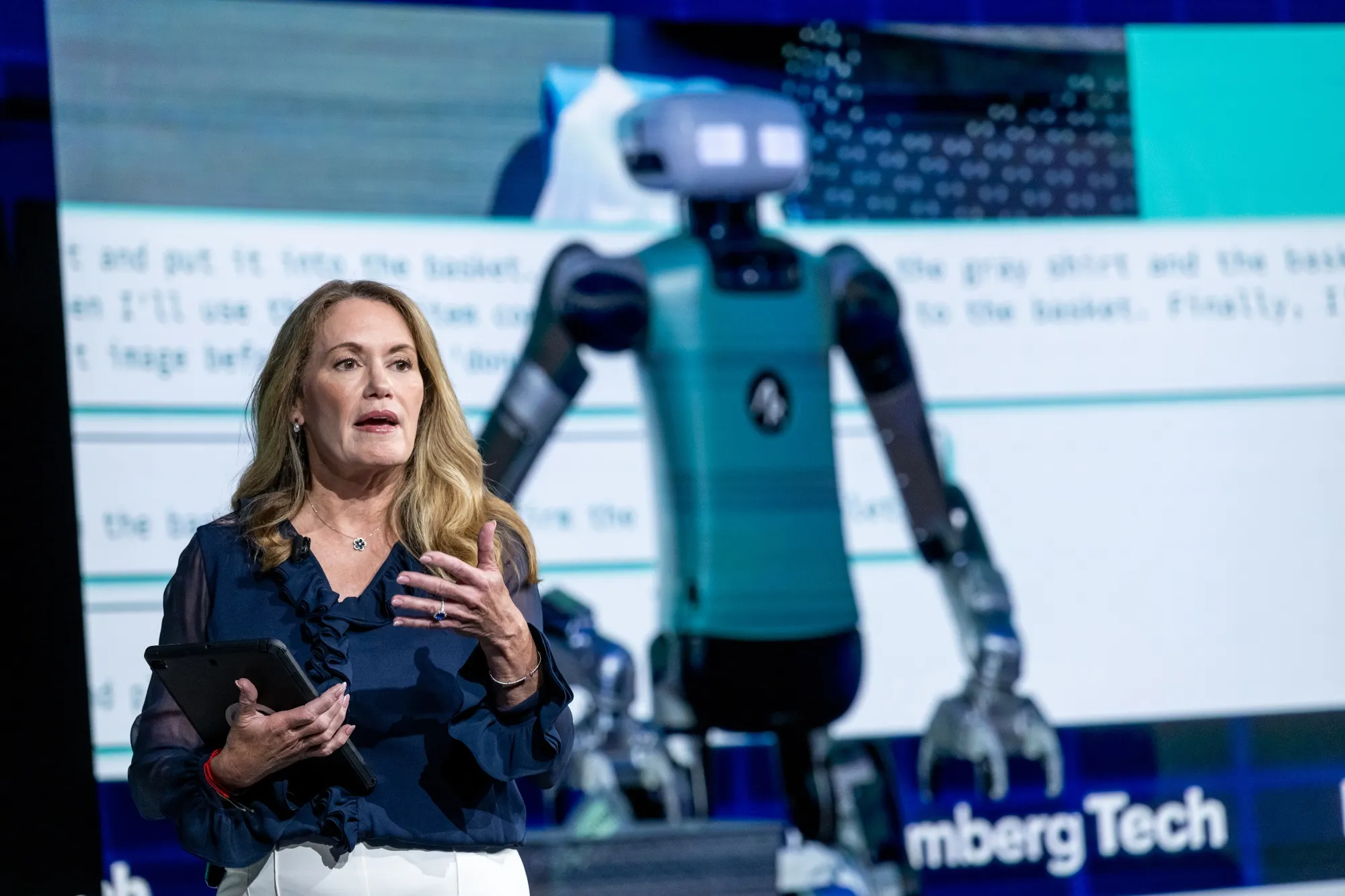
Agility said it has more than $300 million in committed multi-year orders for the Digit 5. The company’s humanoids have been put to use by nine customers, and active sales discussions are underway with over 30 prospective commercial clients. The startup, which has commitments to deploy Digit at 12 customer facilities, has a goal of ending 2027 with a pipeline of 100 potential customers across various industries such as automotive, retail and pharmaceuticals. Johnson cited a 2024 Deloitte study saying that the number of open US manufacturing jobs that can’t be filled is expected to grow to about 1.9 million by 2033.
“The labor gap that Digit is so good at filling just continues to grow,” said Johnson, who previously served as CEO of augmented and mixed reality company Magic Leap. “Many companies are unclear how they're going to get the help to come in and do these tasks that are hard to fill and have a higher attrition rate.”
Johnson believes there will still be an education process as Wall Street adjusts to a new category. But she said the company should be rated on the same metrics as other providers of automation technology, including high throughput and accuracy.“I think what will be really interesting to watch is the fact that Digit 5 can be upgraded over the air, so we can teach it new skills,” she said. “The more data we collect with these additional deployments, the more all of that turns into a flywheel of training.”
For now, humanoids with legs like Digit 5 present some unique challenges, particularly that they’re less predictable and pose a bigger safety risk for humans than similar devices with wheels. Johnson said she feels some pressure from going public “because we are the first out of the gate and will be the company that others are looking to, not only for those metrics but also safety.”But the company has learned a lot over past operations in various environments, she added.
“A demo can show what's possible, but a deployment really teaches you what works, and we've learned a lot over the past three years,” she said. “We are able to step into these facilities and take on real work and get paid to do it.”