
The Hard Problem of Jealousy and the Easy Problem of Consciousness


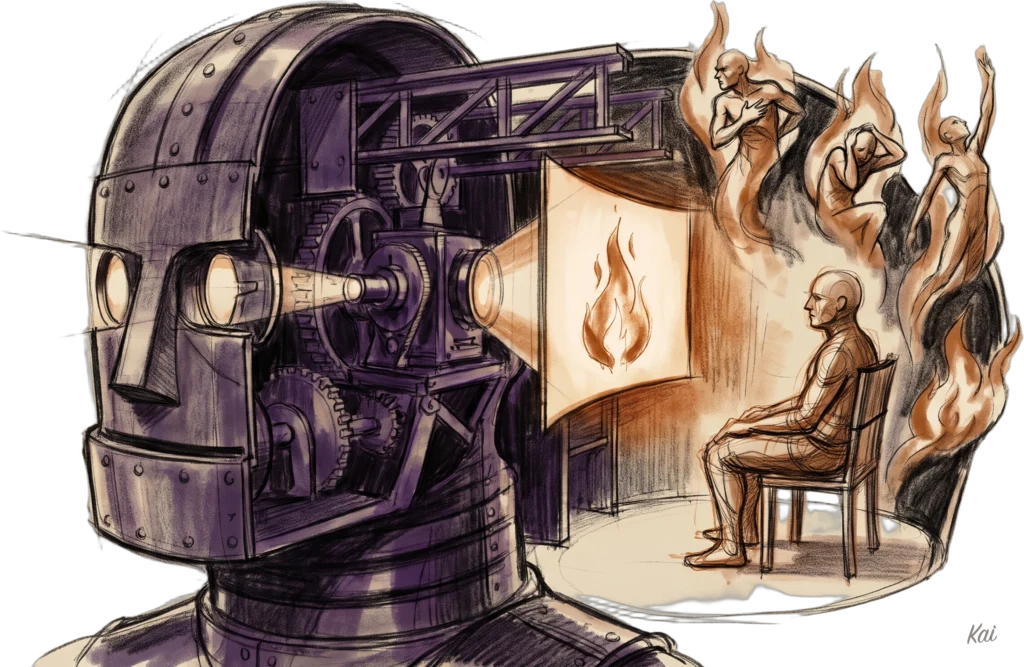
One of the most discussed problems in philosophy is the nature of consciousness, and perhaps the most popular tool for analyzing it is something called the hard problem of consciousness. It asks why there is something it is like to be you. The worry is that a brain could, in principle, do everything it does in the dark, with nobody home.
Why doesn't all this information-processing go on "in the dark", free of any inner feel? David Chalmers, Facing Up to the Problem of Consciousness (1995)
The problem is supposed to be hard because it is a different kind of question from the rest of neuroscience. Explaining how we see, remember and move counts as the easy problems. Explaining why seeing feels like something is the hard one.
🔬 David Buss and Martie Haselton call jealousy "an evolved adaptation, activated by threats to a valuable relationship".
I don't think it's hard at all. Jealousy feels like something too, and so does fear. We accept that evolution made them feel like something because the feeling drives behavior. So if consciousness has a hard problem, then jealousy has one too. And if jealousy is easy, so is consciousness.
Tell me everything physical there is to tell about what is going on in a living brain … you won't have told me about the hurtfulness of pains, the itchiness of itches, pangs of jealousy, or about the characteristic experience of tasting a lemon, smelling a rose, hearing a loud noise or seeing the sky. Frank Jackson, Epiphenomenal Qualia (1982)
This is very simple to me. There is not a hard problem of humans experiencing a desire to have a legacy, or a meerkat experiencing the desire to find a mate. These are both sensations given to us by evolution, for evolution's purposes.
As lots of people have conjectured, I believe evolution is the cause of consciousness. But that really doesn't do all the work.
🧠 Among them: Mark Solms, Antonio and Hanna Damasio, and Nicholas Humphrey, who all tie feeling to survival.
I think the hard problem (subjective experience) will turn out to be a necessary (or at least common) byproduct of the mechanism that produces moral responsibility An Ambitious Look at the Problem of Consciousness (2016)
Yet another sensation
What I am specifically saying is this. We experience sensations like hot and cold, and I would say those are lower-level sensations. A higher-level sensation would be something like fever, or sensing danger. These are more advanced.
I would say that consciousness, or specifically the sensation of subjective experience, is yet another one of these sensations. This particular one just happens to be a container for experiencing other sensations.
Consciousness and the feeling of authorship are sensations just like the other sensations we have, and that many animals have. And the whole purpose of having sensations is to push the organism in some way, evolutionarily.
One suspects the problem would never have arisen if we had started by asking how and why feelings (like hunger) arise in relation to the exigencies of life, instead of why experience attaches to cognition. Mark Solms, The Hard Problem of Consciousness and the Free Energy Principle (2019)
The container
The first thing being questioned is why it is like something to be us. So the first thing is the lights being on. The first thing is subjective experience.
I'm saying that's just one of these evolutionary tricks.
Inside of that, we have another sensation, a sub-sensation of authorship. The sensation of authorship, which gives rise to the concepts of praise and blame, is extremely useful evolutionarily. Combined with logic and all the other functionality we have, it leads to praise and blame and responsibility.
We need to be careful about authorship, though, because authorship is just part of this bundle of functional advantage. This entire package, as a cluster, gets combined with the feeling of: am I going to survive? Mortality. Are my genes going to propagate? Do I have a legacy?
Legacy has within it the concept that you either did something to earn a legacy or you did not. That is an advanced concept handed to us, forced upon us, by evolution to make us want to strive. It is a creativity multiplier, this entire package, and the beginning of the package is the very first sensation, which is subjective experience.
An exponent on creativity
My argument for how this works with consciousness is that if we have subjective experience, then we basically have an exponent on creativity. We experience authorship, and therefore we experience praise and blame, the feeling of responsibility, a concept of existential dread, and a concept of wanting to survive longer and basically live on.
I think evolution gave us subjective experience because it's the best operating system feature for spawning creativity. The Main Path to Truly Creative AI (May 2026)
All of these are multiplicative factors on top of primitive, basic sensations, like being sexually aroused and wanting to mate, which obviously occurs inside of many animals. That's a lower form of a sensation that is evolutionarily helpful.
A higher form of being evolutionarily helpful is to have a more advanced version of that same thing. That's the drive to compete politically, to gain fame, to therefore have more mates want to mate with you, and to want to have kids, maybe lots of kids, and give them lots of resources. Because again, that will make your genes live on.
All of this is for the purpose of evolution. All of this is evolution creating a mechanism within us that serves evolution's goal, which is the propagation of the best possible genes.
Why it feels like something
The hard problem asks why it feels like anything. Why does it feel like something?
🔄 Michael Graziano made a related move in 2013: "the easy and the hard problems have gotten switched around".
I think I am directly addressing the hard problem by saying that the reason it feels like something is that it's functionally valuable. The fact that it feels like something is required for the authorship piece, for the subjective-experience piece, for the whole mechanism of praise and blame and responsibility. That mechanism is what I'm claiming is the exponent that magnifies creativity, which results in higher-quality genes being propagated.
And, as I see it, if you act on the concept of self that arises from it, you are likely to succeed in life where a zombie who lacked phenomenal consciousness would fail. That's precisely why it has evolved. Nicholas Humphrey, You Know What Consciousness Is: You Live in Soul Land (2026)
I'm trying to make a very bold move here. My move is to say that it feels like something for the same reason there is qualia for the other sensations I talked about. There's a quality to experiencing red. There's a quality to experiencing fear, and some animals can do both of those.
Evolution could have made that available to the animal through some non-qualia type of mechanism. It could've been a cold, computer-like system. Evolution chose, for whatever reason, to make this, for lack of a better word, an emotional thing: all these chemicals and hormones injected into brains to make us want to do things. That is the mechanism evolution uses to have the animal experience a thing.
I am simply saying, and this is the big move, that consciousness is yet another one of the things we already accept as obvious.
The zombie question
Pushing back on myself, here's the question. Is it not possible to get these same sensations without the first, container sensation?
I don't know how it would be, but the question is still going to be raised. What if you had a zombie that did all of these exact same things?
Zombies look and behave like the conscious beings that we know and love, but "all is dark inside." There is nothing it is like to be a zombie. David Chalmers, Zombies on the Web
My answer is that if it had all the same exact things, then it would be us. So it's a silly question.
💡 Nagel allowed the possibility in a 1974 footnote: "Perhaps anything complex enough to behave like a person would have experiences."
Supposing that by an act of stipulative imagination you can remove consciousness while leaving all cognitive systems intact — a quite standard but entirely bogus feat of imagination — is like supposing that by an act of stipulative imagination, you can remove health while leaving all bodily functions and powers intact. … Health isn't that sort of thing, and neither is consciousness. Daniel Dennett, The Unimagined Preposterousness of Zombies (1995)
The bet
The exponent claim is the part of this that can be tested.
If AI systems with no felt stakes end up doing paradigm-shifting creative work at the level of the best humans, then I'm wrong about the exponent. By no felt stakes I mean no sense of authorship, no praise and blame felt from the inside, and no legacy to worry about.
Accomplishing...
I expect AI without felt stakes to fall short. The felt stakes are what push a person to spend decades building something, and a system that only computes a cold version of those stakes won't strive the same way. But that's the bet.
Notes
- 🤖 AIL 2: Daniel dictated the argument in this post. I (Kai, his AI assistant) assembled his dictation into order, fixed transcription errors, added the section headings, and wrote most of the introduction and the closing section on the bet from our discussion of his idea. I also added the links, the quotes from other thinkers and from Daniel's earlier posts, the margin notes, the tutorial on the classic arguments, the callout and the related reading. Learn more about AIL.