
Debt Limit, Tariffs Top List of Likely Deals in Trump’s New Era
 6


President Donald Trump will face a Congress solidly under Democratic control in January and that could lead to two years of grinding policy gridlock peppered with acrimonious investigations and impeachment.
But it could also lead to deals between the two sides that have wide-ranging impacts on the economy. Some Trump positions align with Democratic priorities, and deadlines to avert crises such as a debt default or government shutdown also can drive compromise.
Terminal readers can run ELEC to see analysis and results of the 2026 midterm elections.
With the resounding midterm result, attempts to tackle major legislation before the lame duck GOP-led Congress disbands at the end of the year are highly unlikely to succeed. That means lawmakers probably will address a government shutdown deadline with interim funding, delaying delaying a showdown until spring and the debt ceiling left for next year.
The election walloping makes it even less likely the dispirited members of the slender and fractious current US House majority will unify behind a partisan budget bill. Democrats will likely want to wait until they have more leverage next year.
The Senate GOP will be occupied by an attempt to confirm as many judicial and administration nominations as possible before they lose the majority. Washington is on high alert for a Supreme Court retirement.
Among the areas ripe for compromise in next year’s Congress are abolishing the debt ceiling, raising defense and domestic agency spending, renewing Obamacare subsides, capping drug prices and lowering inflation-spiking tariffs through a series of new trade deals.
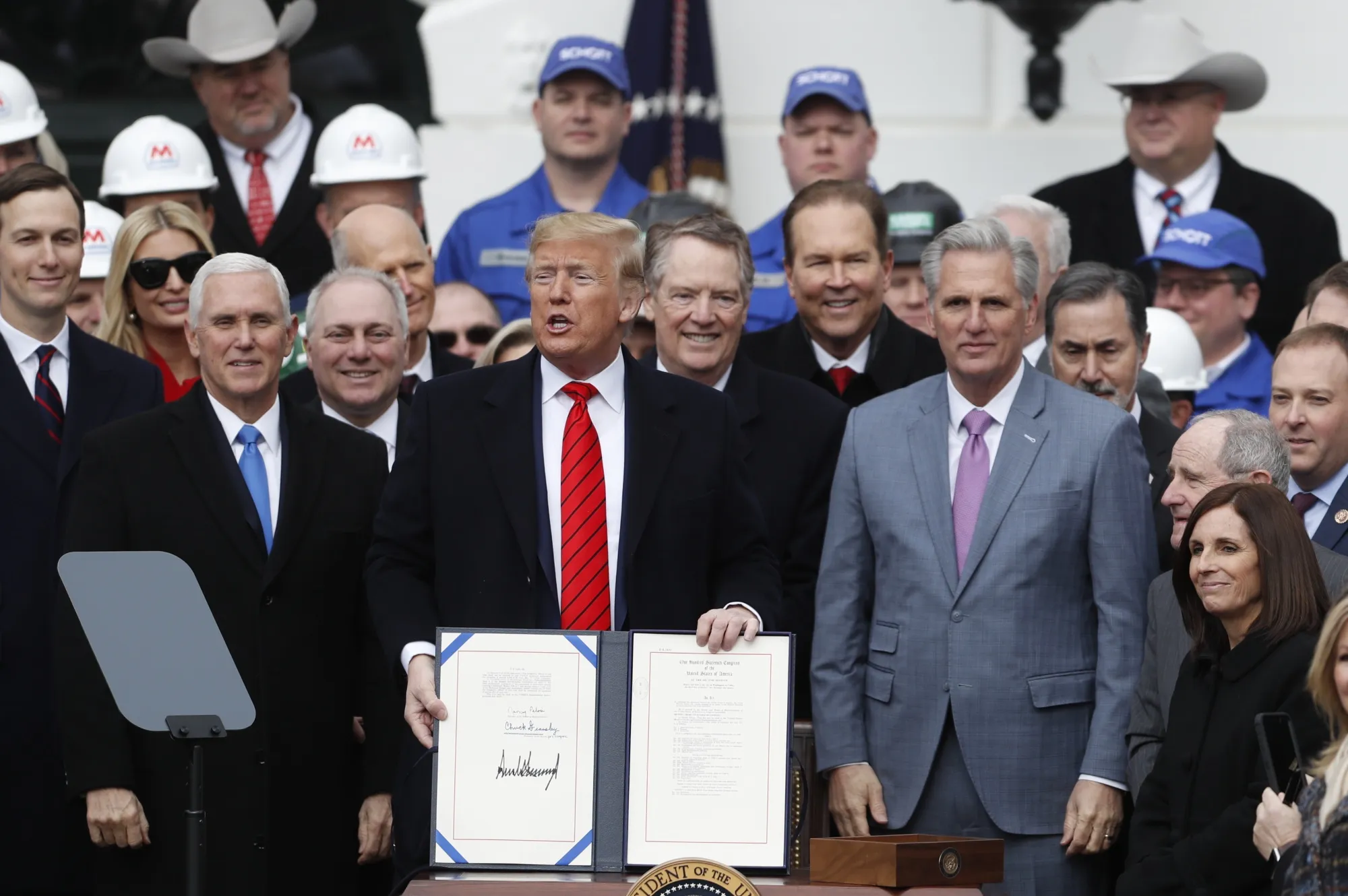
Experienced Democrats and Republicans in Washington noted in interviews that during the first Trump administration, budget and debt ceiling deadlines forced compromises on fiscal policy while a Democratic House passed the US-Mexico-Canada free trade deal in 2019.
NBC News projected Democrats could wind up with 258 House seats to Republicans 177, an 81-seat majority, and well above the 214 seats they hold in the current House. In the Senate, Democrats and independents aligned with them will now hold at least 54 seats, with just Alaska and Mississippi still unresolved. Currently, they have 47 Senate seats.
Trump told Fox News in a midnight interview after the Democratic surge was clear that he could forge compromises with a Democratic Congress.
“I’m a person that likes getting things done,” Trump said. “I can work with them on a lot of things.”
The large incoming Democratic majority in the House likely makes deals easier.
Incoming Speaker Hakeem Jeffries won’t be completely beholden to a small handful of the most left-wing Democrats, for whom any deals with Trump is anathema. He has breathing room to pass compromise legislation even without their votes, while pursuing the investigations they are clamoring for.
Democratic Representative Brendan Boyle, in line to become the House Budget Committee Chair, said his party will push to reverse Medicaid cuts and restore expired Obamacare premium subsidies as part of a government funding deal next spring. Medicaid cuts Republicans passed start to take effect after the midterms and will focus the party on healthcare.
“The timing forces the issue,” he said in a pre-election interview with Bloomberg. “We have to pass a budget and that gives Democrats leverage.”
Some of the biggest issues confronting the nation likely will not see substantial progress for the next two years, lawmakers and analysts said in interviews conducted before Tuesday’s vote. Don’t expect large-scale US deficit reduction, a solution to the impending shortfall in the Social Security trust fund or a comprehensive artificial intelligence bill that tackles security, job losses and data center energy usage. Those challenges will likely have wait until after the 2028 presidential election.
Here are the areas most ripe to break the gridlock in 2027 and 2028.
Debt Ceiling
The US is on course to default on its debt by late 2027 unless Congress acts on the federal government’s legal borrowing limit.
Democrats will almost certainly demand spending increases in return, said Tobin Marcus, a Wolfe Research analyst who once served as a top policy adviser to then-Vice President Joe Biden.
Boyle, incoming the House Budget Committee Chair, said he also hopes to use the moment to get rid of the legal debt ceiling, a step Trump has previously supported.

“There is no world in which I vote to kick the can down the road so that this is weaponized against a Democratic president in 2029,” Boyle said.
Some Republicans predicted Trump would readily agree even it costs a future Republican Congress negotiating clout.
“Trump would sign that for sure,” anti-tax activist Grover Norquist said. “He only thinks of the next two years.”
A showdown over the borrowing limit isn’t likely to make a dent in the US debt itself. Democrats in Congress are in no mood to further cut into the social safety net, and Trump has no plans to roll back his tax cuts, a signature achievement.
The “contours” of a deal are already clear: trading a debt ceiling hike for an increase in non-defense spending, Stephen Myrow at Beacon Policy Advisors said.
While the current Republican-controlled Congress could take the leverage away from Democrats by raising the debt limit or abolishing it before January, they probably won’t because of internal party divisions, said former Senate Republican budget staffer Bill Hoagland, now with the Bipartisan Policy Center.
Trade Deals
Democrats plan to force congressional votes on rolling back Trump tariffs they blame for stoking inflation, raising pressure on the president to strike trade deals lowering import taxes.
One potential early candidate is a revised USMCA, which governs trade with Mexico and Canada. The Trump administration is already engaged in renewed negotiations with Canada, an effort that could yield a deal that lowers the punitive tariffs on Canadian imports.

Democrats said they would be open to international trade deals that bring down tariffs which have raised food prices and provoked trade retaliation against US farm exports.
“I am hopeful from a trade deal perspective that the administration will rethink its tariff strategy given what it is doing to farmers and families across the board,” said moderate House Democrat Josh Gottheimer of New Jersey.
In the aftermath of midterm election losses, Trump risks more Republican lawmakers turning against his tariffs and could confront a veto-proof two-thirds majorities backing Democratic legislation to end the duties, Norquist said. Trade deals lowering tariffs offer him a way out, especially if he can point to concessions from foreign governments.
“The president could say mission accomplished,” said Norquist. “He could announce the problem is improved.”
Health Care
Trump has often advocated bringing down the prices Americans pay for prescription drugs and as president struck voluntary drug price agreements with pharmaceutical companies.
Congress can take more forceful action, such as imposing price controls on drug makers or expanding the list of drugs that Medicare can negotiate on for lower prices.
There is already bipartisan legislation, led in the Senate by populist Republican Josh Hawley of Missouri and Democrat Peter Welch of Vermont, to act on a favorite Trump demand: legally requiring pharmaceutical companies to offer Americans “Most Favored Nation” drug prices no higher than the lowest prices the companies charge abroad.

Legislation to lower drug prices, especially if they are seen as generating savings for government health programs, could be included in a wider budget deal.
Democrats will be demanding that Trump reverse cuts to Medicaid and food stamps enacted as part of Trump’s signature tax law. Those cuts were sought by congressional Republicans and Trump never publicly promoted them. So they could be on the table in negotiations to avoid a 2027 government shutdown or address the debt ceiling.
Defense Spending
Trump is pushing Congress for a 50% increase in defense spending, a $500 billion boon to weapons-makers from Lockheed Martin to Boeing to General Dynamics and Raytheon.
Democrats, meanwhile, are eager to reverse cuts Elon Musk’s Department of Government Efficiency made to domestic agencies, particularly health and education.
Though the current Republican-controlled Congress could theoretically pass a full-year funding deal before the new Democratic Congress takes office, Democrats in the Senate aren’t likely to go along with that unless Democrats’ priorities are included.
There is a bipartisan recognition that the Pentagon will need an emergency infusion of money to replenish missile stocks spent during the Iran War. A targeted package closer to $100 billion, paired with increases for domestic agencies ,could be the foundation of an eventual budget deal.
Marc Goldwein of the Committee for a Responsible Federal Budget said that “bipartisan irresponsibility” is the most likely outcome of divided government where both sides increase spending on their priorities.
Even so, the US treasuries market could be a limiting factor, he said. Yields on US debt instruments have been near their two-decade highs, with the 10-year hovering around 5% since September
Energy Permits
The Senate is poised this month to consider a tentative deal between some Senate Democrats and the White House to speed up approval of energy projects, but the outlook for the bill is murky with some House Democrats urging colleagues to wait until their party has more leverage.
The permitting changes would speed up development of pipelines, power lines and other major infrastructure projects, while requiring protections against electricity price hikes driven by power-hungry AI data centers.
It would be an important victory for oil companies and renewable energy developers. The energy industry has long sought to accelerate federal permitting and scale back environmental reviews that can lead to years of delay and hundreds of millions of dollars in extra costs. It is also a major priority for the White House, which in return has promised to allow some of the wind projects that have been held up by federal agencies since Trump took office.

Representative Jared Huffman, a California Democrat who is poised to lead the House’s natural resources committee said Democrats should hold out for a better deal. Among Huffman’s concerns are provisions weakening the Endangered Species Act, a bedrock environmental law considered sacrosanct by many environmentalists. He also said the Senate bill doesn’t do enough to ensure fair treatment for wind, solar and other clean energy projects.
“Knowing the GOP players, this deal will only get worse, not better, during the lame duck,” Huffman said ahead of the election. “Most Democrats will want to see how things go on November 3rd and then do a reality check.”
On many matters, Democrats could find a willing negotiating partner across the table if they come ready to make a bargain, Joseph Grogan, a former top Trump administration domestic policy official, said.
“I think Trump would do a deal with Democrats,” added Grogan, now co-chair of the Washington-based law firm Covington and Burling’s public policy team. “He came out of the womb looking to make deals.”