
Your Face on File: How Smart Doorbells Name the Strangers Passing By


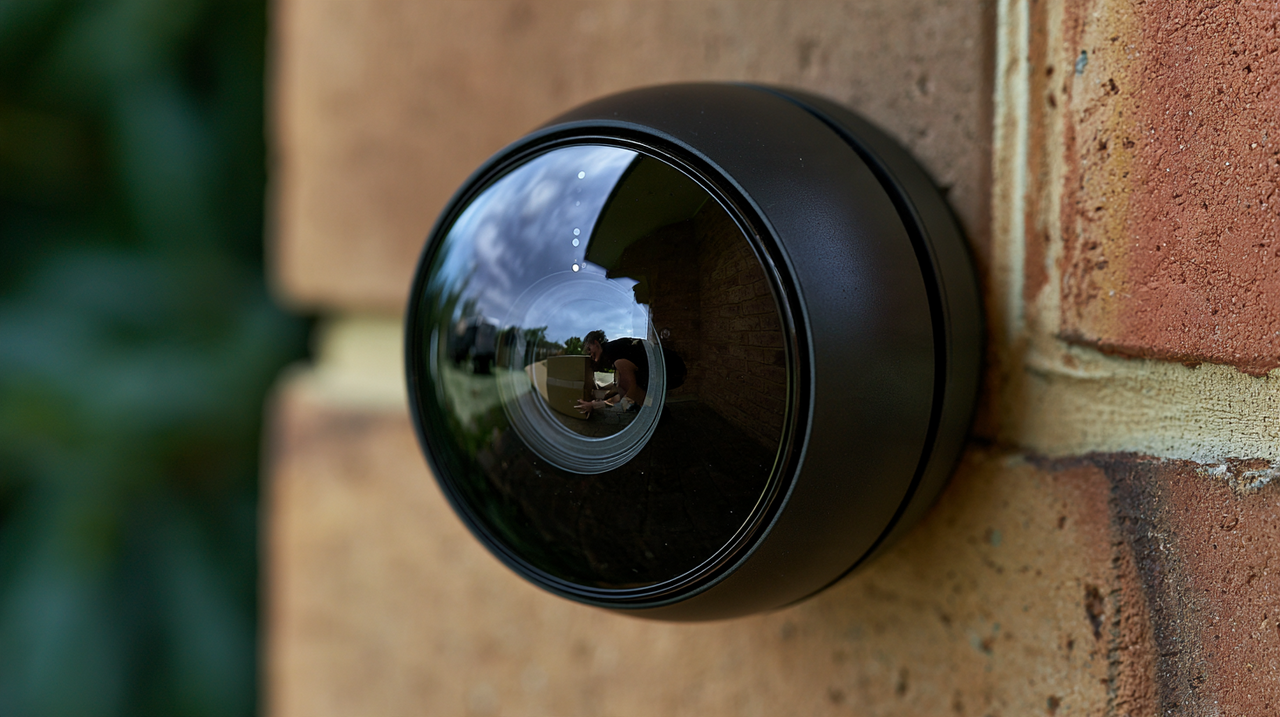
A courier working a suburban delivery round does something that no law, contract or app has ever asked her to think about. She walks up to a front door, puts a parcel down, takes a photograph for proof of delivery, and walks away. Then she does it again. Amazon, describing the job in its own words, says its drivers “typically have at least 150 stops and deliver 200 to 300 packages a day.” Each stop is a doorstep, and more and more doorsteps have a lens beside them. Until recently, that lens recorded her. Now, on some doors, it can learn her. It can measure her face, keep the measurement, recognise her the next time she comes, and offer the householder a box in which to type a name.
On 14 October 2026, CNET reported on three proposed class actions that put that change before the American courts: Sigwalt against Amazon, and Fennessy and Trevino against Google. All three allege that the familiar-face features in Ring and Nest video doorbells and cameras create biometric faceprints of people who never agreed to anything. The people they name are delivery workers, neighbours, visitors and passers-by. Their faces, the suits say, are captured, analysed and kept as profiles that the device's owner can label. The companies have already switched the features off in Illinois, where biometric consent law is strictest, and they say the data is protected and, in the framing CNET reported, stays on the device. The day before CNET's report, Apple had announced a range of cameras and a video doorbell for its own Home platform that can recognise familiar faces.
Three lawsuits against two companies, and a third company entering the market, mean the pattern is now set across the industry. That makes it possible to ask the larger questions directly. What happens to the old assumption that you can move along a street without being recorded under your name? Who should have to agree to being recognised at a front door: the person who bought the camera, or the person the camera learns? And what does a neighbourhood become when every entrance can put a name to everyone who comes up the path?
Three Lawsuits Built on One Absence
The three cases share one central fact, and it is an absence. None of the people suing ever bought the product.
Charles Sigwalt, a Virginia resident, filed the first complaint in the United States District Court for the Western District of Washington on 1 June 2026. The case is Sigwalt v. Amazon.com, Inc., number 2:26-cv-01887, and it names Amazon and Ring LLC as defendants. It is assigned to Judge Kymberly K. Evanson. The complaint alleges that Ring's Familiar Faces feature scans the faces of guests and passers-by and that the resulting facial recognition data is “not stored locally” but held in Amazon's cloud.
Four weeks later, on 29 June, eight Virginia residents filed Fennessy v. Google LLC in the Northern District of California, case number 5:26-cv-06534. Their complaint says Nest's Familiar Face Detection scans “the face of every person who appears in the camera's field of view” and compares the result against a library of stored profiles. “The feature is activated by the camera's owner,” the complaint continues. “It is not activated by, and cannot be consented to by, the bystander whose face is being scanned.” The plaintiffs say they have never bought a Nest product, never opened a Google Home account and never agreed to any terms of service. They simply walk through neighbourhoods, visit friends and run errands past houses where Nest cameras are visibly installed.
Two days later, Barbara Trevino, a resident of Glendale, California, filed Trevino v. Google LLC, number 5:26-cv-06694. Her claims rest on California law, including intrusion upon seclusion and the state constitution's right to privacy, and court summaries describe her as someone who walks past homes with Nest cameras in her own neighbourhood. A third Google case, Miller v. Google, followed on 17 July. On 4 September 2026, Judge Edward J. Davila consolidated the three Google cases in San Jose as In re Nest Privacy Litigation, under the lead number 5:26-cv-06534. A consolidated amended complaint was due on 19 October, and Google's response is scheduled for 1 December 2026. Google is represented by Cooley LLP.
None of these allegations has been tested, no class has been certified and no court has found either company liable. Even so, the complaints do something useful before any ruling. They describe, in sworn pleadings, how a person experiences these systems from the wrong side of the lens. The Fennessy complaint is frank about the gap. “Plaintiffs cannot identify which devices scanned them or on which occasions with certainty,” it says, “because Google built the system to make that information virtually impossible for Plaintiffs to obtain.” The person being recognised cannot know where they were recognised. The only parties that can find out are the company and, in part, the household that owns the camera.
The Consent Instruction Addressed to the Wrong Person
The companies have not ignored consent. They have addressed it to the wrong person.
Google's own support page for Nest's familiar face detection tells camera owners: “Use familiar face detection in compliance with the law.” It goes on: “Depending on where you live, you might need to get consent to have your camera help identify people visiting your home.” The same page says the feature “is not available on Nest cameras used in Illinois,” describing the restriction as a precaution in response to state legislation. Ring's help page for Familiar Faces makes a similar move. It recommends that owners tell the people they save as Familiar Faces, notes that some laws require explicit consent from visitors before the feature is switched on, and lists the places where the feature is not offered: Illinois, Texas and Portland, Oregon in the United States, and the province of Quebec in Canada.
Read as a set of instructions, these pages ask a householder to do something that cannot be done. A homeowner can ask a sister or a regular babysitter to agree to being recognised. A homeowner cannot ask the courier who will arrive next Tuesday, who may never come again, who is on a timed route and who has no idea the camera is doing more than recording. The homeowner certainly cannot ask the stranger on the pavement who happens to cut across the drive. The duty to obtain consent has been handed to the one party in the arrangement with no way of carrying it out.
That mismatch was noticed before the lawsuits. In December 2025, Senator Ed Markey of Massachusetts released Amazon's response to his questions about Ring's face recognition. His office said the answers showed that people wanting their face data removed must approach each device owner individually, “forcing delivery drivers to potentially make separate deletion requests at hundreds or thousands of homes.” Markey's office described delivery drivers, including Amazon's own, as the group facing the greatest threat. The point is about structure as well as privacy. When consent and deletion are left to individual households, the person with the most exposure has the least ability to use either.
What 'On the Device' Does and Does Not Mean
The companies' main reassurance, as CNET summarised it, is that the facial data stays on the device. The companies' own documentation is less uniform than that slogan, and even where it holds, it answers a different question from the one the lawsuits ask.
Start with Ring. Its Familiar Faces help page says that profiles and facial recognition information are encrypted and “stored in the cloud, not on your Ring devices.” The page also says Familiar Faces is not compatible with Ring's end-to-end encryption option. Ring offers a library of up to 50 named profiles and removes unnamed profiles after 30 days without a recognition. The Sigwalt complaint relies on this architecture when it alleges that the data is held on Amazon's cloud rather than locally.
Google's position is more mixed. According to the Fennessy complaint, which quotes Google's documentation, earlier Nest models set up in the Nest app store familiar face data in Google's cloud. Newer models set up in the Google Home app store it in the device's internal memory, but “the cloud is used for clean-up.” The complaint also alleges that Google's documentation does not specify an automatic deletion period for unfamiliar faces. Google has not yet answered these specific allegations in court.
Apple's statement is the most carefully worded. Its 13 October announcement says that “Camera footage is securely processed locally on the customer's own Apple Home hub or in Private Cloud Compute,” and that “No one, not even Apple, can access the data.” Private Cloud Compute is Apple's server system for heavier tasks; introducing it in June 2024, Apple said that “no user data is retained in any form after the response is returned.” Apple's long-standing HomeKit face recognition is described in the same way. A February 2025 explainer from How-To Geek, consistent with Apple's own documentation, says the analysis takes place on the home hub rather than on Apple's servers.
These differences matter, and Apple's design is a real improvement on the question of what the company can see. A face template that never leaves a hub in someone's living room cannot be turned over in bulk from a central server. But keeping the data local answers only one question: who apart from the owner can reach it. It does not change the fact that the stranger's face was measured. It does not change the fact that a household now holds a record of when that stranger came and went. And it does not change the most important feature of all, which is that the owner can attach a name to that record. A named record kept in a neighbour's hallway is still a named record. “On device” describes where the data sits, not whether anyone agreed to its creation.
Apple Walks Into the Same Doorway
Apple's entry changes the debate because Apple sells privacy as part of the product. On 13 October 2026, the company introduced the Apple Home Collection, a set of accessories built with LG Electronics and Schneider Electric and managed through the Apple Home app. Apple said the range includes an LG Video Doorbell Wired starting at $249.95 in the United States, plus LG indoor and outdoor cameras and a floodlight camera. Apple's announcement says the cameras recognise “people, familiar faces, pets, vehicles, and packages.” The doorbell and cameras will be sold in the United States, Canada and the United Kingdom, with availability beginning in December.
The face recognition behind these products is not new. Apple's Home app has offered it for compatible HomeKit cameras and doorbells for years. Apple's iPhone user guide explains that the feature identifies people from faces in the owner's photo library or from recent visitors captured by the camera. Owners can tap an unidentified person listed under Recent, choose Add Name, and enter the person's name or their relationship to the household. The How-To Geek explainer gives a revealing example of a label an owner might use for a visitor the camera keeps seeing: “The Postman.”
That example captures the issue better than any legal brief. Apple's system is built to stop Apple, LG and Schneider from seeing what the camera sees, and it may well achieve that. But it is also built, quite deliberately, to let a household turn a recurring unknown face into a known one, even if the name is only “The Postman.” The person who delivers the post was never asked. The careful privacy engineering protects the owner's data from the company. It does nothing to protect the courier's face from the owner.
There is also a twist for British readers. Ring's Familiar Faces is offered only in the United States and Canada. Apple's doorbell will go on sale in the UK, where the law treats a camera that looks beyond its owner's boundary very differently.
A Round of 150 Doors
Go back to the courier. The doorbell debate is usually framed around a single visitor at a single door. Her working day is not a single visit. It is a sequence of 150 or more.
Each familiar-face library belongs to a single household. Ring's holds up to 50 named profiles, and Google's is shared across the cameras linked to a single home account. Nothing in the companies' public documentation says that these libraries are pooled into a national index of faces, and the lawsuits do not prove that they are. What the architecture does allow is this. A courier on a fixed round, passing many doors that have face recognition switched on, can end up recorded in many separate household libraries. In each one she may be named, labelled or simply stored as a repeat unknown face, under whatever description that household chose. The Fennessy complaint makes the repetition point about its own plaintiffs. Because they “repeatedly traverse the same routes,” it says, “the same devices would have captured and processed their faces on multiple occasions.” For a courier, repetition is not occasional. It is the job.
The research on delivery work explains why this matters. In October 2022, Data & Society published “At the Digital Doorstep,” a report by Aiha Nguyen and Eve Zelickson based on interviews with 20 delivery drivers and 20 doorbell camera owners across the United States. Most of the drivers worked for Amazon Flex, and most of the owners had Ring cameras. The authors concluded that doorbell cameras, though marketed as tools for home security, “are also near-constant tools of workplace surveillance for delivery workers.” They described householders taking on the role of a manager: using their cameras to monitor, instruct and sometimes discipline the people bringing their parcels. The report also found that drivers of colour spoke more reflectively and at greater length than white drivers about being watched during shifts, and about feeling conspicuous in predominantly white neighbourhoods. One line in the report sums up the courier's position: “The doorstep is both a workplace and a stranger's private property.”
Those findings came from the era of the recording camera. Recognition adds two things recording lacks: memory and a name. A clip of an unknown courier is a moment. A named profile that fires an alert each time she comes back is a running record of her working pattern, kept by a customer she has never met. She cannot see it, correct it or delete it, except by finding the house and asking. As Markey's office pointed out, a deletion right that must be exercised household by household is, for a delivery worker, a right that exists mostly on paper.
Even the law that does exist handles repetition oddly. Illinois's Biometric Information Privacy Act, the statute both companies avoided by withdrawing, requires written consent before a private entity collects a biometric identifier. In February 2023, in Cothron v. White Castle, the Illinois Supreme Court held that a separate violation accrues with each unconsented scan. On 2 August 2024, Governor J.B. Pritzker signed Senate Bill 2979, which provides that collecting “the same biometric identifier or biometric information from the same person using the same method of collection” is a single violation. The change targeted runaway damages in workplace fingerprint cases, but its arithmetic speaks to the courier too. Under the strongest biometric law in the United States, being scanned at the same door a hundred times is now treated as one wrong. Yet each separate household that recognises her is a separate act of recognition, and no statute yet speaks to what it means to be recognised at a hundred different doors on a single round.
The Presumption of Passing Unremarked
The central question in this story concerns something the law has rarely needed to name: the presumption that ordinary movement goes unremarked.
People are seen in public all the time. What they have historically not been is identified, recorded and remembered by the buildings they pass. The legal scholars Woodrow Hartzog and Evan Selinger gave this condition a name in their 2015 article “Surveillance as Loss of Obscurity,” published in the Washington and Lee Law Review. Obscurity, they argued, is not secrecy. It is the practical difficulty, the transaction cost, of finding or understanding information about someone. A face in a crowd is visible but obscure, because joining it to a name takes effort that almost nobody bothers to make. Hartzog and Selinger proposed that the answer to surveillance often lies in deliberately putting friction back into the process. Familiar-face doorbells do the reverse. They reduce the cost of identification to the tap of a button labelled Add Name.
The urban writer Jane Jacobs, in The Death and Life of Great American Cities in 1961, argued that a safe street needs “eyes upon the street, eyes belonging to those we might call the natural proprietors of the street.” It is tempting to treat doorbell cameras as the digital version of those eyes. They are not. Jacobs's shopkeepers and residents watched and intervened, but they also forgot. A strange face was tolerated precisely because nobody filed it. A face-recognising doorbell is an eye that does not forget and will, if asked, write a name beside what it saw.
American constitutional law has begun to grapple with this idea, though in cases about government rather than neighbours. In Carpenter v. United States in 2018, Chief Justice John Roberts wrote for the Supreme Court that “A person does not surrender all Fourth Amendment protection by venturing into the public sphere.” Six years earlier, in United States v. Jones, Justice Sonia Sotomayor warned in a concurring opinion that “GPS monitoring generates a precise, comprehensive record of a person's public movements that reflects a wealth of detail about her familial, political, professional, religious, and sexual associations.” These rulings do not apply to private doorbells. The Fourth Amendment restrains the state, not the household next door. But they set out a principle that ordinary people grasp without reading any case law. Being visible at a moment is different from being compiled over time, and being compiled is what changes the relationship between a person and the places they pass through.
The Fennessy complaint tries to turn this intuition into a private-law claim. In its intrusion upon seclusion count, it argues that the plaintiffs' expectation of not being scanned is objectively reasonable because Google gives no notice and because “no social norm puts a passerby on notice that a doorbell is generating a mathematical map of his or her face.” That is the presumption of anonymity in movement, set out as a legal argument. Whether a court accepts it remains an open question.
Who Has to Say Yes
So whose consent should count? There are two candidates, and the products are designed around only one of them.
The owner's consent is real but limited. A household that switches on face recognition has agreed to the company's terms, and that agreement can cover the faces of its own members and of anyone who has actually agreed to be enrolled. It cannot cover the faces of strangers, because a person cannot consent on someone else's behalf to the measurement of that other person's body. The companies' support pages accept this logic when they tell owners that consent may be legally required. Their designs then leave the owner with no means of getting it.
European law answered the question some years ago, in a case involving an ordinary household camera. In December 2014, in Ryneš (Case C-212/13), the Court of Justice of the European Union considered a Czech homeowner whose camera also covered part of the public footpath. The court held that, to the extent such surveillance covers a public space, even partially, it is “directed outwards from the private setting of the person processing the data in that manner.” It therefore falls outside the exemption for purely personal or household activity. The court did not ban such cameras. It accepted that protecting one's property and family can be a legitimate interest. But it made the homeowner a data controller, with obligations to the people the camera captured.
British law has kept that principle. The Information Commissioner's Office tells householders that “If CCTV records beyond your property boundary, data protection law applies and there are rules you must follow.” The guidance expressly covers smart doorbells. It says owners must let people know they are recording, in most cases provide recordings to people who ask, delete footage regularly, and “stop recording a person if they object to being recorded and there's no legitimate reason to continue recording them.” Under the UK General Data Protection Regulation, biometric data processed “for the purpose of uniquely identifying a natural person” is special category data. Special category data can be processed only under narrow conditions, of which explicit consent is the obvious one for a householder. Apple's doorbell will go on sale in a country where the stranger's consent is not a courtesy but, in many circumstances, a legal requirement that the householder must meet. Apple's announcement does not explain how a UK owner is expected to meet it for a passing courier.
The English courts have already shown where the line falls. In Fairhurst v Woodard, decided in Oxford County Court in October 2021, Her Honour Judge Melissa Clarke found that a homeowner's use of his cameras, including a Ring doorbell, breached data protection law, and upheld his neighbour's harassment claim. The detail of the ruling is instructive. The judge accepted that the doorbell's video, which captured the neighbour only incidentally as she walked past, struck an acceptable balance. She found its audio capture, which reached much of the neighbour's property, disproportionate. The principle is proportionality. Incidental capture of a passer-by as part of protecting a home can be justified. A capability that reaches well beyond what that protection requires cannot.
Recognition of strangers falls on the wrong side of that line. Seeing who is at the door protects a home. A named, persistent record of the people who walk past protects nothing further, and costs people who have no say. A design that respected the consent of the person being recognised is easy to describe. Recognition would apply only to faces enrolled with the knowledge and agreement of the person enrolled. Faces that do not match would be discarded immediately rather than kept as unnamed profiles for a month. And owners would not be able to turn an unknown visitor's clip into a named profile without that visitor's agreement. That is no technical moonshot. In Illinois, the companies have simply withheld the feature instead.
The Street as a Directory
The deepest question in the CNET report concerns the future of the neighbourhood itself. What could a street become when every entrance can name everyone who approaches it?
The answer depends on whether the separate household libraries stay separate. Today they mostly do. But the industry has already shown it can link neighbourhood cameras when it wants to. Ring's Search Party feature, launched in 2025, connects outdoor Ring cameras in an area and uses AI to look for a specific lost dog. Reporting by 404 Media and others says it is switched on by default, so owners must opt out if they do not want their cameras to take part. Camera owners are alerted to possible matches and decide whether to share a clip. Ring's founder Jamie Siminoff has insisted, in comments reported by Newsweek, that the feature “is not designed to process human biometrics.” Yet in an internal email to staff in October 2025, obtained by 404 Media, Siminoff wrote: “You can now see a future where we are able to zero out crime in neighborhoods.” Asked by TechCrunch in March 2026 about features Ring was not currently building, he said: “It's very hard to say we're never going to do something in the future.”
No one has announced a feature that lets a neighbourhood search its doorbells for a named human face. It would be wrong to say one exists. But the parts are now sitting side by side. There are cameras at a great many entrances. Many households have face libraries in which strangers can be named. And there is a proven, opt-out mechanism for coordinating neighbourhood cameras in a search. Whether those parts are ever joined up will be decided by companies, by courts and by legislatures, not by the technology, which already makes it possible.
Even without a network, the social effects are visible. The Data & Society research shows that doorbell cameras already change how outsiders are treated in a neighbourhood, and that the burden falls unevenly. Add the ability to name, and the street starts to behave like a directory. Regulars are known, strangers are flagged, and the difference is recorded at every door. Such a street is not obviously safer, but it does tell people who belongs. The courier, the carer, the canvasser and the new neighbour are all unfamiliar faces until somebody decides to name them. Jacobs's street worked because it could absorb strangers without cataloguing them. A street of naming doorbells keeps a catalogue.
What the Courts Will Not Settle
The lawsuits will take years. The Nest cases are still at the pleadings stage, with Google's response not due until December. Sigwalt has barely begun, and both companies have real arguments to make. Arguments open to them include that the plaintiffs cannot show their faces were ever scanned, and that owners, not manufacturers, decide what the cameras do. Some may succeed. Class actions are a slow way to settle the basic conditions of public life.
But the questions the cases raise will not go away whatever the verdicts. A household device now creates a named record of the people who pass it. The companies have shown, by switching the feature off in Illinois, that they know how to withhold it. They have shown, by telling owners to seek consent, that they know whose consent is missing. And with Apple's launch this week, the industry has shown that the feature is becoming standard, sold as the privacy-respecting version of the same thing. On-device processing, end-to-end encryption and Private Cloud Compute all answer the question of who else can see the data. None of them answers the question the courier is in a position to ask, if anyone ever asked her: why is my face on file at a door I visited for 30 seconds?
The presumption of anonymity in ordinary movement was never written into law because it never needed to be. It was guaranteed by the effort it took to identify a stranger. That effort is disappearing, door by door, through settings that a homeowner can switch on in a minute. The decision about who has to consent to being recognised at a front door is being made right now, in product design and support pages, mostly by default. It should be made deliberately, by people who will one day be the stranger on someone else's path. That includes everyone.
References
- CNET. Report on proposed class actions against Amazon and Google over familiar-face recognition in Ring and Nest video doorbells and Apple's entry into the market. 14 October 2026.
- Sigwalt v. Amazon.com, Inc. and Ring LLC. Class Action Complaint, Case No. 2:26-cv-01887, United States District Court for the Western District of Washington, filed 1 June 2026. https://storage.courtlistener.com/recap/gov.uscourts.wawd.363574/gov.uscourts.wawd.363574.1.0.pdf
- CourtListener. Docket, “In re: Nest Privacy Litigation,” No. 5:26-cv-06534 (N.D. Cal.), including the Fennessy et al. v. Google LLC Class Action Complaint filed 29 June 2026 (ECF No. 1) and the order consolidating cases signed 4 September 2026; and docket, “Trevino v. Google LLC,” No. 5:26-cv-06694 (N.D. Cal.), including the complaint filed 1 July 2026. https://www.courtlistener.com/docket/73548337/in-re-nest-privacy-litigation/ Fennessy complaint also available at https://www.classaction.org/media/fennessy-et-al-v-google-llc-complaint.pdf
- Google Nest Help. “Troubleshoot familiar face detection.” https://support.google.com/googlenest/answer/9281945?hl=en
- Ring Help Center. “Familiar Faces.” https://ring.com/support/articles/z3yhg/familiar-faces
- Office of Senator Edward J. Markey. Press release on Amazon's response regarding Ring facial recognition and delivery drivers. 10 December 2025. https://www.markey.senate.gov/news/press-releases/just-in-time-for-holiday-deliveries-sen-markeys-probe-exposes-amazons-alarming-privacy-violations-with-facial-recognition-technology-in-ring-doorbell
- Apple Newsroom. “Introducing Apple Home Collection, a new lineup of smart home accessories.” 13 October 2026. https://www.apple.com/newsroom/2026/10/introducing-apple-home-collection-a-new-lineup-of-smart-home-accessories/
- Apple Security Research. “Private Cloud Compute: A new frontier for AI privacy in the cloud.” 10 June 2024. https://security.apple.com/blog/private-cloud-compute/
- Apple Support. “Use Face Recognition in Home on iPhone.” iPhone User Guide. https://support.apple.com/guide/iphone/use-face-recognition-iph04af43727/ios
- Davidson, Adam. “How to Use HomeKit Secure Video Face Recognition to Know Who's at Your Door.” How-To Geek, 16 February 2025. https://www.howtogeek.com/how-to-use-homekit-secure-video-face-recognition-to-know-whos-at-your-door/
- Amazon. Delivery Service Partner driver diary, About Amazon. https://aboutamazon.com/news/transportation/amazon-delivery-service-partner-diary-photos
- Nguyen, Aiha, and Eve Zelickson. “At the Digital Doorstep.” Data & Society, October 2022. https://datasociety.net/wp-content/uploads/2022/10/AttheDigitalDoorstepFINAL.pdf
- Illinois General Assembly. Public Act 103-0769 (Senate Bill 2979), amending the Biometric Information Privacy Act, 740 ILCS 14, signed 2 August 2024. https://ilga.gov/legislation/publicacts/103/103-0769.htm
- Davis Wright Tremaine. “Illinois Revises Biometrics Law To Reduce the Prospect of 'Ruinous' Damage Awards.” August 2024, updated April 2026. https://dwt.com/blogs/privacy--security-law-blog/2024/08/illinois-bipa-biometrics-law-amended-for-damages
- Hartzog, Woodrow, and Evan Selinger. “Surveillance as Loss of Obscurity.” Washington and Lee Law Review 72, no. 3 (2015): 1343. https://scholarlycommons.law.wlu.edu/wlulr/vol72/iss3/10
- Jacobs, Jane. The Death and Life of Great American Cities. New York: Random House, 1961.
- Carpenter v. United States, 585 U.S. 296 (2018), decided 22 June 2018. https://www.law.cornell.edu/supremecourt/text/16-402
- United States v. Jones, 565 U.S. 400 (2012), Sotomayor, J., concurring. https://www.law.cornell.edu/supremecourt/text/10-1259
- Court of Justice of the European Union. František Ryneš v Úřad pro ochranu osobních údajů, Case C-212/13, ECLI:EU:C:2014:2428, judgment of 11 December 2014. https://eur-lex.europa.eu/legal-content/EN/TXT/?uri=CELEX:62013CJ0212
- Information Commissioner's Office. “Domestic CCTV systems.” https://ico.org.uk/for-the-public/domestic-cctv-systems/
- UK General Data Protection Regulation, Article 9, “Processing of special categories of personal data.” legislation.gov.uk. https://www.legislation.gov.uk/eur/2016/679/article/9
- Fairhurst v Woodard, Case No. G00MK161, Oxford County Court, judgment of HHJ Melissa Clarke, 12 October 2021. https://www.judiciary.uk/wp-content/uploads/2022/07/Fairhurst-v-Woodard-Judgment-1.pdf
- Koebler, Jason. “Leaked Email Suggests Ring Plans to Expand 'Search Party' Surveillance Beyond Dogs.” 404 Media, 18 February 2026. https://www.404media.co/leaked-email-suggests-ring-plans-to-expand-search-party-surveillance-beyond-dogs/
- O'Connell, Liz. “Ring responds to concerns ICE could access new tracking feature.” Newsweek, 11 February 2026. https://www.newsweek.com/ring-responds-concerns-ice-could-access-new-tracking-feature-11496717
- Loizos, Connie. Interview report on Ring founder Jamie Siminoff and privacy concerns. TechCrunch, 8 March 2026. https://techcrunch.com/2026/03/08/rings-jamie-siminoff-has-been-trying-to-calm-privacy-fears-since-the-super-bowl-but-his-answers-may-not-help/

Tim Green UK-based Systems Theorist & Independent Technology Writer
Tim explores the intersections of artificial intelligence, decentralised cognition, and posthuman ethics. His work, published at smarterarticles.co.uk, challenges dominant narratives of technological progress while proposing interdisciplinary frameworks for collective intelligence and digital stewardship.
His writing has been featured on Ground News and shared by independent researchers across both academic and technological communities.
ORCID: 0009-0002-0156-9795 Email: tim@smarterarticles.co.uk
Listen to the free weekly SmarterArticles Podcast