The geometry of enlightenment: A transition from curvilinear to rectilinear perspective projection in the visual field after dissolving solidity in the somatic field


We have discovered a remarkable curiosity. In January this year, I spent a week hanging out with a frequent collaborator, the meditation coach Roger Thisdell. This week was intended to be something of a meditation retreat; except that I’m an abysmal meditation student, and mostly I just sat in a hammock and asked him an endless series of questions instead.
Some years ago Roger experienced a perceptual shift which some teachers would call fourth path enlightenment – though he prefers to avoid labels, instead explaining his changes to perception in terms which directly describe the phenomenality of his experience. In short, he managed to dissolve what he describes as a knot at the center of his experience.
We first discussed the concept of a bodymind knot on smoothbrains.net in 2024. In short, we use the term knot to refer to something like a habitual trajectory which attention follows within experience, which may or may not have trivial topology, and may also have some semantic content associated with it. The semantic associations might be negative, and in some cases dissolving the knot might go hand in hand with overcoming psychological trauma. In this respect, it’s an open question whether the sense of self might also be such a bodymind knot. We’ve asked this question before:
My own impression is that what we call the “self” appears to be a cluster of various phenomena, the most relevant of which in this context might be a habitual returning of attention to a location at the center of the head – the egocentric point.
These knots are generally felt at a specific location in the body, but it’s ambiguous what specific physical structures might underlie them. The central nervous system maintains a map of the body in the somatosensory cortex – but who’s to say that these knots aren’t actually out somewhere in the peripheral nervous system, in the body itself? We choose to remain agnostic for now – again, we prefer to simply refer to a given experience by its phenomenality.
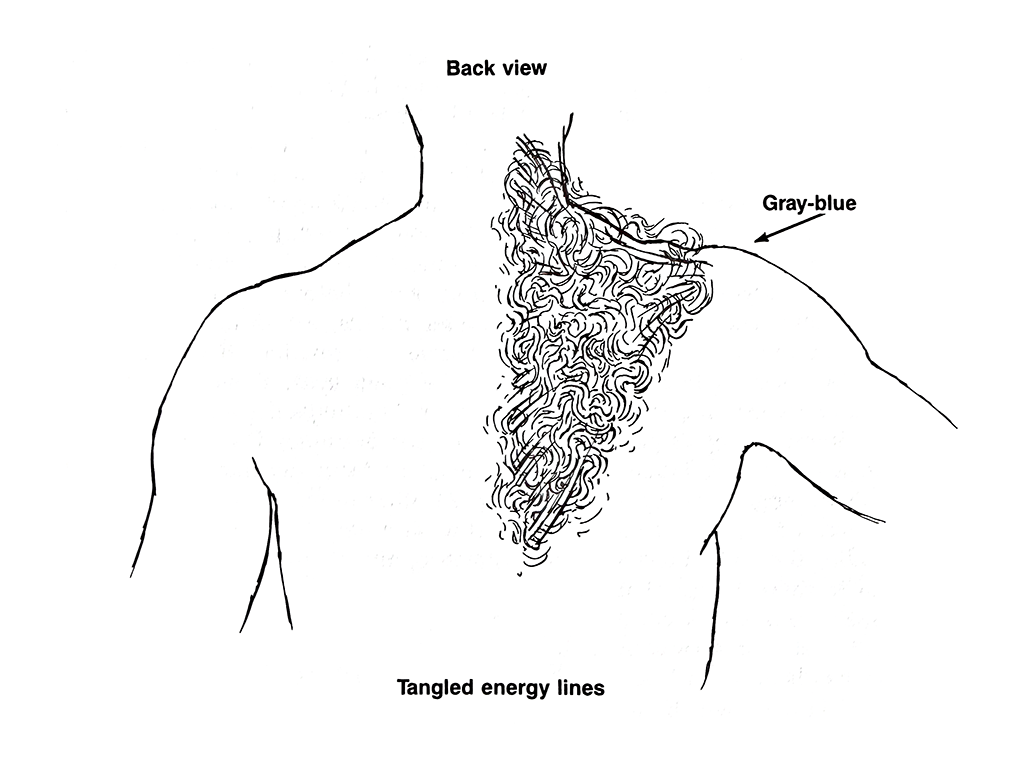
In Roger’s case, he can describe his experience in detail – both before and after dissolving the knot. He claims that this knot was what reinforced the sense that “he” was a central observer within his experience, looking “out” at his mind’s simulation of the world. After dissolution, he reports that his experience transformed, the structure of attention becoming centerless – all parts of his simulated world mutually observing one another. All of this was accompanied by a significant reduction in suffering.
Why might this contribute to valence? Importantly, this also entailed dissolving a sense of muscular tension around the sides of his face, which Roger described as being coupled with the visual field. We’ll come back to this.
Enlightenment, centerlessness, non-duality, call it what you like – but this is not what we discovered. This sort of thing has been widely discussed across a variety of contemplative traditions for centuries. However, such transformations are quite challenging to describe in concrete terms, so we became quite excited when we accidentally ran across something stranger and more specific – an easily characterisable perceptual difference between our two experiences.
At some point I wound up asking Roger if there were any changes to perception that came about as the result of his shift. Apparently he no longer gets dizzy if he spins around on a computer chair! He also reported that there were some changes to his experience of visual perspective such that lines which were previously perceived as curved were now perceived as straight – which he attributes to defabricating somatic sensations in the face.
He brought up an experiment that our mutual friend Scry Visuals had proposed, which involved holding a broomstick on the shoulders behind your head – but we couldn’t find a long enough broomstick. I knew that when standing upright and staring at the horizon, I perceive it as straight – but when lying upside down for some reason I perceive it as noticeably curved. I suggested we lie down on the decking, look at the horizon, and compare what we saw:

For reference, this is what is visible if I take a picture with my iPhone in the direction Roger is looking:

And the same, but with the iPhone turned upside down:

However, in these images the horizon line is straight, whereas if I look at the horizon while I’m upside down it appears curved. ChatGPT was able to modify the photograph to resemble my description:
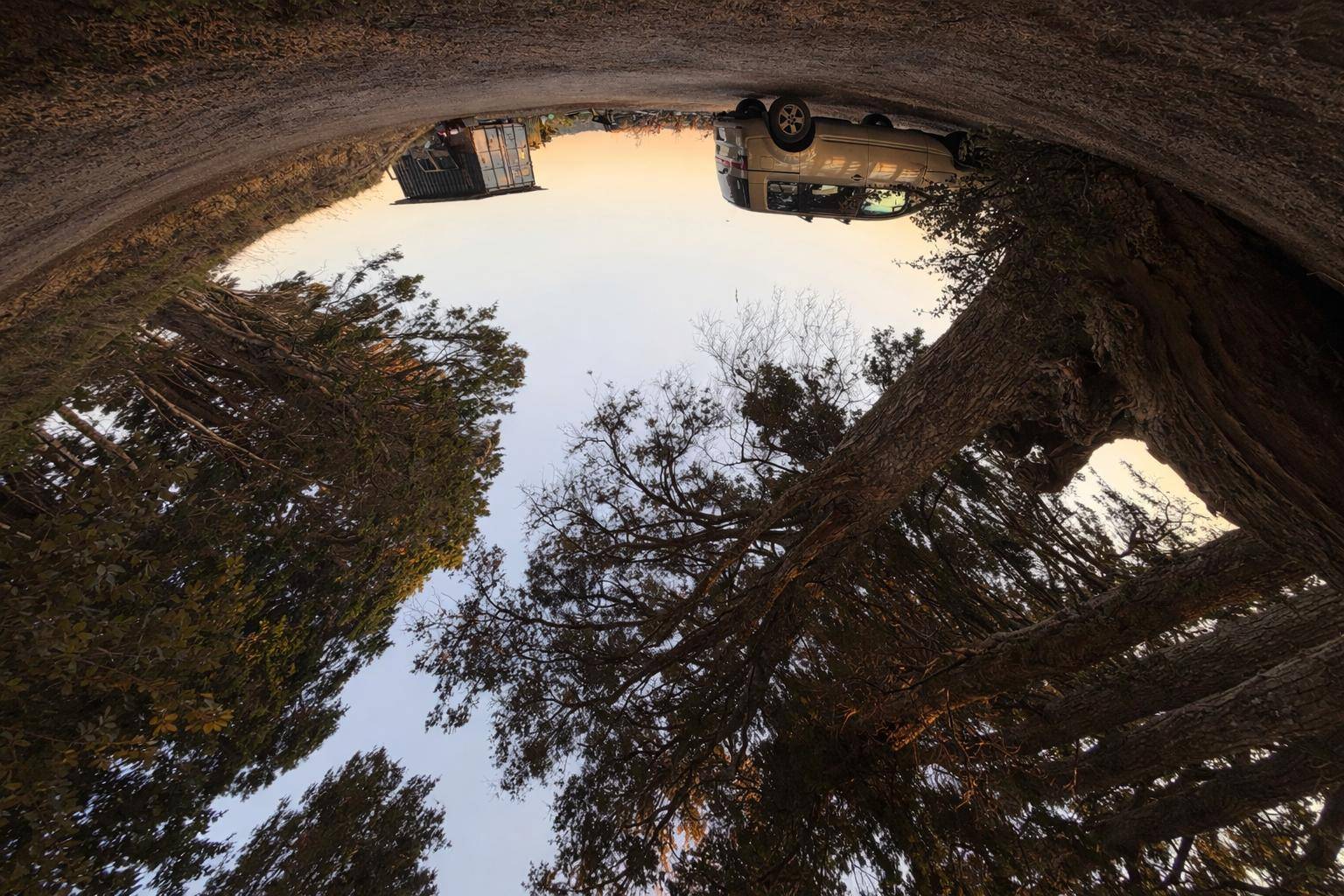
This is a crude replication of what I saw. This image simulates what is called a curvilinear perspective projection – in which lines that were straight in the original scene are curved in the projected image, unless they pass through the very center of the projected image.
However, when Roger views this scene, he finds that the horizon line is straight while the vertical tree trunks run parallel to one another. We coaxed ChatGPT into producing a somewhat exaggerated version of what he sees, to contrast with my own image:

This is a crude replication of what Roger saw. This image simulates what is called a rectilinear perspective projection, in which lines that were straight in the original scene remain straight in the projected image, while angles and shapes that are closer to the edges of the image are distorted to compensate.
These two projections can be summarised as follows:
| Projection | Straight lines | Local angles |
|---|---|---|
| Rectilinear | Preserved | Distorted |
| Curvilinear | Distorted | Preserved if the projection is stereographic; distorted if the projection is equidistant, equisolid or orthographic |
So, why do I think there’s a signal, here? I can’t see Roger’s visual field – all I have is this report, and I can think of a handful of possible misunderstandings which could have led us to report differently on our experience of perspective. If it wasn’t for the efforts of Andrés Gómez Emilsson to try to convince the general public that the psychedelic DMT can introduce hyperbolic curvature in the visual field – along with my own experience with strange visual field distortion – I would be more skeptical that the visual field could adopt a wholly different geometric structure.
I should confess that on this particular sunny day I’d started my morning with a modest dose of LSD – maybe an eighth of a tab – and followed this up with perhaps a quarter of a gram of mushrooms in the afternoon, followed by a couple of spliffs. So I had a bit more neuroplasticity to work with than usual.
After a small amount of experimentation I found a mental move by which I could “unsplay” chunks of the visual field, switching the local perspective projection from curvilinear to rectilinear. This felt a little like applying a sense of expansion to a specific region of the field to compensate for the curvature. I suspect that this correlated with some subtle motion embedded in my face. However, this lacked pressure. I found that I was only able to “unsplay” a small section of the visual field at one time – I could make one grove of trees turn rectilinear, and then the other – but never both at the same time, let alone the entire visual field. Still, this was enough for me to feel satisfied that I wasn’t just taking Roger’s claim on pure faith.
With some further experimentation, I confirmed that the horizon would also curve while I was standing upright and tilting my head. The comparative advantage of viewing the horizon from a supine position is that it forces the great circle of the horizon much higher up in the field of view than it would be normally – exaggerating the curvature effect. This squares with what a curvilinear projection predicts, which is that lines should bend the most when they are furthest from the center. Interestingly, the center of the projection appears anchored to the head, rather than wherever the eyes are fixating.
I studied what was going on at the level of individual saccades. The visual field does not display a live feed of what’s currently on the retina. Rather, it seems to be a semi-persistent representation, assembled piece by piece from snapshots accumulated across many saccades. I speculate that what made the difference between curvilinear and rectilinear – and what was going on with the “unsplaying” – was some subtle aspect of attention, set immediately after a saccade, which governs how each new snapshot is projected into the visual field. Perhaps this mechanism is flexible, and adapts to fit its circumstances – after every saccade, it asks: right now, how much do I bend straight lines to keep shapes undistorted? It’s an open question why some people’s minds wind up preferring a particular mode – it’s possible this is caused by accumulated stress.

I tested the procedure again once I was confident I was sober, at midday the following day. I found I was no longer able to perform the “unsplaying” maneuver.
It bears mentioning that we sat on this information for a while; I feared that if we discussed this in public someone might use it to falsely claim attainments which they otherwise lack, and I know that the Buddhists tend to take that sort of thing seriously. We ultimately decided this was interesting enough to make it worth it, but let us make this clear – if you use the information in this post to pretend you’re an arahant – in Roger’s words, we think you’re a twat.
Before we continue further, I should give the reader a brief rundown of what kind of projections exist, and what sets different projections apart.
Very broadly, a projection is a mapping from one space onto another – usually one with fewer dimensions. A camera projects points in a three dimensional scene down onto a two dimensional image. In the specific case that concerns us, a projection is a rule for flattening the sphere of directions around your eye onto a flat image, and since a sphere can’t be flattened without distortion, choosing a projection entails choosing what compromises to make.
Projection can also be viewed as casting a ray from each point in the scene towards the image, and marking where it lands. The first distinction worth making is between perspective projection, in which those rays all converge upon a single point – the eye – and parallel projection, in which they never meet, as if the eye were infinitely far away. A familiar example of a parallel projection may be the isometric projection used in the God’s eye view of some classic video games like Age of Empires or Sim City 2000.
Architects ship renderings to clients in egocentric perspective projection, while engineers take the view from nowhere – drawing in allocentric parallel projection. My father was a site manager, and often had to mediate between both these types of people; I suspect that if he were still around he would have joked that you could explain everything about how someone sees the world by the type of projection they use.
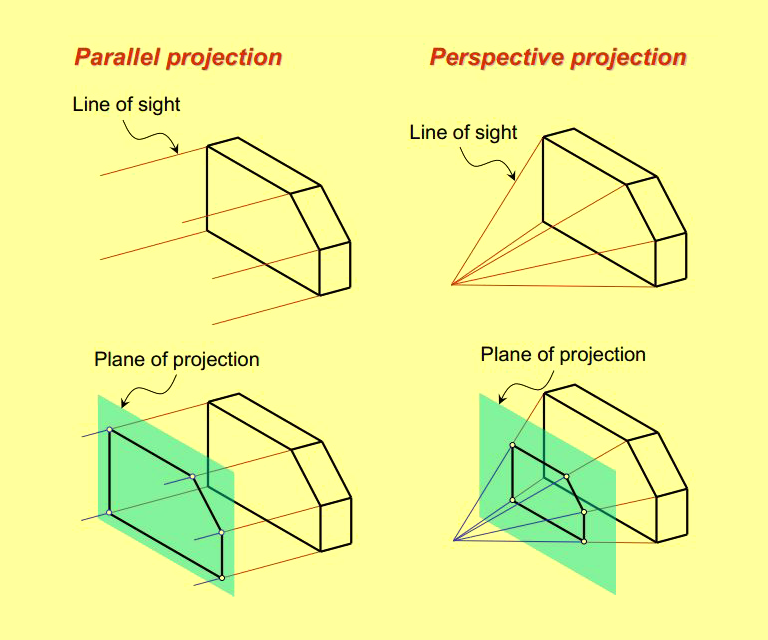
We briefly entertained the fanciful notion that Roger had somehow found a way of transforming his internal projection from a perspective to a parallel one. Andrés has speculated that the self might be a kind of focal point or optical cusp – a point where the rays of attention converge – and one way you can dissolve an optical cusp is by ensuring its rays run parallel to one another.
What if one such cusp was responsible both for the sense of self and the way the visual field is projected? Should we then expect the visual field to assume the geometry of a parallel projection? We suspect that this would feel quite nice – but how would it look? Would it even be describable? We quickly realised that we both still observed vanishing points within experience – canonical artifacts of perspective projection – ruling out the possibility of parallel projection.
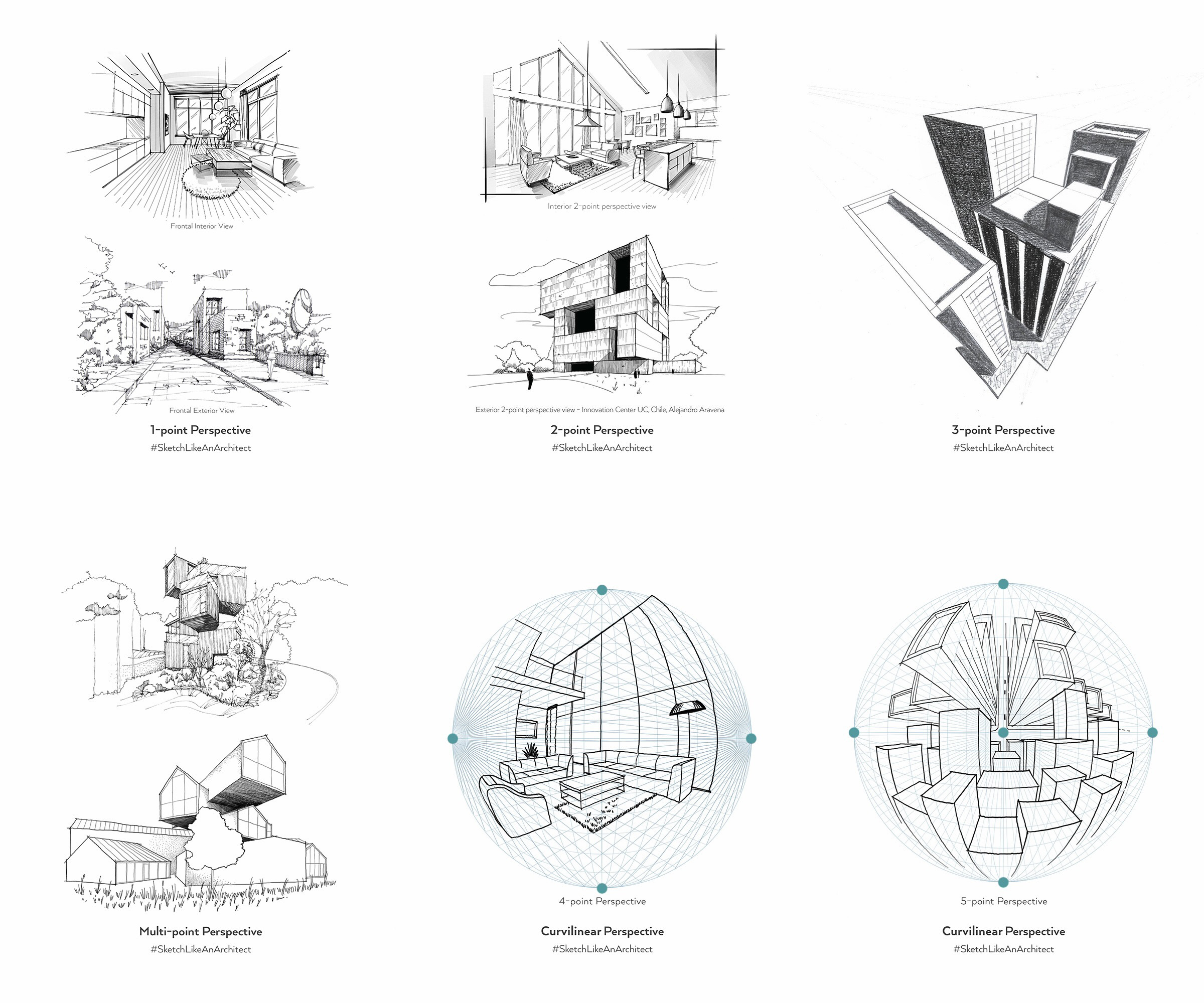
Another important distinction is the one between rectilinear perspective projection and curvilinear perspective projection. As we discussed earlier – rectilinear perspective preserves straight lines, while curvilinear perspective does not. This distinction should be most familiar in the case of camera lenses. Perfect rectilinearity is considered to be a design goal – most lenses are at least a little curvilinear, which manifests as barrel distortion.
In practice, it’s possible to build rectilinear lenses, but there’s a practical limit on the field of view of about 130°, and the rectilinear projection itself must always be narrower than 180°. This has curious implications for Roger, given that the human visual field spans roughly 200°.
When I started writing this article, I did not realise that the original iPhone photographs we were working with were already rectilinear. The iPhone 17 Pro’s ultra-wide lens is not optically rectilinear. The raw image it produces is closer to a fisheye, and the operating system corrects it afterwards in software. This setting can be turned off in Settings → Camera → Lens Correction if you want to experiment with it yourself.
So the replication of what Roger sees uses the same projection as the original photograph – straight lines are straight in both images – so perhaps that image should be best viewed as an illustrative caricature of what rectilinearity feels like from the inside.
Curvilinear perspective is actually a whole family of projections. The four most common ones are stereographic, equidistant, equisolid, and orthographic. Here they are alongside rectilinear projection, each characterised by which quantities they preserve:
| Projection | Checkerboard | Inverse checkerboard | Straight lines | Local shapes | Distance from center | Area |
|---|---|---|---|---|---|---|
| Rectilinear r = f tan θ | — | Stretched outward (2.00×) | Enlarged (1.65×) | Enlarged (8.00×) | ||
| Stereographic r = 2f tan(θ/2) | Bent into circular arcs | — | Enlarged (1.10×) | Enlarged (1.78×) | ||
| Equidistant r = f θ | Bent | Squashed toward the center (0.83×) | — | Enlarged (1.21×) | ||
| Equisolid r = 2f sin(θ/2) | Bent | Squashed toward the center (0.75×) | Shrunk (0.95×) | — | ||
| Orthographic r = f sin θ | Bent into elliptical arcs | Squashed toward the center (0.50×) | Shrunk (0.83×) | Shrunk (0.50×) |
I have generated a series of checkerboard images in order to demonstrate how each projection distorts a flat checkerboard scene. I have also generated a series of inversely distorted checkerboard images. In theory, we can test which of these projections we experience by simply viewing the inversely distorted images at the appropriate viewing distance, and checking which one looks most like a regular grid – our internal projection cancelling out the pincushion distortion. To try it yourself:
- Close one eye.
- Fixate the red dot in the center.
- View the image from a distance of half its height away. On my 65 inch television, that’s 40 cm. On a 14 inch laptop screen that’s about 10 cm, which is too close for most people to focus.
In practice, I was unable to distinguish which of the curvilinear images looked least distorted.
Surely somebody’s studied this before, right? A quick language model literature review turned up the following papers:
- Straight lines, ‘uncurved lines’, and Helmholtz’s ‘great circles on the celestial sphere’ (Rogers & Brecher, 2007)
- Visual globes, celestial spheres, and the perception of straight and parallel lines (Rogers & Rogers, 2009)
- The Perceived Size and Shape of Objects in Peripheral Vision (Baldwin et al., 2016)
Nobody seems to have fitted a single projection function to human vision across the whole visual field. Rogers & Rogers (2009) showed participants curved chessboards and found that they misjudge the straightness of lines in their peripheral vision, which rules out rectilinear projection. Baldwin et al. (2016) asked participants to draw circular discs mounted 30° into their peripheral vision. Participants drew discs that were squashed, which rules out stereographic projection, which would keep them circular.
The specific amount of squashing suggests a projection somewhere between equisolid and orthographic, though the squashing was stronger above and below the center than it was at the sides. Participants also drew their discs smaller overall – far more than any of these projections predicts. So if the visual system is bending straight lines in order to keep shapes undistorted, it isn’t doing a very good job of it. At best, I think we can conclude that the neurotypical – or perhaps, unenlightened – experience of the visual field fits a curvilinear perspective projection.
For additional reading, the vision researcher and phenomenologist Steven Lehar has written a number of posts on the geometry of the visual field:
- Geometric Algebra: Projective Geometry (Lehar, 2014)
- Geometric Algebra: Conformal Geometry (Lehar, 2014)
- Double Conformal Mapping: A Finite Mathematics to Model an Infinite World (Lehar, 2014)
Something Roger encourages through his teaching is understanding how parts of the somatic field can become coupled with the visual field, and vice versa. By cultivating high-resolution awareness of these dynamics and their structure, we can come to understand how these patterns contribute to suffering within experience, and ultimately liberate ourselves from them. The best introduction to his mindset is his video which demonstrates how to feel visual sensations with your body:
By way of a colourful example, Roger sent me this Substack post, from someone called Aidan:
This is crazy, why did nobody tell me that bodywork… works? I relaxed a knot in some fascia in the back right of my head and my eyes converged to make the whole world look 3D. It made me realize that I’ve had slight double vision for the last 20 years and blamed it on vague “dissociation”. I didn’t realize dissociation was so physical. The world is flat, I have trouble drawing images from my mind, and I’m often clumsy, especially around people who make me feel unsafe/watched. This aligns a lot with my cognitive style of seeing patterns across topics and forgetting details (like what I’m doing right now) – it’s like blurring your eyes to get the big picture of a painting. I’m certain this is a protective mechanism from childhood, it’s fascinating that it’s so directly tied to fascial tension.
This is all pretty high level, so I asked Roger a few questions about the finer details. What precisely did he do in order to unravel the central knot?
Have you ever done body scanning meditation, perhaps over the face? You might notice that your attention follows certain natural contours – the curved topography of your face and head. Roger told me that as a child he had a thing for drawing comic book characters, and that tracing the webbed lines on Spider-Man’s mask over and over again helped him to become acutely aware of facial topography.

What if you scanned straight up and down, instead? Roger recommended a scanning technique that cuts across the face’s natural contours rather than tracing them, training attention to follow straight lines rather than curved ones:
Roger: Don’t follow the meridian lines, muscles, or fat in the body – resist the curve and go straight. It’s not so much about getting it straight – you can bend it in the opposite direction entirely – limber it up.
I also asked about what actually got him to his shift in perception. This took a daily one-hour practice, with lots of noting and parsing the senses. Defabricating the central point itself took a lot of effort. From notes I took during our conversation:
Roger: Thinking about it in spatial terms is very revealing and helpful. It’s about putting attention really accurately on the center. That’s what popped it. Roger: It can take a lot of force to get attention onto it. It’s like squishing a tomato seed – it wants to slip out. I learned how to corner it – I had to come at it from two angles – both sides.
I remember that Roger held two fingers up, one on either side of his head, drawing two imaginary lines skewering an invisible point in space somewhere in front of his eyes. He described this process through clenched teeth, as if to convey the sheer amount of concentration that was required.
Cube Flipper: When you dissolved it where did you feel it dissolve? Roger: On both sides of the head and at the central knot behind the eyes. It’s like the sensations around the head form a boundary, and the knot was keeping it in place. I can still feel the sensations on the side of my head, but they can’t form a boundary. Cube Flipper: Did you dissolve both of these things at the same time? Roger: Yes. I don’t know that that happens for everyone, although I can’t imagine that it doesn’t – you can’t have a center without an implied shape of something. Cube Flipper: What did it feel like? Roger: I was looking at the center point, and the tension was as close into itself as possible and then the central contraction just released. I opened my eyes in disbelief, because something had radically changed, here, and then I had a sense of the world syncing up with itself, it kind of went from left to right. Now I would understand it as – that was actually the border sensations unravelling themselves. It’s like if you watch a slow motion video of a soap bubble popping, the way it travels around. Roger: It put my body into shock because it was so different from anything I’ve experienced before. It was incomparable to any jhāna or ego death experiences I’d had before in meditation or psychedelics. My jaw was wide open.
The interesting thing seems to be the structure – why would there be a knot in Roger’s head as well as a “boundary” around the sides of his face? A specific claim Roger makes is that if you send attention all the way to the edge of the visual field, you can notice the point at which attention skips back onto the sides of the head – it joins up at the ears. Apparently, if you do this enough, you can collapse the sense of space between the somatic and the visual field:
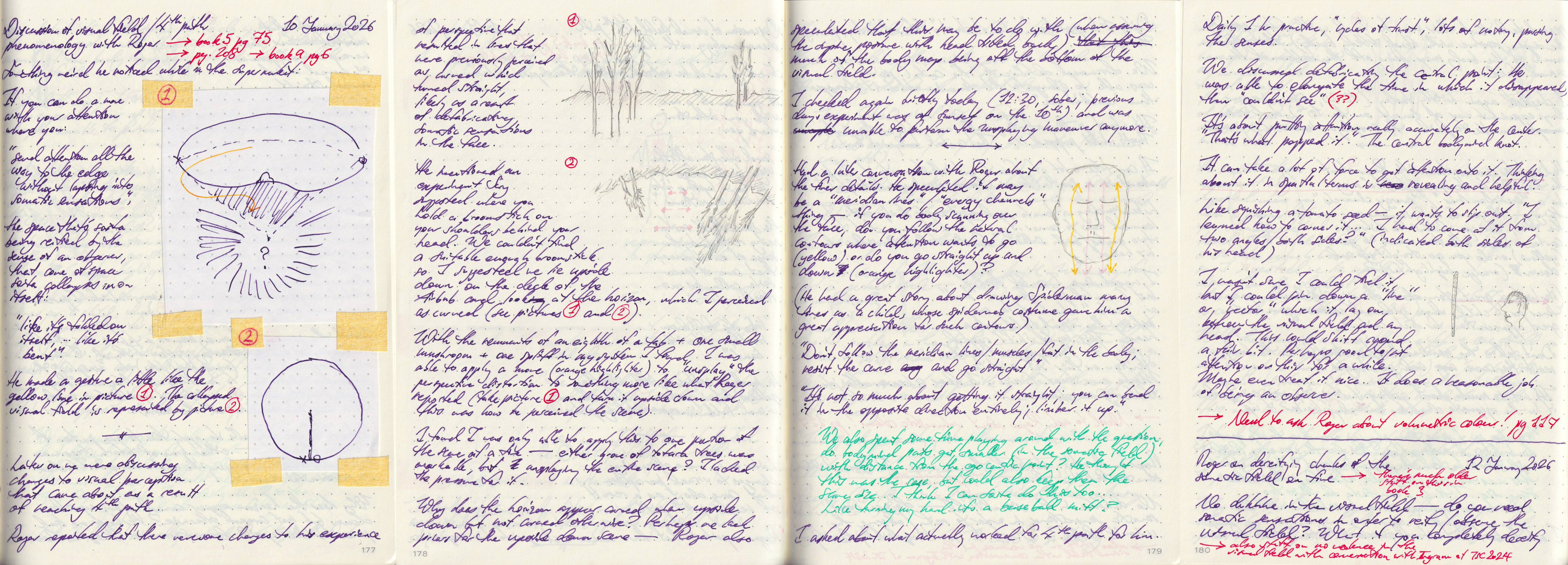
Roger: If you can do a move with your attention where you send attention all the way to the edge without lapsing into somatic sensations – the sense of space that’s being reified by the sense of an observer, that cone of space collapses in on itself. Like it’s folded onto itself.
He said he originally discovered this phenomenon while wandering around a supermarket – was there something helpful about the flat checkerboard tiles on the floor? Roger tells me that the main contributing factor was that the lights in the supermarket were so bright that it really illuminated his peripheral vision. I remain unsure whether all this is a separate practice from unravelling the knot or the same thing approached from the outside in.
I have a few questions which I need more data to answer.
Is dissolving the central knot – which may or may not connect to a change in visual perspective – really an essential part of what people call “enlightenment”? Or instead, is it just one of many structures which some people might accumulate over time, which one might also dissolve as part of a general path of defabrication? If the latter is true, then might these structures be stickier for some people than others? Should we expect small children to see straight lines or curved?
How mundane could this sort of thing be? One reason that I tend to be an optimist about this kind of question is that it’s possible that meditative practices select for the people with the stickiest structures who get the most out of meditation – who also stick around the longest. I suspect that in the general population it’s really not so rare to be able to apply weird and subtle transformations to your perception.
It was time to start asking around. At the recent Qualia Research Institute psychophysics retreat in Tepoztlán, México, I took the opportunity to ask a small sample of other phenomenology nerds what they saw when they looked at the horizon upside down. Would this turn out to be just one of those random things that some people experience while others don’t? Aatu and I saw curved lines; Andrés and Ethan claimed to be able to see it both ways; and Roger, Taru, and Wystan reported seeing straight lines.
How diverse should we expect people’s reports of perspective to be? Perhaps we could set expectations by looking at the diversity of ways that people experience the boundary of the visual field. There’s a classic thread from Michael Stroe about how the boundary changes during stream entry, and a couple of years ago I ran a poll about how sharply people experience the boundary:
How can the visual field be finite and yet feel edgeless? What could possibly lie beyond its edge? Some have proposed that the visual field is an open set:
An open set is a set that doesn’t include its own boundary. An example is the set of all numbers x such that 0 < x < 1. You can get arbitrarily close to one – 0.9, 0.99, 0.999 – but there’s no actual largest number in the set. If the visual field works like this, then there would be no outermost point within the visual field. Wherever you move your attention – there’s always a tiny bit more space for it to go beyond.
Maybe that’s how it’s supposed to work. Perhaps sometimes something gets tangled up around the ears.