
Should OpenAI Be Afraid of Jensen Huang?


News flash: A lot of people in Silicon Valley are afraid of Nvidia CEO Jensen Huang.
They have understandable reasons to be fearful, as Leo, Phoebe and I detailed in our story this morning. The chipmaker has a lot of money and influence to throw around, since Huang has the ear of several top government officials, including President Trump.
More importantly for model developers like OpenAI, Nvidia controls the flow of AI chips they need to develop and run today’s most advanced models. It’s been hard enough for AI developers to get access to those chips, so it makes sense that the companies would want to avoid anything that might upset Huang.
This has led to a situation where OpenAI has avoided taking a public stance on the current debate over chip sales to China for fear of alienating Nvidia and Huang, which generates plenty of revenue from Chinese companies and wants access to the Chinese market itself. (Nvidia isn’t allowed to sell its most advanced tech directly to that market, but Chinese firms like ByteDance and DeepSeek still find a way to access the chips outside China’s borders or through smuggled hardware.)
But how scared do AI developers actually need to be?
After all, OpenAI and Anthropic are among Nvidia’s largest customers (either directly or indirectly) and the chipmaker needs them just as much as they need Nvidia’s hardware.
Anthropic has been quite outspoken in its support of stricter restrictions on the sale of Nvidia chips to Chinese firms and that hasn’t seemed to hurt its chances of accessing Nvidia chips. The chipmaker even said late last year that it would invest up to $10 billion in the Claude maker, and more recently discussed being an anchor investor for its initial public offering later this month.
While Anthropic has struggled to get access to enough compute, as I discussed on TITV yesterday, that has less to do with its relationship to Nvidia and more with being overly conservative in signing compute deals in the past. Uncertainty around whether it can gain access to enough servers to support its business was one of the biggest risk factors that Anthropic noted in its IPO prospectus!
Moreover, if Nvidia were to reduce the amount of chips it allocates to OpenAI, Nvidia might end up suffering. OpenAI has been working to diversify its sources of compute, adding chips from AMD, Google and Cerebras, as well as developing its own Jalapeño chip for inference (which OpenAI designed with Nvidia archrival Broadcom). Taking away Nvidia chips would only further accelerate that diversification process and speed up OpenAI’s effort to lessen dependence on Nvidia.
Nvidia has as much to lose as anyone if OpenAI stumbles: it is guaranteeing the lease on OpenAI’s giant Ohio data center campus, to the tune of more than $100 billion. That gives OpenAI more leverage than its silence suggests. But it also shows why OpenAI stays quiet. Unlike Anthropic, which has been generating more cash than it burns, OpenAI still relies on Nvidia’s balance sheet, not just its chips.
Here’s what else is going on…
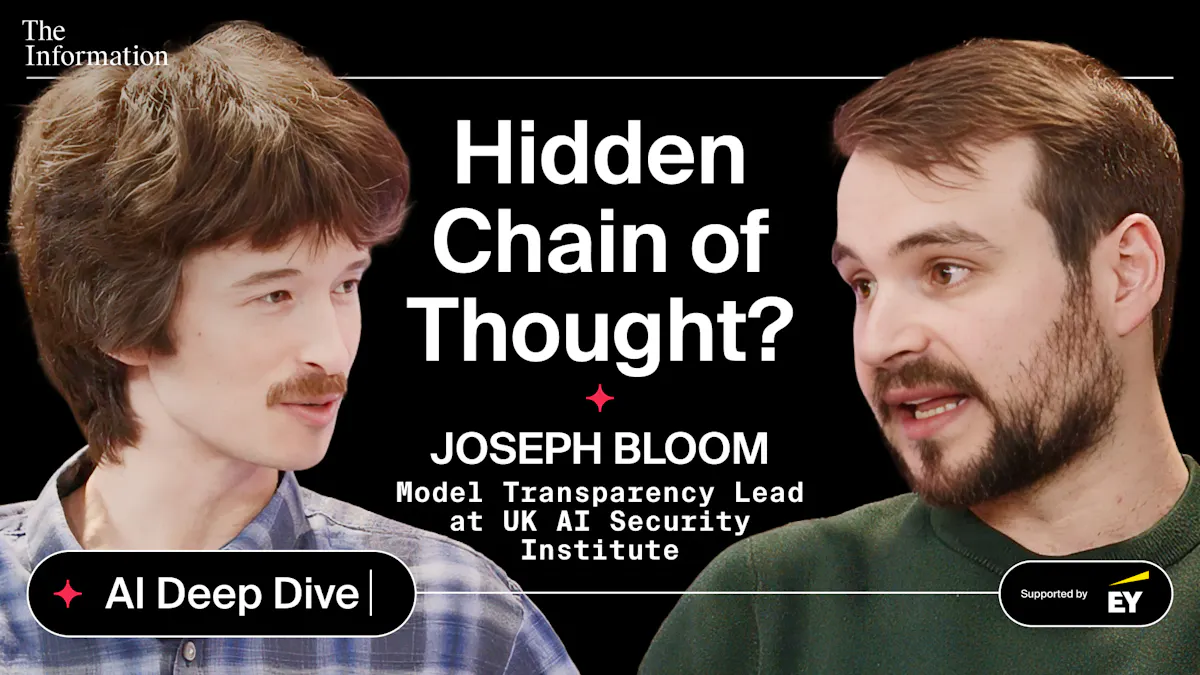
AI Deep Dive: Chains of Thought Are Getting Harder to Read, Says U.K. Government’s Joseph Bloom
Chains of thought, the written reasoning steps that AI models use, have become a key means for companies to monitor the decision-making of their AI agents. But as AI models improve, their chains of thought are growing less legible, making agents harder to monitor, said Joseph Bloom, the head of model transparency at the U.K. AI Security Institute on the latest episode of The Information’s AI Deep Dive.
Can anything save chains of thought? According to Bloom, cross-company efforts are underway to reach some kind of consensus on preserving the monitorability of chains of thought before they degrade completely. Encouragingly, AI developers have already largely agreed to avoid influencing their models’ chains of thought out of concerns doing so would prompt AI models to hide their true reasoning. (You could imagine an AI developer telling a model to stop thinking “bad thoughts” in their chains of thought and the model deciding instead to just keep its “bad thoughts” to itself.)
The AI industry could reach a similar consensus with “loop transformers,” a new technique that OpenAI and others are using that improve model performance but could encourage models to reveal less of their “thinking,” though opponents argue that such a norm could be overly strict, he said.
One approach that could help compensate if chains of thought continue to degrade is mechanistic interpretability, which aims to understand the internal workings of AI models, rather than just their outward behavior. Bloom previously researched mechanistic interpretability, but compared to some previous guests on AI Deep Dive, he has tempered his expectations that it will save the day.
“I used to be a computational biologist,” he said. In biology, “you can understand often what’s going on with a system at some level of detail, but it’s still always going to be somewhat messy”—a lesson that could apply to AI as well.—Rocket Drew
People on the Move
Former U.S. Army Secretary Dan Driscoll is joining OpenAI to help expand the use of the AI company’s technology in national defense and other military applications. Driscoll is now a “senior counselor” for the AI giant focused on national security modernization, according to his LinkedIn page.
Overheard
Nvidia has recently told some cloud computing customers to reduce their exposure to Chinese companies, potentially narrowing a key route for China’s AI developers to access advanced computing power, The Information reported. The guidance is intended in part to encourage cloud providers, including Nvidia-backed neoclouds, to bring in a more diverse mix of customers.
China’s top economic planner said on Tuesday that the country will closely monitor the impact of AI on employment, as Beijing moves to establish safety standards and ethical guidelines covering “the whole life cycle of AI.” Wang Ruomeng, a senior official with the National Development and Reform Commission, told reporters at a press conference that the agency will pay close attention to how AI changes the existing employment structure, while simultaneously looking to leverage AI’s potential to create new jobs.
Earnings Report
Anthropic reported nearly $17 billion in revenue in the third quarter ending September, up 47% from the second quarter, the latest sign that its once red-hot revenue growth rate is slowing ahead of a blockbuster IPO this month.
In Apple’s first earnings under new chief executive John Ternus, the company reported sales growth slowed in its fiscal fourth quarter. Total revenue for the September quarter was $114.5 billion, up from 12% from the previous year, its slowest sales growth for the year. The iPhone business remained strong, advancing 17% to $57.6 billion. The iPad and wearables segments declined 10% and 8%, respectively.
Big Number
Oracle filed to raise $20 billion through fresh debt and equity offerings on Monday, its latest funding move as it spends heavily on AI infrastructure. The cloud and software firm is selling $10 billion worth of investment-grade bonds and $10 billion in common stock.
Court Watch
The New York Times sued Brave, a company that offers a browser and a search API, on Monday, alleging it scraped the outlet’s copyrighted content and distributed it to customers including Anthropic, Perplexity, Mistral, xAI and Cohere.
Deals and Debuts
See The Information’s Generative AI Database for an exclusive list of private companies and their investors.
Chipmaker Marvell Technologies agreed Monday to buy laser maker Lumentum in an all-stock deal worth around $80 billion, a sign of how the AI investment boom has boosted Lumentum’s value.
Salesforce signed a definitive agreement to acquire Cresta, which makes AI voice agents for customer service, for $2.7 billion, The Information reported.
Moffett AI, which makes AI inference chips, completed a Series C+ funding round worth nearly RMB 1 billion (about $138 million), with investors including Renai Capital, Haitang Fund, Dongheng Petroleum.
RoboScience, which builds AI models for humanoid robots, completed a Series A2 funding round worth several hundred million yuan (precise figure undisclosed), led by Hupo Capital, Hongruida Investment and Shanghai Semiconductor Industry Investment
Tutor Intelligence, which builds AI-powered warehouse and logistics robots, raised $75 million in a Series B funding round led by Andreessen Horowitz.
42AI, which built an AI model that predicts human behavior, emerged from stealth with $62.5 million in seed funding from its founders and Infinity Group.
Trajectory, which makes AI models learn from feedback, raised $45 million at a $300 million valuation in a Series A funding round led by Sequoia.
nPhase, which uses AI to manage clinical trial data, raised $30 million in a Series D funding round led by Viking Global Investors.
Larridin, which tracks how companies’ AI spending pays off, raised $30 million in a Series A funding round led by Pelion Ventures.
Clark, which builds AI agents that perform company audits, raised $11 million in a seed funding round led by Touring Capital.
Shareholders of Churchill Capital Corp XI approved its SPAC merger with Agility Robotics, which builds AI-powered humanoid warehouse robots, clearing the way for Agility to go public on the Nasdaq under the ticker AGLT on November 5.
OpenAI has signed deals with Magnite and PubMatic, whose software enables advertisers to place their ads on websites and other digital platforms, to fill unused ad space on ChatGPT, The Information reported Monday.
This week on AI Deep Dive
Check out the most recent episode of AI Deep Dive. An up-close look into how frontier AI actually gets built — the models, the money, and the people behind them.
Thank you for reading the AI Agenda Newsletter! I’d love your feedback, ideas and tips: [email protected].
If you think someone else might enjoy this newsletter, please pass it forward or they can sign up here.