
Alan Zaslavsky
 2


We had a wonderful cohort of students in the statistics Ph.D. program at Harvard in the late 1980s, and I learned so much, not just from the faculty and from my contemporaries in the program, but also from those who were a couple years ahead of us: those students who seemed to know everything that was going on in our seminar courses and who were deeply involved in theoretical and applied research projects. Our program was kind of disorganized, but this had the benefit that every homework assignment was in itself an open-ended challenge—that’s a polite way of saying that it usually wasn’t clear what the professor actually wanted us to do—and I would take the work of these older students as an inspiration to try to go as deeply as I could in attacking these problems. At that time I hadn’t yet heard the expression, God is in every leaf of every tree, but I guess that’s one place I learned it.
The older students who were the most influential to me were T. E. Raghunathan, John Carlin, and Alan Zaslavsky. Each of them combined technical competence—no, that doesn’t sound quite right, let me rephrase this as a level of comfort with the necessary mathematics that allowed them to move beyond the mathematical details—to “chunk” the math, as it were—to focus on the deeper and more challenging statistical questions (my point here being that if you’ve internalized the math, it becomes transparent and you don’t feel like you’re doing algebra or whatever, you can just see through to the next step), with a talent for getting to the heart of applied problems (which, again, requires both the ability and inclination to do the necessary work, and the rarer ability to be able to step back and reassess your models and methods), along with a worldly or selfless maturity and wisdom. By “selfless,” I don’t mean they were “saints”—whatever that means!—but rather that, in their conversations about life, politics, etc., they were able to place the immediate and the long-term in the same frame, as it were. I was formed by so many people in that program, but these students provided intellectual and moral leadership.
I’ve collaborated with Raghu and John on various projects and hope to do so again, but right now I’ll talk about Alan because he recently passed away after a very full life and career. Alan was already about 40 when he was in our program—he was officially an applied math Ph.D. student at MIT, but he was working with Don Rubin at Harvard so we thought of him as one of us. As Chris Schmid put it, “Alan was one of those rare people who could tell you were wrong or maybe you might want to think about something in a slightly different way without making you feel bad and at the same teaching you something that you always appreciated.” After graduating from college in the late 1960s, Alan worked as a teacher and a union organizer for a decade or so before going to grad school, and then after his Ph.D. he took a faculty position at Harvard public health and also was involved in government service.
Alan’s work during and immediately after his Ph.D. involved census adjustment. An important contribution was his paper, Combining Census, Dual-System, and Evaluation Study Data to Estimate Population Shares, which begins:
The 1990 census and Post-Enumeration Survey produced census and dual system estimates (DSE) of population by domain, together with an estimated sampling covariance matrix of the DSE. Estimates of the bias of the DSE were derived from various PES evaluation programs. Of the three sources, the unadjusted census is the least variable but is believed to be the most biased, the DSE is less biased but more variable, and the bias estimates may be regarded as unbiased but are the most variable. This article addresses methods for combining the census, the DSE, and bias estimates obtained from the evaluation programs to produce accurate estimates of population shares, as measured by weighted squared- or absolute-error loss functions applied to estimated population shares of domains. Several procedures are reviewed that choose between the census and the DSE using the bias evaluation data or that average the two with weights that are constant across domains. A multivariate hierarchical Bayes model is proposed for the joint distribution of the undercount rates and the biases of the DSE in the various domains. The specification of the model is sufficiently flexible to incorporate prior information on factors likely to be associated with undercount and bias. When combined with data on undercount and bias estimates, the model yields posterior distributions for the true population shares of each domain. The performance of the estimators was compared through an extensive series of simulations. The hierarchical Bayes procedures are shown to outperform the other estimators over a wide range of conditions and to be robust against misspecification of the models. The various composite estimators, applied to preliminary data from the 1990 Census and evaluation programs, yield similar results that are closer to the DSE than to the census. Analysis of a revised data set yields qualitatively similar estimates but shows that the revised post-stratification improves on the original one.
This is typical of his work in that it was innovative, with applied importance, and understated. Alan continued to work on the census, but his later career focused on health care policy, with hundreds of influential collaborative papers as well as methodological innovations. Among other things, he had some very useful thoughts on hierarchical modeling (see links here and here).
And here’s a graph that Shira recently shared from Alan’s paper, Statistical Issues in Reporting Quality Data: Small Samples and Casemix Variation:
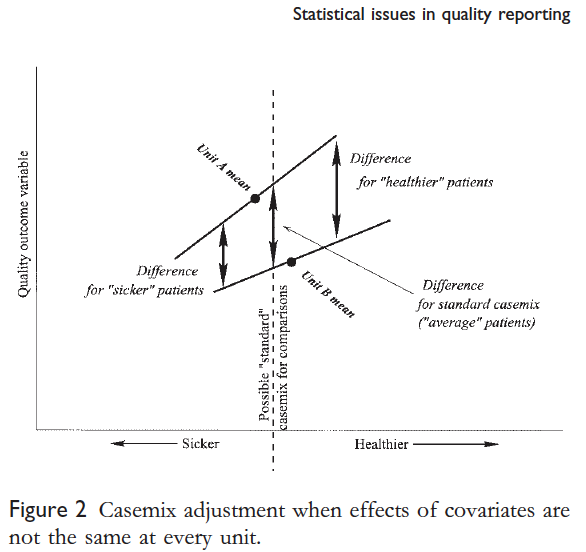
Again you see the combination of general ideas and clarity with a focus on a particular application. The rest of us can than take these insights and use them elsewhere.