
Democrats Brace for Turbulence Over Trump’s Election Threats
 2


I’m Jonathan Tamari, senior Washington reporter for Bloomberg Government, and each weekday I’ll be coming to you with inside-the-room reporting and insights that reveal what’s really happening in Washington—and how it impacts you. Email me with feedback and comments here. If this newsletter was forwarded to you sign up here.
Today: Will Trump try to shape the count?, Haley Stevens’ November surprise, and a freezer with DNA from 200,000 Icelanders.
On Edge
One of the biggest wildcards left in the midterm election (aside from Haley Stevens) has little to do with candidates or campaigns.
It’s the question of how Donald Trump responds to a close finish, and if his administration tries to put its finger on the scale in drawn-out counts — especially if control of the Senate comes down to a narrow result.
While it’s unclear what, if anything, Trump may do, he has laid the groundwork to challenge the outcome — signaling the next phase of the campaign could be in court.
The maneuvering continued over the weekend as judges in California and Alaska ruled against administration moves to question certain ballots or results.
But Republicans are still pushing investigations in Alaska, one of the potentially decisive Senate battlegrounds, with some suggesting the chamber should refuse to seat Democrat Mary Peltola if she wins.
Democrats accuse Trump of trying to “steal” an election. The party’s senators held a briefing Sunday night on potential threats and responses with election lawyer Marc Elias, BGOV’s Zach C. Cohen reports.
“If he can’t win Americans’ support, he’ll try to cancel their vote,” top Senate Democrat Chuck Schumer wrote Friday in an opinion piece.
The Senate appears more vulnerable to potential election challenges, given so many races are close. The House, polls suggest, is leaning more decisively toward Democrats.
Elections are run by states, by law leaving the federal government with a limited role.
But Trump has long obsessed over fraud, while failing to produce credible evidence of major wrongdoing.
“The system we have today falls catastrophically short,” the president said in a July address from the White House.
The administration has pressed California, host to several major House races, over some 20,000 ballots that it says (but hasn’t proven) are likely from non-citizens, including issuing criminal subpoenas to state and local officials.
Studies have long shown that voter fraud is extraordinarily rare, far smaller than even 1% of ballots cast in major races. Previous pronouncements about fraud have also fallen apart. A September claim that up to 16,000 non-citizens were on Nevada’s rolls turned up zero.
More recently, the administration sued to potentially block the results in Alaska’s Senate race — and the state’s top federal prosecutor launched a criminal probe after The New York Times revealed Democrats were behind a move to add another Dan Sullivan to the ballot, potentially siphoning votes away from the GOP senator with the same name.
Senator Sullivan said Sunday he would accept the results.
Meanwhile, a Department of Homeland Security unit typically focused on human trafficking and drug smuggling is taking a leading role in probing illegal voting, Bloomberg Law’s Ximena Bustillo reports. It’s produced around three dozen arrests on accusations of voter fraud.
“Those that are interested in opposing our democracy and undermining our democracy are telling us what their plans are,” Hannah Fried, the head of All Voting is Local, told me.
The last time Trump was in office for a nationwide election, the fight continued well past Election Day and included dozens of failed court challenges, attempts to throw out millions of votes, and a riot at the US Capitol.
Now, the president wields power even more aggressively.
Democrats have spent weeks gaming out potential election interference scenarios, and Schumer on Friday announced a “war room” to respond to any efforts to unfairly influence the election.
Senator Jon Ossoff said Trump is inviting a backlash by singling out largely Black cities that are Democratic power centers — including Atlanta, whose home county the FBI targeted in a January raid seizing 2020 election ballots.
“The people’s answer is determined and defiant and massive,” Ossoff told supporters last week.
Democrats have also sued to preemptively block armed federal agents from going to polling places. (No FBI or ICE employees are serving as election monitors, a top Justice Department official said in a court filing last week.)
California Governor Gavin Newsom said he’s sent out 100 election lawyers across the state, where Democrats are aiming to pick up several House seats. Big Law firms are also helping staff a nationwide voter hotline to ensure ballot access and uphold voter rights.
Fried, however, said she’s confident courts and election officials in both parties will ensure votes are counted properly, even as her organization has sent staff to eight battleground states.
“This stuff that the administration is trying, courts are rejecting, the public is rejecting,” she told me.
Top News
Representative Haley Stevens defended her decision to break with fellow Democrat Abdul El-Sayed in Michigan’s critical Senate race and endorse Republican Mike Rogers, setting off a firestorm just before Election Day.
Trump has nine tele-rallies scheduled today as he banks one last time on his personal brand and the MAGA faithful to preserve his Senate majority.
A Democratic wave would expose Trump to greater oversight and force him to accept compromises to enact legislation, Greg Giroux writes.
Trump said he’ll become “Mr. Veto” if that happens, predicting to the New York Post that eventually “they come over and make a deal.”
The president said he’s willing to offer protective pardons to Elon Musk and close aides if Democrats target them in investigations.
Democrats are ahead in nearly all seven battleground states that will determine Senate control in the final set of polls from The New York Times/Siena.
Adding the election uncertainty: AI. The tech has put lawmakers and watchdogs on alert for faulty chatbot info, disinformation, and hacks, BGOV’s Cristiano Lima-Strong reports.
Some Democratic candidates are warning about risks to rural hospitals from the GOP’s signature tax and spending law last year.
Even South Carolina may be in play in the race for the Senate.
Ukraine resumed strikes on oil refineries just as Russia’s gasoline shortages seemed to be easing.
In a terrifying scene, a Learjet nose-dived in Florida, killing nine people on board.
Trump said a US-Canada trade deal is “very close” after talks with Mark Carney, who said both sides would work on a “mutually beneficial” outcome.
The search for the next Ozempic hinges on DNA samples from nearly 200,000 Icelanders.
Gulf Arab states worry that another US-Israeli attack on a better-prepared Iran could unleash an even more destructive response across the region.
Traders have pulled nearly $5 billion from Binance since it was hacked last week, though that’s still less than 3% of the assets held by the world’s largest crypto exchange.
Watch This
Go Deeper With BGOV
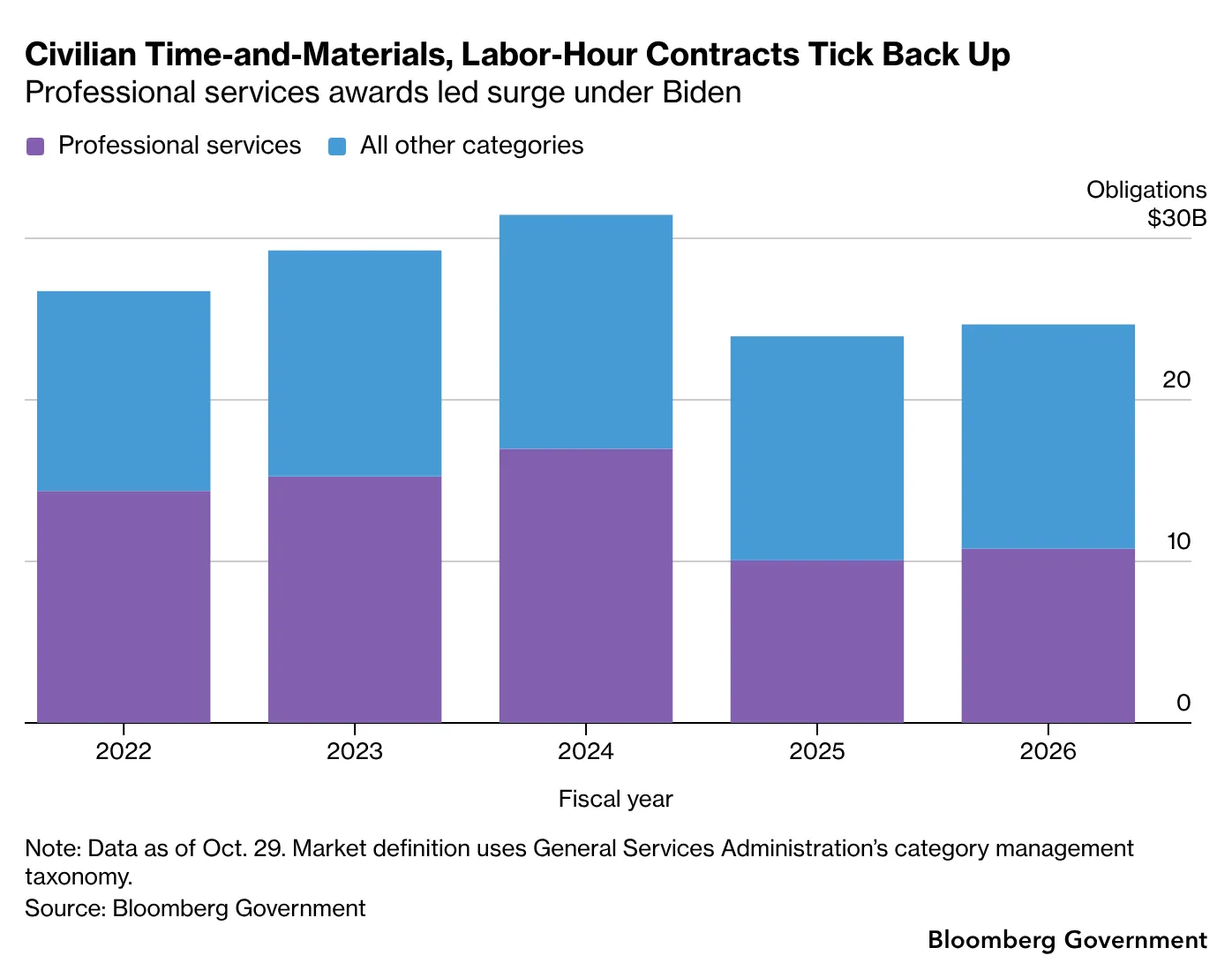
Civilian agency spending on a contracting method commonly used for professional services increased slightly in fiscal 2026 but is still down 22% from its peak under the Biden administration, BGOV’s Maika Ito writes.
Agencies obligated $24.7 billion using time-and-materials and labor-hour contracts, 44% of which was for professional services. The contracts are considered riskier to the government because they pay contractors for fixed hourly rates, but the total hours and the final cost are uncertain.
Use of the contracting method plummeted in fiscal 2025 and the Trump administration has since prioritized fixed-price contracts. Time-and-materials and labor hour contracts now account for one-fifth of annual professional services obligations, down from 27% in fiscal 2024.
IT procurement led all other spending categories for time-and-materials and labor-hour contracts, growing year-over-year to $10.2 billion from fiscal 2022 to fiscal 2026. That category accounted for 35% of the market during the same period.
On Today’s Agenda
Trump holds nine tele-rallies, including for Louisiana Senate candidate Julia Letlow. He speaks at the Lincoln Memorial Reflecting Pool at 2 p.m.
JD Vance heads to upstate New York to campaign for Republican House candidate Anthony Constantino and rallies in Swanton, Ohio.
More From Bloomberg
Like Washington Edition? Check out these newsletters:
Balance of Power for the latest political news and analysisFault Lines from Bloomberg Economics for daily research on how geoeconomics is reshaping business and marketsCongress Tracker for BGOV clients to stay on top of the action on the HillFOIA Files for Jason Leopold’s weekly newsletter uncovering government documents never seen beforeMorning Briefing Americas for catching up on everything you need to know
Explore all newsletters at Bloomberg.com.