
What Social Constructs Are (And Are Not)
 2


This post is mostly adapted from a section of another post. I wanted a standalone version, to serve as background for a sequence on the mechanisms of social reality.
You’ve probably heard that things like laws, conventions, norms, cultural associations, status, and so forth are “social constructs”: they’re kinda arbitrary in some sense, an artifact of social reality as opposed to physical reality. This post offers a little more clarity on what social constructs are, and the ways in which they are and are not “arbitrary”.
Example: Vehicle Categories
The vehicles humans build today mostly fall into categories like “minivan” or “truck” (among other categories). These categories cash out in predictions: when I see a vehicle with sliding side doors, I predict that it will have a trunk door that opens overhead, three rows of seats, be driven by someone with kids, etc. On the other hand, when I see a vehicle with a flat bed in the back, I predict that it will not have three rows of seats, will have a back gate which opens downwards, be driven by my cousin, etc.
But humans could choose to make different vehicles, which would change which clusters exist amongst our vehicles. The types of vehicles people make are a matter of social convention - i.e. vehicle types are a social construct. Crucially, this does not mean that vehicle categories are “fake”! Categories like minivan and truck are very real in our world, they have real predictive power, and they have predictive power because humans choose to build vehicles which match those categories.
Two key points:
- Many humans, or a few well-resourced humans, could change which vehicle-clusters exist by changing what vehicles are produced. We can change the social construct by going out and changing things in the real world.
- Changing a social construct is not just about deciding that I personally am going to categorize things differently. If I draw different vehicle-clusters, I will probably just be wrong, in the sense that I make worse predictions about e.g. vehicles with sliding side doors also having three rows of seats.
Here’s the mental picture, in terms of clusters:
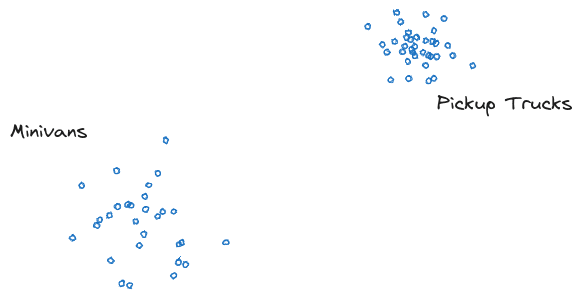
This is a classic straightforward case of words pointing to clusters in thingspace. But if people go out and build other kinds of vehicles, it might look like this:
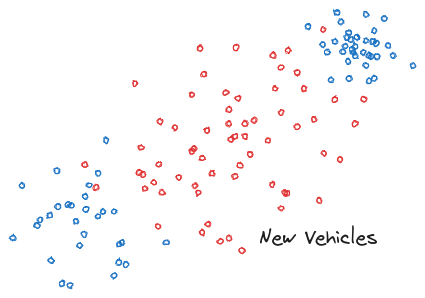
… and if they build enough new vehicles, it can totally change what clusters are present:
Our two key points, in terms of clustering:
- People can totally change what stuff is in the world, in such a way that the “natural categories” (in this case the clusters) change.
- … but that requires going out and changing stuff in the world; it’s not just a matter of me deciding to carve up the same data in different ways.
So even if the clusters can be changed by humans by changing the world, that doesn’t mean that choice of clusters is a totally arbitrary choice of how to view the same data.
Example: Laws
Laws are another classic prototypical example of social constructs.
Like vehicle categories, laws have a lot of predictive power. For instance, if I look up some case law on vehicular manslaughter online, and then I go into any of thousands of different courtrooms in the US, I expect to see proceedings hinge on basically the points described online. Just like the minivan/truck categories provide predictive power insofar as they statistically describe lots of real-world vehicles, laws provide predictive power insofar as they statistically describe lots of real-world actions by police, judges, etc. Even an alien observing humans would find it useful to keep track of the laws, in order to predict how lots of different humans behave.
But just like with the vehicles, humans can collectively decide to adopt different laws. The same two key points apply:
- People can totally change the laws, in such a way that all the predictions summarized by “laws” change.
- … but that requires somehow changing the behaviors of a whole lot of individual police, judges, etc, as well as many written records; it’s not just a matter of me deciding that vehicular manslaughter is fine now.
The General Principle
In general, social constructs are real predictive patterns which are out in the world because humans collectively chose to put those patterns in the world. In principle, humans can collectively choose to put different patterns in the world. And sometimes we do! E.g. laws change, or new vehicle categories are created.
Social constructs are “arbitrary” in the sense that humans as a group can decide to make different patterns instead. But they are decidedly not arbitrary in the sense of being “fake” or saying nothing substantive about the world, nor are they arbitrary in the sense that I can change the construct just by deciding to ignore it. Changing a social construct requires lots of humans to actually do different things.
- Note that these predictions are not supposed to be accurate 100% of the time, but they’re supposed to make good predictions statistically across many vehicles. That’s part of the intuition behind the clustering picture below: we’re not trying to draw a sharp dividing line between the clusters, they’re supposed to be statistical descriptions.