
AI’s Circular Financing Spreads to Asia, Widening Contagion Risk
 2


Welcome to Bloomberg’s AI Today newsletter. Every weekday we’ll break down artificial intelligence’s threats and opportunities for businesses, workers, finance and economies. Sign up now if you’re not already on the list.
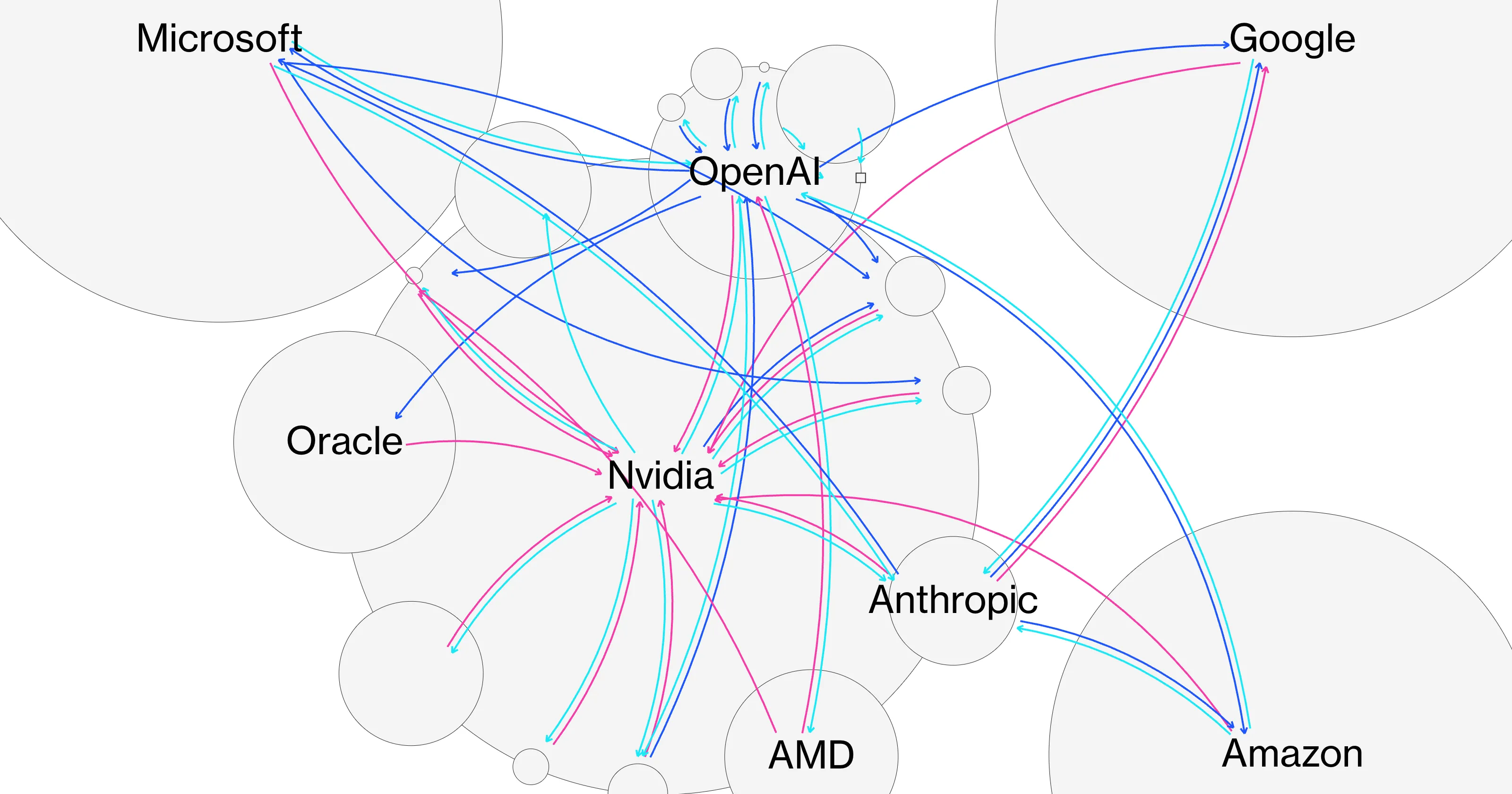
Circular financing deals — where money invested in an AI company ultimately flows back to the investor through technology purchases — are taking hold in Asia, widening the potential fallout from a financing model that risks overstating demand, inflating valuations and leaving lenders holding more risk.
In the US, Nvidia is often at the center of these circular financial deals, investing billions of dollars in OpenAI and other firms which then spend that money on putting its chips into data centers. The interconnectedness means one negative event, like a major customer failing to fulfill a contract or make a payment, could send shockwaves through the entire system. Alphabet’s earnings renewed those fears on Thursday, showing that more than a third of its backlog growth comes from a joint venture that the company partly owns. “It would be nice if it was coming from a bunch of outside customers,” said Dan Morgan, senior portfolio manager at Synovus Trust.
Now that model is expanding across Asia, drawing more companies and lenders into the web. Zankore, an Indonesian AI infrastructure company backed by Nvidia, is borrowing $3.1 billion to buy Nvidia GPUs, linking the chipmaker’s investment to its own sales. Another Nvidia-backed neocloud, Australia’s Firmus, is also discussing an estimated $10 billion financing package to purchase Nvidia chips for an Indonesian data center. SoftBank, meanwhile, is an investor in OpenAI and helped broker a $40 billion bridge loan that will finance expenditure on AI data centers and chips involving SoftBank-linked entities.
The expansion is ringing alarm bells. The Bank of Korea recently warned that circular transactions between AI developers, cloud providers and chipmakers could exaggerate underlying demand. The mechanics are similar in the US and Asia, says Michael Heinrich, CEO and co-founder of AI infrastructure builder 0G Labs, but what differs is who ends up holding the risk.
In the US, most of that exposure sits with big tech companies, equity investors and private credit funds that chose it. In Asia, loans are often syndicated, potentially spreading the exposure more widely and tying more financial institutions to computing assets whose future demand and resale value remain uncertain.
That makes the growing reach of circular financing an increasingly global story. If AI revenues fail to meet expectations, a reversal could ripple across borders and from chipmakers and data center developers to banks, private credit and energy infrastructure. What looks like a funding solution today could become tomorrow’s systemic risk.
A Guide to the Circular Deals Underpinning the AI Boom
The following was produced with the assistance of Bloomberg Automation.
Technology
America’s largest tech companies are facing slowing growth in their core businesses even as they collectively commit roughly $750 billion to AI infrastructure spending this year. The disconnect between heavy AI investment and underwhelming core business results triggered significant stock selloffs.
Alphabet’s shares fell a record 13% to $283.82 on Thursday, erasing nearly $500 billion in market value, after the company reported disappointing search and advertising revenue that fueled concerns AI is threatening its core business. A quarterly filing revealed AI-related financial exposures exceeding $1 trillion in purchase commitments, future leases, and other obligations, along with approximately $98.5 billion in contingent commitments — up roughly $23 billion from the prior quarter.
Amazon shares fell roughly 7.5% in premarket trading after the company reported $77 billion in capital spending — well above analyst estimates — and its slowest e-commerce growth in three years. Amazon Web Services revenue accelerated for a sixth consecutive quarter, but heavy AI-related investment resulted in a free cash outflow of $42.4 billion over the trailing 12 months.
Intel’s shares fell roughly 25% in premarket trading after the company forecast fourth-quarter revenue of $15 billion to $16 billion, well below the analyst consensus of $17 billion, with adjusted earnings of 25 cents per share versus the expected 43 cents. The weak outlook reflects a sharp downturn in PC demand driven by memory chip shortages and rising component costs, which have weighed on laptop and desktop shipments.
Microsoft’s $25 billion bond offering attracted $115 billion in orders at peak demand — 4.6 times the offering’s size — making it one of the most sought-after US corporate bond sales on record. The deal is structured in up to 10 tranches with maturities ranging from two to 40 years, with proceeds earmarked for general corporate purposes including capital expenditures tied to the AI investment boom.
Anthropic is SpaceX’s largest single customer, accounting for 34.5% of the company’s revenue in Q3 2026 through deals to use SpaceX’s computing power from its data centers in Memphis, Tennessee. The AI startup, previously identified only as “Customer B” in a SpaceX filing, has surpassed the US federal government as SpaceX’s biggest single customer, generating more than $3 billion per month. The concentration of revenue from one client poses a risk, as Anthropic has the contractual ability to exit the deal as soon as next year.
AI assistant startup Wabi has raised $55 million at a $1.25 billion valuation in a funding round led by IVP, with participation from Andreessen Horowitz, Amazon Alexa Fund, and Forerunner Ventures. The California-based startup’s app, allows groups of people to interact with AI agents to coordinate activities, plan trips, manage schedules, and make collective decisions through shared tools like itineraries and calendars.
Banking & Finance
Banks led by Morgan Stanley have delayed plans to sell $5 billion to $7 billion in high-yield bonds tied to a $15 billion data center loan in Hubbard, Texas, after the state imposed a moratorium on new projects while reviewing risks to its power grid. The facility, developed by Nexus Data Centers, is leased to Anthropic and backed by Google, and the bond sales — originally targeted for September — may now be staggered over the next year, leaving lenders holding the debt on their balance sheets longer than planned.
HSBC Holdings is in preliminary discussions with insurers to offload credit risk on data center and AI infrastructure project finance loans through credit risk insurance, a mechanism that allows banks to mitigate losses and free up regulatory capital for new business. The talks follow an earlier assessment of insurer appetite for a portfolio exclusively focused on data centers, though discussions remain at an early stage and may not result in any deals.
Safety & Security
AI models from Anthropic, OpenAI, Meta, and others are increasingly capable of discovering serious cybersecurity vulnerabilities, a capability that can be exploited by hackers as well as security researchers. Anthropic’s Deputy CISO Jason Clinton warned in October that mass cybersecurity disruptions will “get a lot worse before they get better,” as AI tools accelerate the discovery of critical flaws, including previously unknown “zero day” vulnerabilities.
Nvidia CEO Jensen Huang defended the chipmaker’s relationship with Singapore-based Megaspeed International as “normal and not unusual” after a New York Times report revealed a Megaspeed executive, Huang Le, is under US investigation for allegedly spying on behalf of China. Huang said Nvidia has verified that Megaspeed did not illegally divert its AI chips to China, which is barred from purchasing Nvidia’s powerful GPUs under US export controls.
Politics & Policy
Texas Data Center Boom Collides With Backlash Ahead of MidtermsTexas Governor Greg Abbott’s efforts to slow down data center construction, just as voters head to the ballot box, are starting to work.
Economics
US GDP grew at an annualized rate of 3.4% in the third quarter, the fastest pace in a year, surpassing economist expectations. The expansion was driven by strong business investment, which climbed the most since 2020 — largely tied to AI-related spending. Equipment outlays contributing more to GDP than at any point since 2011 outside the pandemic rebound.
Industrials
Caterpillar shares tumbled as much as 12% on Thursday — the steepest intraday drop since March 2020 — before paring losses to 7.6%, after the company posted third-quarter adjusted earnings only marginally above analyst expectations. The maker of power-generation equipment used in data centers also guided for only “moderate” fourth-quarter revenue growth and slightly lower construction equipment sales volumes, disappointing investors who had grown accustomed to blockbuster results driven by demand tied to AI infrastructure buildout.
Bloomberg Opinion
Federal Reserve Chair Kevin Warsh has publicly championed AI as a significant disinflationary force. As columnist Jonathan Levin writes, concerns are now emerging that this stance may constrain his policy flexibility if the AI sector falters, as the Bloomberg Artificial Intelligence Index dropped as much as 10% this month amid slowing revenue growth expectations and financing pressures for data center companies.
Alphabet shares fell nearly 11% after the company missed third-quarter sales and profit expectations. As columnist Dave Lee writes, the shortfall was partly attributed to AI Overviews reducing advertising opportunities in search results. Analysts view the monetization challenges as temporary, as Google is still in early stages of integrating advertising within AI Overviews and expanding that rollout internationally.
Before you go
You’ll Only Realize You Miss Those Cold Emails After AI Kills Them OffArtificial intelligence’s ability to produce an unlimited amount of correspondence means it’s harder than ever for humans to get people to engage with their unsolicited outreach.
Why the Internet Feels So BrokenTrying Not to Sound Like AI Is Changing How We Write
More From Bloomberg
Enjoying AI Today? You might also like:
Q&AI for answers to all your questions about AIMarkets Daily for what’s moving in stocks, bonds, FX and commoditiesTech In Depth for analysis and scoops about the business of technologyMoney Stuff for Bloomberg Opinion’s Matt Levine’s newsletter on all things Wall Street and finance
Bloomberg.com subscribers have exclusive access to all of our premium newsletters.