What I learned about power from LBJ and Robert Moses
 1


Thanks to Max Farrens, who paired with me in writing the script for this video essay.
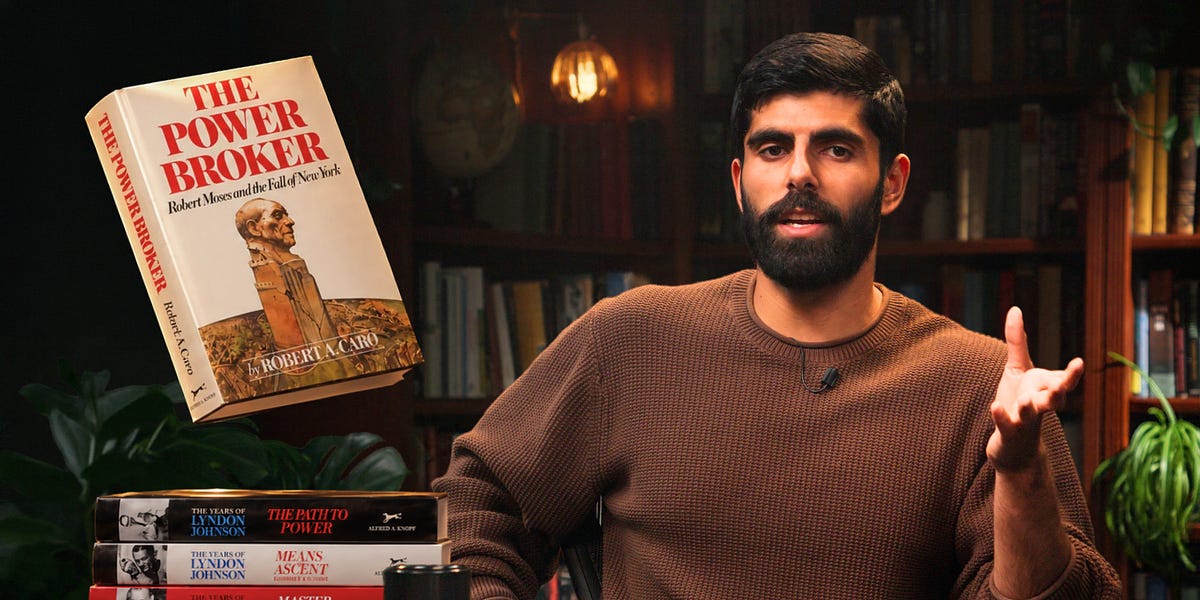
I recently interviewed Robert Caro. He’s spent the last 50 years writing a four volume biography of Lyndon Johnson, and he spent another 7 years before that writing the biography of Robert Moses, the master builder of New York. His books are widely regarded as the best explorations of political power that have ever been written.
They also happen to be literally my favorite books ever. Whenever I meet somebody new, one of the first questions they ask me is, “Who is it that you most want to interview that you haven’t yet?” And for six years, I’ve answered the question the same way: Robert Caro.
I’ve spent so much time trying to make this interview happen: chasing his agent, calling his publisher, contacting the museums that have his archives, and even sending him handwritten letters.
I finally got to sit down with him, and I’m very happy with how it turned out. It’ll be out this Friday.
In the meantime, as I was preparing for the interview, and rereading these biographies, I wrote down the lessons they laid out about how to accumulate and use power.
Robert Moses
Robert Moses was the master builder of New York. He built more of the physical city than anyone before or since: the Triborough and Verrazano bridges, the Cross Bronx Expressway, Jones Beach, Lincoln Center, Shea Stadium, two giant power dams upstate, in addition to hundreds of parks and dozens of pools. Of the 899 miles of highways completed in New York State by 1964, Moses had built 672 of them. His projects collectively cost hundreds of billions of dollars in today’s money.
For more than 30 years, Robert Moses was the most powerful person in New York (more powerful than any elected mayor or governor, despite not being elected to anything). How did he get and keep that much power?
Exploits in law
Part of the answer is that Moses wrote the laws that governed him. He was called ‘the best bill drafter in Albany,’ and he used that skill to write himself powers that the legislators voting on his bills didn’t know they were granting.
The political genius of Robert Moses is perhaps best illustrated by his use of public authorities, which are government-created corporations that build city infrastructure. Public authorities sell bonds to pay for a specific project, say a new bridge. Once the bridge is built, the authority would charge drivers a toll until it had collected enough money to pay off its bonds. Then the authority would tear down the tollbooths, hand the bridge over to the city, and go out of existence.
At least, that was the idea. And that’s what Albany assumed would happen when the New York State Legislature approved the Triborough Bridge Authority Act of 1933, whose final version included - buried within pages and pages of legalese - a few seemingly minor alterations drafted by Robert Moses.
Section 1 clearly stated that the authority would dissolve once the bonds were paid off. And since the bonds could run at most 40 years (and the revenues from the bridge would pay back the initial cost far sooner), it seemed like the authority had a clear, built-in expiration date. However, in a subsection of Section 9, Moses added a single sentence that said the Authority could “from time to time” pay off its old bonds by issuing new ones. And those new ones could be “for any other corporate purpose.” So just before the original bonds were about to expire, the authority now had the right to issue a totally fresh 40 year note, for a potentially totally different use.
And what could the Authority build with all that money? The original act let it build two bridges and their “approaches.” Moses’ amendments also gave this authority the right to build “connecting” roads and “facilities not inconsistent with the use of the project”. These rights, when interpreted as creatively as Moses intended to, would allow Moses to alter most of the roads, parks, and housing in New York - for if a road connected to a road which connected to a road which connected to the bridge, or if a park lay along the road that connected to the road that connected to the road that connected to the bridge, surely the Triborough Authority was entitled to improve and change it.
All this construction could be financed by the bridges’ enormous toll revenues and the right of the Triborough Authority to borrow against them. To give some perspective, in 1946, the entire New York City government could only borrow $150 million before hitting its legal debt limit. That very same year, Triborough could borrow $360 million. So Moses’ bridge authority had access to more than double the amount of money as the largest city in America.
But what if a future governor or mayor eventually learned about all the power and revenue that had been delegated to this authority, and decided to claw back? Moses had planned for that too, and his solution was so clever that no lawyer or lawmaker in Albany saw it coming. The US Constitution says that no state shall make “any … Law impairing the Obligation of Contracts” entered into by a government entity. A bond issued by a public authority is such a contract. Moses snuck a clause into the law that allowed him to add into those bond contracts “any other matters, of like or different character, which in any way affect the security or protection of the bonds”. These “matters” included whether Triborough could charge tolls for however long they wanted, and whether they would get to keep the surplus thus generated.
That is to say, Moses could now entrench his powers simply by writing them into the bonds he issued. From the moment the bonds were sold, those powers could no longer be revoked by the Legislature, the governor, or the mayor - by anything, in fact, short of a Constitutional Convention. The powers that Moses now had were guaranteed for the bonds’ entire lifetime - a lifetime which could always be extended simply by refinancing.
So, with just a few minor tweaks, Moses turned an act meant to allow the construction of two bridges into the basis of an institution that could build basically anything it wanted anywhere in New York (and whose authority to do so was protected by the U.S. Constitution).
The indispensable man
These bond covenants had turned Triborough Authorities’ power into granite, but nothing in them guaranteed that Robert Moses would remain as chairman. So how did Moses retain his position for 30 years?
Part of the answer is, again, the law. Moses drafted the Triborough act so that its commissioners could be removed mid-term only “on stated charges after a formal hearing.” But any differences he had with a mayor or governor were more about what he decided to build and whom he displaced to build it, rather than personal conduct.
As Caro says, “Robert Moses was not himself corrupt. He was, in fact, as uninterested in obtaining payoffs for himself as any public servant who ever lived. In the politicians’ phrase, he was ‘money honest.’”
So, there were never any formal charges to bring. But this only explains why he wasn’t fired in the middle of his term. Why was he reappointed every six years? Well, at his peak, Moses was a hydra with a dozen heads. He held 12 different government posts at the same time: city construction coordinator, chairman of the State Council of Parks, chairman of the State Power Authority, and so on. Some of these positions were appointed by the mayor, some by the governor, so no single person could cut off all his heads simultaneously. And removing him from any one position meant making an enemy of the man who would still be the most powerful person in New York.
More importantly, no mayor or governor wanted to fire him. The way we remember Robert Moses today is based on a reputation that calcified in the 1970s, when The Power Broker came out and New York was experiencing a dark age of crime, deindustrialization, and white flight. Moses got much of the blame (the subtitle of The Power Broker is “Robert Moses and the Fall of New York”). In my opinion, that crisis had more to do with large structural factors than with Moses himself - cities he had nothing to do with, like Detroit and St. Louis, experienced a much more dramatic collapse.
For the vast majority of his career, Moses was incredibly popular. In the 1930s and 1940s, New York high schools voted Moses ‘the most admired New Yorker’. This was because he had delivered, over and over again, public works which millions of New Yorkers got to use and enjoy: beaches, parks, pools, and playgrounds, as well as the bridges and the parkways that let families drive out to them. And he did so at a speed and a scale that nobody had seen before: in just his first four months as the city’s Park Commissioner, by keeping crews working around the clock, he finished 1,700 park renovations. And he did it all without a whiff of personal scandal.
As Caro writes in The Power Broker, “[I]t was not unusual at park and playground opening ceremonies for children, prodded by their parents, to break into the cheer ‘Two, four, six, eight—who do we appreciate? Mr. Moses! MR. MOSES!! MR. MOSES!!!’”
Importantly, Moses could deliver these enormous and popular public works within a timeframe that fit into a single election cycle. If a mayor gave Robert Moses the power to build something, he could expect to be standing at the ribbon-cutting for it before he was up for re-election. Today, it’s almost unimaginable that the government could construct something big in a year or two. For example, construction on the Second Avenue subway in New York began in 1972; the first section was opened in 2017, and just these initial 2 miles cost taxpayers $4.5 billion.
A lot of the funding for public works comes from Washington - cities that receive the most money are the ones who have already finalized their blueprints and can break ground as soon as a new federal initiative is announced. Moses had the largest and best team of planners and engineers in the country. And because of that, by 1936, New York was getting one-seventh of the money that the federal government had set aside for Depression era work-relief… for the entire nation. And the projects this funding was going towards were the ones chosen by Moses. If the mayor had some different idea about what should be constructed, he’d have to draw up his own plans, which he didn’t have the independent technical expertise to do. So he could either build the projects that Moses wanted to build or build nothing at all.
Between his popularity, his unique ability to get things done, and his control over money, Moses had a lot of leverage. And he was not shy about using it. Far from being worried about getting fired, Moses would constantly threaten to quit whenever he didn’t get his way. Under Mayor Wagner, one aide said, “it seemed like he was resigning about one thing or another about twice a day.” He threatened resignation to La Guardia so often, over such small things, that La Guardia’s lawyer got a stack of forms printed that read “I, Robert Moses, do hereby resign as…”, to save Moses the trouble of writing it out every time.
Behind that joke was real fear. If a mayor accepted that resignation, not only would he be forfeiting completion of whatever projects Moses was working on (along with the money apportioned for those projects), he’d also be picking a public fight with the most respected official in all of New York. Moses had spent years befriending the owners of the city’s newspapers - he spent weekends at the summer home of the Sulzbergers, the family that owned the New York Times. The mayor knew that if Moses resigned, the next morning, all the front pages would tell the story of how the man above politics was driven out by a craven politician because he refused to compromise the city’s interests.
The coalition for yes
And the power that Moses derived from his popularity with the masses was nothing compared to the power he derived from his connections with New York’s powerful private interests.
We are very used today to NIMBY, where powerful but concentrated interest groups manage to stymie projects despite their broad popularity. Moses built a concentrated faction for YIMBY. He built a graft machine that greased the wheels for new construction, because it ensured the most influential people in the state would all benefit whenever a project got underway.
The banks got to buy his bonds at a steep discount without competitive bidding, the unions got more jobs, politically connected lawyers got legal fees, and party bosses got paid to broker insurance policies on bridges that had no plausible risk of falling down. Moses could then rely on these beneficiaries to call up anyone who stood in the way of one of his projects, whether that was a borough president or the governor himself.
Power reveals
Caro paints Moses as someone who began as an idealist, rather than someone who craved power from the start. In the 1910s, Moses was a brilliant young reformer who joined this new “good government” movement, which was trying to replace Tammany Hall’s patronage with honest and competent administration. He spent years fighting the machine. But his reforms got killed - the machine won. Moses learned that ideals are useless without the power to realize them. Caro writes:
In the beginning—and for decades of his career—the power Robert Moses amassed was the servant of his dreams, amassed for their sake, so that his gigantic city-shaping visions could become reality. But power is not an instrument that its possessor can use with impunity. It is a drug that creates in the user a need for larger and larger dosages. And Moses was a user.
Lyndon Johnson’s story, on the other hand, is kind of the opposite. For most of his career, there was little evidence he had a coherent political ideology - he was a ruthless power-seeker who embraced whatever happened to be most expedient at the time. When Johnson first entered the U.S. Senate, he realized that the most powerful men there were conservative Southern Dixiecrats. And the Johnson that they encountered was one who had molded himself to their form.
While writing Master of the Senate, Caro interviewed former Georgia Senator Herman Talmadge. He asked Talmadge what impression he got from freshman Senator Lyndon Johnson about the proper relationship between white people and black people.
“Master and servant.” So I [Caro] asked, Well didn’t Johnson have any sympathy for blacks, any desire to improve their lot? My notes say “long pause.” And then I wrote [Talmadge’s] two-word reply: “None indicated.” Another pause, and then: “He was with us in his heart. I believed him. I believed him.”
Of course, we know that once he became president, Johnson spearheaded the 1964 Civil Rights Act and the 1965 Voting Rights Act, the most important civil rights laws since Reconstruction.
So Moses began as a naive idealist but, in Caro’s telling, became someone seeking power for its own sake. Johnson was an ambitious opportunist from the very start, and it was only once he had real power that he used it for ideals few knew he had.
Lyndon Johnson
Lyndon Johnson was the most powerful Senate majority leader - perhaps the most powerful legislator period - in the history of this country. Here’s Caro in Master of the Senate:
He was master of the Senate—master of an institution that had never before had a master, and that at the time, almost half a century later, when this book is being written, has not had one since.
No leader before Johnson had wielded this kind of power, because the Senate had been deliberately set up by the founders to not be “led”. When Johnson asked the Library of Congress for a list of the Majority Leader’s formal powers, he found that there was only one: the right to be recognized first on the floor. Before Johnson, the Majority Leader was less a leader and more a lightning rod. He’d be blamed in the national press and in his home state for everything the Senate failed to do, yet he had no actual power to do anything about those failures. Being in this predicament was so politically toxic that Johnson’s two predecessors as majority leaders had both lost their own Senate seats.
A big part of the reason that Johnson became his party’s leader at just 44, in a Senate whose average age was around 60, was that hardly anyone else wanted such a thankless and useless job. And in their hands, this job would have remained useless. But they were not Lyndon Johnson.
Johnson turned himself into the second most powerful man in America (right behind the president) in three different ways.
Things to promise, things to threaten with
Johnson transformed the Senate’s rules, institutions and norms so that he alone had the power to grant important favors to his colleagues. If a senator needed a bill passed, Johnson was the one who could get it scheduled on the floor and persuade the committee chairman to report it out. If the bill needed help in the House, Johnson was the one with a direct line to Speaker Sam Rayburn. And if the senator needed money for his next campaign (to ensure that he would remain a senator), Johnson was the one who could put in a good word with oilmen from his native Texas.
Johnson also put himself in a position to control committee assignments, which are the single biggest factor that shapes how a senator’s whole career plays out. For about a century, they had been handed out by seniority. Practically overnight, Johnson changed the system so that many seats were no longer being settled by seniority but rather negotiated by the party’s Steering committee, which Johnson controlled. If you wanted a good seat, you had to do what Johnson wanted. In 1957, Estes Kefauver voted against Johnson on an important motion. That very same week, the highly coveted open seat on the Foreign Relations Committee, which Kefauver was expecting to get, was instead handed over to a far more junior senator named John F. Kennedy.
The real political genius of Lyndon Johnson was identifying and then gaining control over every possible source of leverage over his colleagues. Whatever a senator needed to survive, whether that was money, committee seats, or the passage of bills that matter to his home state, Johnson could give, and Johnson could withhold.
Setting the agenda
What the final bill that passes says depends on which one version actually comes to a vote, and with what final modifications. Whoever gets to set the agenda controls the outcome. So you won’t be surprised by who put himself in this position. Johnson’s main tool for setting the agenda was the unanimous consent agreement. By default, Senate debate is unlimited. A senator can talk about a bill for as long as he likes, and as he does so, he can also offer amendments that have nothing to do with that bill, each of which can stall the bill even further. A unanimous consent agreement sets those freedoms aside for a single bill: it fixes the allotted time for debate and constrains the opportunity to amend it. Earlier leaders rarely used such agreements, and even then, only after weeks of debate on a bill had already exhausted all the senators. Johnson made their use the norm in the Senate. He wouldn’t even allow a bill to reach the floor until such an agreement was in place.
Johnson wanted to control which bill reached the floor, and to keep the floor from changing anyone’s mind, because he wanted every vote settled in private beforehand, through the wheeling-and-dealing where his leverage worked best. The last thing he wanted was for a long, public debate on the merits of the bill to change a senator’s mind at the last minute, or for a surprise amendment to unravel a deal he had spent weeks painstakingly brokering. As Paul Douglas put it, under Johnson “all the action takes place offstage, before the play begins.”
The view from the center
Johnson made sure that as much of the Senate’s information as possible ran through him. He had every committee assign a staffer to tell him what was being drafted. His aides tracked what every senator was up to. And he spent his own days in the cloakroom and the hallways cajoling and listening to his colleagues. So he knew what each senator really wanted, what he would and wouldn’t give up to get it.
In any session, the Senate faces hundreds of possible bills and amendments. A senator’s vote on one bill can be traded for another senator’s vote on a different one, and any single bill can be amended a dozen ways to win someone over. So there’s an almost endless combination of possible deals to be made. Johnson made sure that he was the one instigating and brokering most of these deals. As a result, he could make sure that any deal left Johnson coming out ahead.
A good example here is how he got the Civil Rights Act of 1957 passed through the Senate. Johnson was desperate to make sure that a civil rights bill passed that year, even if it was weak. That’s because he wanted to be president, but no Southerner with his record of consistently voting against civil rights could hope to win the Democratic presidential nomination in 1960.
The problem was that there seemed to be no bill strong enough to win Northern liberals yet weak enough that the Southerners wouldn’t filibuster it. The sticking point was who would preside over the court cases where Southern electoral officials were accused of suppressing black voters. Southern Senators insisted on jury trials. But Northern Senators were livid - this would gut the whole bill. The entire point of the law was to combat the exclusion of black citizens from the voting rolls, but Southern states required jurors to be registered voters. An all-white Southern jury would never convict white registrars for turning away black voters.
Any version that one side could accept, the other would reject. A less creative legislator would have backed one side or fallen into the chasm between the two. But over the course of seven months, Johnson built a masterful deal that brought together wholly unrelated factions, and whose byproduct included the passage of this civil rights law. Western senators got a federal dam they had wanted for years between Idaho and Oregon. Midwestern Republicans, who had powerful railroad unions in their state, got the right to a jury trial extended to striking workers. And moderates got a clause guaranteeing that black citizens could serve on federal juries, so they could tell voters they had created a new civil right. Meanwhile the jury-trial guarantee for Southern registrars stayed in, which kept the bill weak enough that the Southerners agreed not to filibuster.
A dam in Idaho, protections for union workers, and federal jury rules had nothing to do with voting rights in the South. At least, not to anyone who lacked the shrewd inside understanding and political creativity of Lyndon Johnson.
Coda
Caro’s books are the best-written accounts of how political power actually works. But they are written so compellingly, with characters more vivid and stories more gripping than any novel, that it’s very easy to get so engrossed that you just keep turning the pages. And you never step back to ask what lessons the stories teach about power.
I wanted to write this essay, both so that I could think through what those lessons actually are, and also so that you would have the context necessary to watch my interview with Caro and get as much out of it as I did when I spoke to him.
You’ll be able to watch the interview this Thursday. By the time you’re reading this, it might be already out. I hope you enjoy it!