Bowser’s Fury outshines Sunshine, SA2B, and Billy Hatcher


Bowser’s Fury masters the “multiple goals; same geometry” and “expressiveness through jank” themes from GameCube-era platforming adventure games that I consider some of my favorites: Super Mario Sunshine, Sonic Adventure 2: Battle, and Billy Hatcher. If these games mean anything to you, then do not miss Bowser’s Fury. The entire game is one cohesive, snackable, free-flowing experience with a complete break from Super Mario’s arcade and hardware-constrained past, removing mainstays like 1-UPs, game-overs, segmented levels, and linear progression.
Collecting all 100 “Cat Shines” in Bowser’s Fury took me only 6 hours, played in small chunks over the course of two weeks (Sept 10→24). When I wasn’t playing, I found myself humming the calming Lapcat Lake theme 🎶, and if you’re like me, you’ll be humming it long after you’ve finished, too. Seriously, this song is a banger. Have this track playing while you read this blog post for maximum artistic integrity.
Perfecting “Multiple goals; Same geometry”
If you’re a game designer and your game has hundreds of goals for the player to accomplish, it’s better to re-use the beautifully hand-crafted levels than to create unique (and time-consuming...) geometry for each goal ring, shine, or emblem. But there was one glaring issue with each of the three games I’m referencing today that becomes obvious after only a few minutes of playing Bowser’s Fury...
“Oh wow, there’s no menus!” I had my brother try Bowser’s Fury shortly after wrapping the game myself. After he collected his first Cat Shine, the gameplay just... kept going. The difference is night and day compared to games from our childhood. Long-jumping from Scamper Shores’ lighthouse into the lake rewards you with a music change and a new mission: Pounce Bounce Isle. The gameplay loop feels this seamless until you’re at the very end, cleaning up the last few Cat Shines.
Paging through menus to select a level and being kicked out mid-adventure now seems clunky in comparison. I distinctly remember paging through guide books to recall which Shine Sprite, Emblem, or Mission I had to select in Super Mario Sunshine, Billy Hatcher, and Sonic Adventure 2, respectively, to find what I was after. And if you found a secret goal while you were on your adventure, it almost felt like being punished, because you’d be forced to replay the level after getting kicked back to the “overworld”.
I could feel the playfulness and constraint from the level designers in Bowser’s Fury, too. It felt as though the designers created the original geometry with a singular goal, and then, without allowing themselves to change that geometry at all, had to add five times more goals. You’d find yourself traversing levels backwards, exploring previously inaccessible areas, or being surprised that the world was much bigger than you previously thought. In Bowser’s Fury the “key levels” were used for this, forcing players to take different paths with a constrained move-set while carrying the key to a locked cage. Slipskate Slope’s key level reminded me of Billy Hatcher’s “Climb up the hill” level in Giant Palace, where in both the goal is to ascend the slope that you just slid or rolled down in the prior level.
You can tell that this was no small feat, either. Every time I loaded the game at the start of a play session, the initial loading time would be substantial (~30 seconds?). That’s because the entire world needs to be mostly loaded at all times; there’s only one level, after all! I found myself selecting the load button and then arranging the pillows on the couch or grabbing a Diet Coke instead of waiting for Mario to appear.
Spoilers inside! If you don’t want any spoilers, don’t open. During the kaiju-style battle sequences between Fury Bowser and Giga Cat Mario, the levels you were platforming across become a massive arena! The geometry is repurposed as cover to dodge fireballs, beams, and spiny shell rollouts. These segments reminded me of the final levels of Katamari Damacy, where you quickly and seamlessly go from rolling up junk on a desk to cars, ships, and continents. Also, the final battle with Fury Bowser reminded me of Finalhazard, the last boss from Sonic Adventure 2. Beams, balls, and a high-speed chase sequence: what more could you want?
“Jank” (aka “Expressiveness”)
I was doing some research into Sonic Adventure’s design to figure out why Bowser’s Fury reminded me so much of playing the Sonic Adventure games. One review highlighted an under-appreciated aspect of Sonic Adventure’s design: the idea that “jank” is evidence of “expressiveness” in the player’s movement and choices.
Somewhat famously, in Sonic Adventure you’d sometimes fall through the floor, or maybe a jump or rail-grind wouldn’t quite connect, causing you to awkwardly fly off the stage to your doom. This can be off-putting, but what it means for the player is that your movement is your own. Platforming is never a set piece; there aren’t any tracks or invisible walls keeping you on the geometry.
Bowser’s Fury feels that way, but with Nintendo’s absurd amount of polish that keeps you immersed and in the moment. “Oh you can stand on THAT?” was a common refrain while searching for a route in key levels. Fury Bowser instantly changes any careful moment into a hurried frenzy as you dodge his attacks from all angles. The Plessie Medals have you crashing through trees and enemies, desperately squeezing a high-speed dinosaur through geometry designed for Mario’s footprint.
Through all the chaos and impromptu situations, you won’t find yourself asking whether what you’re doing is intentional. You melt into the controller and the moment.
Notes
Spoilers ahead! If you don’t want any spoilers, don’t read beyond this point!
Below is a picture and transcription of the notes I took while playing Bowser’s Fury. I’ve been keeping notes during my play sessions.
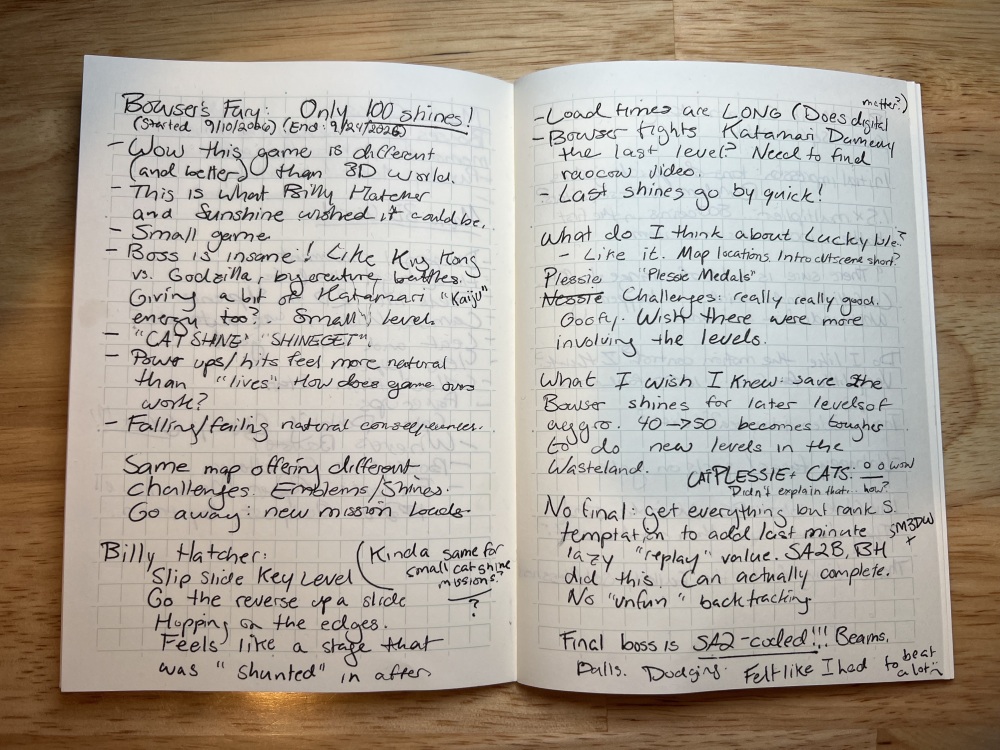
Transcription of my handwritten notes Bowser’s Fury: only 100 shines! (Started 9/10/2026, end: 9/24/2026)
- Wow this game is different (and better) than 3D World.
- This is what Billy Hatcher and Sunshine wished it could be.
- Small game
- Boss is insane! Like King Kong vs. Godzilla, big creature battles. Giving a bit of Katamari energy too? Small level. “Kaiju”.
- “CAT SHINE” “SHINE GET”
- Power ups / hits feel more natural than “lives”. How does [sic] game overs work?
- Falling / failing are natural consequences.
- Same map offering different challenges. Emblems / shines. Go away: new mission loads.
- Billy Hatcher: Slip Slide key level, go the reverse up the slide hopping on the edges. Feels like a stage that was “shunted” in after. Kinda the same for small cat shine missions?
- Load times are LONG (does digital matter?)
- Bowser fights, Katamari Damacy the last level, need to find raocow video.
- Last shines go by quick!
- What do I think about Lucky Isle? Like it, map locations. Intro cutscene is short?
- Nessie “Plessie Medals” Challenges are really, really good. Goofy. Wish there were more of these involving the levels.
- What I wish I knew: save the Bowser [block] shines for later levels of aggro. 40→50 becomes tougher to do new levels in the Wasteland.
- CAT PLESSIE: o_o wow. Didn’t explain that, how? [In reference to cats riding Cat Plessie]
- No final: get everything but S rank temptation to add last minute (Lazy “replay value”). SA2B and BH did this. Can actually complete, no “unfun” backtracking.
- Final boss is SA2-coded!!! Beams, balls, dodging. Felt like I had to beat a lot :(
Thanks for reading ♥ I would love to hear your thoughts! Contact me via Mastodon, Bluesky, or email. Browse the blog archive. Check out my blogroll.