
Why Californians Are Fighting Over a Proposed Billionaire Tax


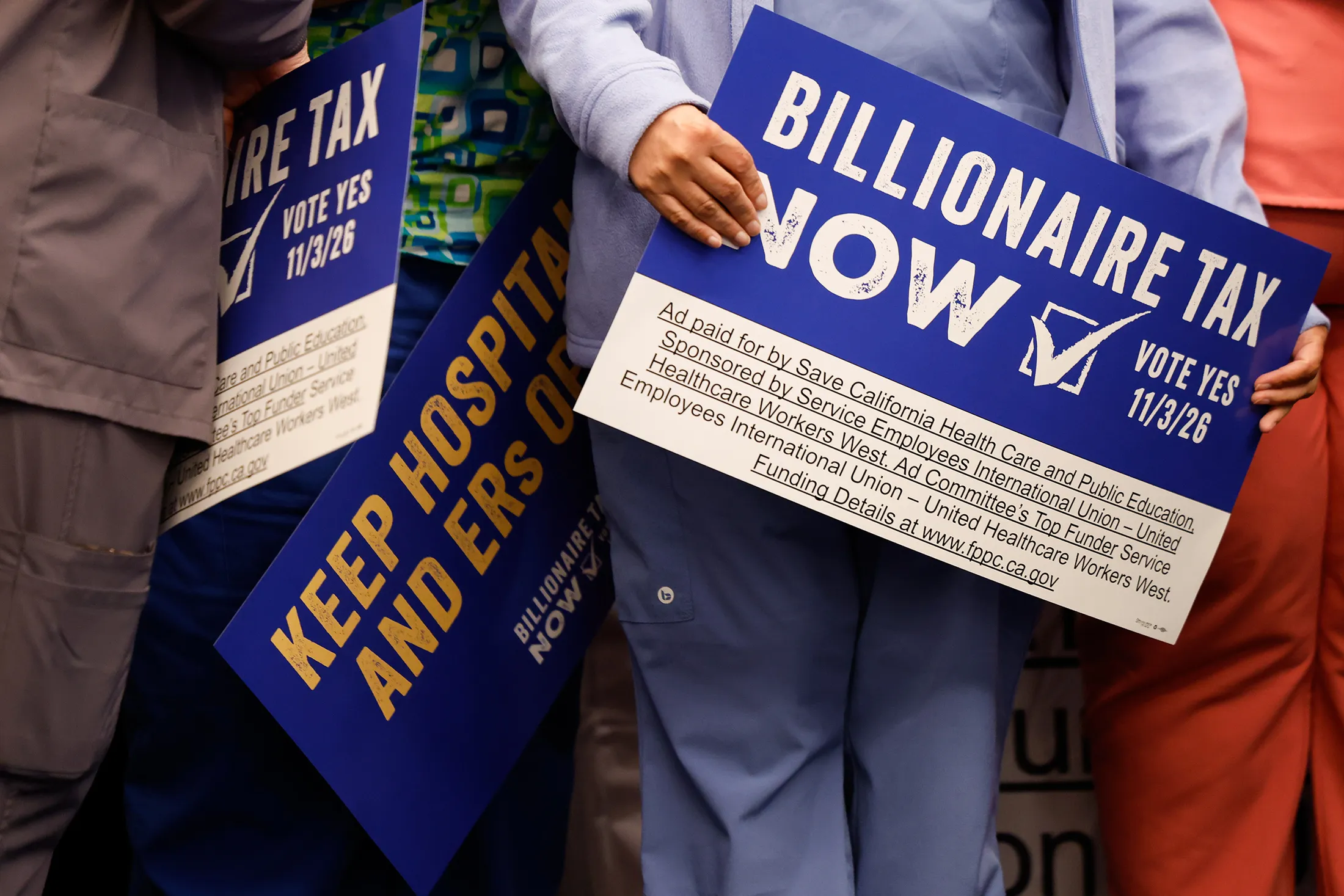
California’s latest technology boom is fueling vast fortunes — and anger over the widening divide between the ultra-rich and everyone else. Now, voters will get a say.
Californians are being asked on their November midterms ballot whether to impose a one-time tax on residents whose net worth exceeds $1 billion. If adopted, it would be the world’s first wealth tax specifically targeting billionaires.
Proposition 40 is opposed by much of the state’s political and business establishment, including Democratic Governor Gavin Newsom. Tech billionaires have raised more than $300 million to fight it while pursuing a more unusual strategy: backing two other ballot measures that could prevent the tax from taking effect even if voters approve it.
Labor unions, California’s Democratic Party as well as progressive politicians, such as Vermont Senator Bernie Sanders and Silicon Valley Representative Ro Khanna, are backing the tax. They see it as a litmus test for taxing extreme wealth — and a potential springboard for similar campaigns across the nation.
The fight has already had an impact on the lives of California’s richest residents. Google co-founders Sergey Brin and Larry Page have taken steps to leave the state, as have other billionaires. Mark Zuckerberg struck a deal with Meta Platforms Inc. that would give him access to billions of dollars in liquidity to pay the tax.
How would a billionaire tax work?
Prop 40 would impose a one-off, 5% levy on the assets of California billionaires. Covered assets include stocks, privately held businesses, art, collectibles and intellectual property, while real estate, pensions and retirement accounts are generally excluded. Publicly traded securities would be valued based on their market value on Dec. 31, 2026. The tax can be paid in full in 2027, or in equal portions over five years for an additional fee.
The tax would apply to billionaires who were California residents on Jan. 1, 2026, meaning those who moved out of the state after the cutoff would still be subject to the levy. Taxpayers also can’t avoid the tax through last-minute charitable giving: Assets worth more than $1 million given away for less than fair market value after Oct. 15, 2025, generally would be added back to the net worth calculation.
How much would the tax raise?
Proponents estimate the tax could raise around $100 billion over five years. The measure requires that 90% of the revenue collected be dedicated to healthcare, with the rest going mostly to state programs for education and food assistance.
Yet the revenue projection could be optimistic. California’s Legislative Analyst’s Office, an independent state agency, said it is “very hard to predict” exactly how much the tax might raise, estimating it to be in the tens of billions of dollars. The LAO also warned that targeting billionaires could reduce state income-tax revenue if some leave California.
Researchers at Stanford University’s Hoover Institution have calculated the tax will raise just about $30 billion after factoring in billionaires who have taken steps to abandon their California residency. They argue the departures also would deprive California of future income-tax revenue, producing an overall net revenue loss with a present value of $38.9 billion.
What are the arguments in favor of the tax?
Proponents argue that billionaires don’t pay enough in taxes and should contribute more to the state where they built their fortunes. The proposal’s authors estimate billionaires account for just about 2.5% of the state’s personal-income tax revenue, in part because their wealth consists of gains that aren’t taxed until sold. Prop 40 backers say roughly 250 billionaires reside in California, with a combined net worth of about $2.3 trillion. The tax was written by a group of academics including University of California, Berkeley, economist Emmanuel Saez, who previously helped develop similar proposals for Sanders and Massachusetts Senator Elizabeth Warren.
The measure was pitched by healthcare workers union SEIU-UHW, which argues taxing the ultrawealthy is the only way to make up for the billions of dollars in cuts to federal healthcare enacted under the Trump administration’s 2025 “Big Beautiful Bill.” The tax would serve as a temporary patch while lawmakers work on longer-term solutions, proponents say.
What are the arguments against Prop 40?
Opponents warn the tax could backfire by driving wealthy residents, businesses and investment out of the state. While the levy could produce a one-time windfall, departures could erode future income-tax revenue and discourage entrepreneurs from starting and growing companies in California, critics say. Tech founders have also said that billionaires whose fortunes are largely tied up in company stock potentially face the threat of diluting their control by forcing sales, and that the tax would hit newly minted “paper billionaires” especially hard.
Some critics, including Newsom, support taxing the wealthy more but say a national tax would be harder for wealthy individuals to avoid by moving across state lines. Other opponents also object to using a one-time tax to address long-term healthcare funding, and question why the money would be used almost exclusively on healthcare when there are shortfalls in other areas of the state’s budget. That concern has helped ally labor unions, including the California Teachers Association and building-trades groups, to billionaires like Brin in fighting the bill.
How would the amount of tax owed be determined?
Unlike an income tax, the measure would tax unrealized gains on stocks and other assets that haven’t been sold. Proponents designed the tax this way in part because wealthy individuals often hold appreciating assets without selling them, instead borrowing against their wealth to get cash.
Prop 40 establishes a formula for valuing difficult-to-price assets, using factors such as company profits and recent investments. Opponents argue such calculations could inflate the value of businesses and leave their owners facing enormous tax bills on wealth they can’t easily turn into cash.
Californians are also weighing in on a separate ballot measure, Prop 3, that would make permanent higher income tax rates for wealthy residents. That measure, much less controversial than the wealth tax, has drawn wide support, including from Newsom.
How did the billionaire tax wind up on the ballot?
While about half of US states allow citizens to put issues before voters, California has made the process an integral part of its politics — and a testing ground for ambitious policy proposals. Proponents need only to gather enough voter signatures to qualify the initiative for the ballot, and once voters enact the measure, lawmakers can’t undo it without returning to voters.
How might competing propositions block the billionaire tax?
California also allows voters to choose between competing proposals during the same election. Billionaire-backed opponents of Prop 40 took advantage of that system to put two measures on the ballot, Prop 41 and Prop 42, that could prevent the tax from taking effect.
Prop 41 would prohibit new state taxes that exempt their revenue from California’s constitutional spending limit, as the wealth tax would. Prop 42 would amend the state Constitution to prohibit new taxes on financial assets and other personal property — and is being marketed to voters as a way to protect their retirement savings from taxes.
Both measures contain so-called poison pill provisions explicitly aimed at the wealth tax.
If either Prop 41 or Prop 42 passes and receives more “yes” votes than Prop 40, the billionaire tax could be blocked from taking effect, according to the Legislative Analyst’s Office. While there is precedent in California for the measure receiving more votes to prevail when there’s a conflict, courts would likely have to determine whether and to what extent the measures conflict.
How common are wealth taxes?
A comprehensive tax on individuals’ net wealth has never been implemented in the US, but several countries have experimented with wealth levies.
Switzerland, Norway and Spain have long-standing taxes on net wealth. France has taxed a broader range of wealth for decades, but in 2018 narrowed its wealth tax to real estate holdings. Germany, Sweden and other European countries have abandoned their wealth taxes over concerns about administrative costs, tax avoidance and wealthy residents fleeing the country.
The European Commission published a study in April showing wealth taxes have generally produced a relatively small share of government revenue, with outcomes depending heavily on how the taxes are designed and how taxpayers respond.

What did Mark Zuckerberg do in response to the proposed tax?
Zuckerberg, the world’s sixth-richest person, contemplated leaving California after the billionaire tax qualified for the ballot, at one point telling Meta’s board he intended to put his Palo Alto home up for sale. Meta’s chief executive officer spent months negotiating with the board over ways to unlock the billions of dollars he would need to pay the levy without jeopardizing his control over the company he co-founded more than two decades ago. Based on his current net worth, a 5% tax would cost him more than $10 billion.
Ultimately, Meta created a new class of non-voting stock that will allow Zuckerberg to raise cash without weakening his grip on Meta. He committed to staying in California — or wherever Meta is based — for the next eight years. Wealth tax supporters seized on the agreement as evidence that billionaires could find ways to pay the levy without leaving the state.
What is the likelihood that the tax measure will pass?
A poll released Oct. 27 by the Public Policy Institute of California showed the initiative had support of 46% of likely voters, down from 52% the month before.